Showing posts with label Upper Peninsula of Michigan. Show all posts

Wednesday, June 8, 2016

DNR seeks input on updated Michigan Deer Management Plan

English: White-tailed deer

The Michigan Department of Natural Resources invites those interested in the management of Michigan’s white-tailed deer population to review and provide input on its draft updated Deer Management Plan.
The plan was created in 2010 through a process that involved substantial stakeholder input and incorporated the best scientific information possible.  A similar process was undertaken in 2015 to update the plan, ensuring that it remains current and reflects the current status of the deer program in Michigan.
“The updated plan will continue to provide strategic guidance to DNR staff for the management of white-tailed deer in Michigan,” said Chad Stewart, DNR deer, elk and moose program specialist.  
The plan supports the mission of the deer program by maintaining a healthy white-tailed deer population, using sound scientific management, maximizing recreational opportunities while minimizing negative effects on ecosystems and other wildlife species and without creating undue hardship to private interests.
The draft plan focuses on goals and objectives that are desirable, with defined actions outlined to achieve these goals and objectives. With this structure, the DNR has the ability to adopt an adaptive approach to deer management, accounting for differences between regions and incorporating changes in management techniques or technology to achieve a desired result.
“We’d like to thank all of the individuals, stakeholders and partners who have assisted in this process over the last year and a half,” Stewart said.
The draft updated plan is available on the DNR’s website at www.michigan.gov/deer. The plan will be available for review through July 8. Comments may be submitted to dnr-wildlife@michigan.gov or sent to DNR Wildlife Division, 525 West Allegan St., Lansing, MI 48909.

Tuesday, December 8, 2015

U.P. Focus: Firearm deer hunting season a mixed bag in the Upper Peninsula

Michigan Department of Natural Resources wildlife biologists said preliminary check station data shows mixed results for the firearm deer hunting season in the Upper Peninsula.
So far, indications are there was a drop in the overall harvest. However, with hunters across the region registering a higher proportion of mature bucks, many of those deer were beautiful bucks.
After three consecutive severe winters in the region, DNR biologists predicted hunters this firearm deer season would likely see fewer deer in the U.P., especially in the 1 ½- and 2 ½-year-old age classes.
“It was a challenging firearm deer hunting season, as anticipated,” said David Jentoft, a DNR wildlife biologist at the Sault Ste. Marie Field Office. “The number of bucks being checked is generally down, but check stations have seen a higher proportion of mature bucks coming in, particularly 3 ½- and 4 ½-year-olds.”
DNR biologists expected more mature bucks in the harvest, with the effects of the previous year’s harsh winter weather limiting the number of yearling bucks available in the U.P. deer population this year.
Early Statistics
Preliminary estimates indicate deer check stations in the U.P. registered deer totals down about 13.5 percent through the firearm deer hunting season, compared to last year.
Check station results are only one indicator the DNR uses to evaluate the deer season and not all of that data has been compiled yet. A clearer picture of the season is expected to emerge once camp and hunter surveys are returned in the weeks ahead.
Hunter posing with the first buck he's shot in seven years.The DNR check station at Escanaba was the busiest in the U.P., followed by Marquette. Escanaba staff checked a total of 321 deer and there were 165 deer checked at Marquette.
The percentage of bucks checked at those two stations varied widely, demonstrating the limitation of projecting general results across the region from individual stations. The Escanaba station was down about 25 percent from last year, while Marquette had an increase of 20 percent.
A similar situation occurred at the Mackinac Bridge. 
DNR wildlife division staff checked a total of 37 deer over the two days the check station at Bridge View Park in St. Ignace was open, compared to 51 there last year. That marks a dip of 27 percent.
However, a short distance away, Mackinac Bridge Authority toll booth workers informally counted a total of 1,481 deer on southbound vehicles over the firearm deer hunting season. That total represents a 5-percent decline from the 1,563 deer tallied last year.
Deer Health Improvement
Antler beam measurements, which generally indicate a buck’s overall fitness level, were greatly improved in the U.P. from the past two seasons.
“This shows that deer that came out of last winter were in pretty good shape, certainly better than the previous couple of seasons,” said Chad Stewart, DNR deer, elk and moose management specialist at the Rose Lake Wildlife Research Center in East Lansing. “Yearling antler beam growth is back now within the previous 10-year average after being significantly lower the last two years.”
Wolves
Wolves have an impact on the deer population in the U.P., but to what extent is not fully known.
A multiyear predator-prey study — being conducted by the DNR and Mississippi State University — is ongoing in an effort to better understand the predatory impacts to U.P. deer from wolves, coyotes, bears and bobcats.
Coyotes also play a significant role in deer predation. An individual wolf may kill more deer than a coyote. However, there are more coyotes on the landscape, which produces a larger impact on fawn mortality.
The predator-prey research has been conducted over the past six years in low and medium snowfall zones in the region and is moving north to study high snowfall areas next. 
Wolves in Michigan are currently federally protected as endangered species after a U.S. District Court ruling in December 2014.
Endangered species status for the wolf severely limits the tools the state can use toA hunter with his buck at the Mackinac Bridge check station. manage the species, including lethal control, as outlined in the state’s Wolf Management Plan. The federal court ruling prohibits the Michigan Natural Resources Commission from considering hunting as a management tool.
The DNR supports removing wolves from the endangered species list, as gray wolves reached targeted population recovery goals in Michigan, Minnesota and Wisconsin years ago.
Legislation is currently pending in the U.S. Congress which, if passed into law, would prohibit courts from overruling the Department of the Interior on delisting wolves in Michigan, Minnesota, Wisconsin and Wyoming. A similar measure was passed in 2011 for wolves in Idaho and Montana.
Meanwhile, the DNR continues to manage wolves according to the remaining provisions of Michigan’s recently updated Wolf Management Plan, including the use of nonlethal harassment techniques.
The only legal killing of wolves in Michigan is in defense of human life.
Continuing Action
The DNR, NRC and sporting groups continue to partner in efforts to improve the deer population.
Long-range work is being done to preserve and enhance critical winter range areas by the U.P. Wildlife Habitat Work Group and short-range measures have been undertaken to try to preserve a larger number of does surviving the winter, including reducing the number of antlerless tags available to hunters in the U.P.
This past summer, the NRC eliminated the ability to tag an antlerless deer with either the single deer license or combination deer license during the archery season in hopes this may assist in helping the deer herd recover.
That change was expected to reduce the deer harvest by 5,000 to 6,000 deer heading into the winter months. The decision came after extensive discussions and public comment on six potential regulation change options for this fall.
Those options the NRC considered included:
  • Option 1: Maintain the current hunting season and license structure in the U.P.
  • Option 2: Close the entire deer hunting season in the U.P.
  • Option 3: Eliminate the option of using a combination license when hunting in the U.P. (one buck) and eliminate the antlerless option during archery season when using the single deer license.
  • Option 4: Eliminate the antlerless option during archery season for hunters hunting on deer licenses, including the combination license.
  • Option 5: Eliminate the antlerless option for archers hunting on deer licenses, including the combination license, during the late archery season only.
  • Option 6: Eliminate the Liberty and Independence hunts in the U.P.
“The reduced harvest in the U.P., though disappointing for many, will help aid in the long-term recovery of the deer herd, as well as the efforts being made to improve habitat,” Stewart said. “We know the deer numbers in the U.P. are down lower than most want to see. However, an elevated harvest would not be conducive to our goals at this time, which is to grow the deer herd in the U.P.”
Weather
The firearm deer hunting season opened Nov. 15 to unseasonably warm temperatures in the 50s across the U.P. By mid-season, temperatures had cooled and many places received snowfall. But by Monday’sseason close, snow had melted from most areas.
“While we know deer numbers are low and we have taken several steps to help the herd recover, the most important component will be the weather,” said Ashley Autenrieth, DNR Deer Program biologist in Gaylord. “Luckily, this fall and going into this winter, we've seen above-average temperatures and very low snowfall levels. If the trend continues, we should see a mild winter which would be a great start to allowing the deer herd to recover."
License Sales
Deer hunting license sales by county of residence were down about 10 percent in the A hunter with his deer at the Newberry check station.U.P. since March 1. As of Monday’s season close, there had been 63,202 deer hunting licenses sold to U.P. residents, compared to 70,154 last year.
Marquette County had the highest number of residents buying deer licenses in the U.P. this year with 10,921, followed by Delta County with 9,975 and Menominee County with 9,298.
Muzzleloader and Late Archery Seasons
Muzzleloader season opens today in the U.P. and northern Lower Peninsula and closes Dec. 13. Late archery season opened Dec. 1 and continues through the end of the month. Prospects for hunters continue to remain mixed.
“Hunters still should not expect to see many deer, but those who are lucky enough to harvest a buck will likely be harvesting a 3 ½- to 4 ½-year-old buck since their numbers appear to be higher than younger age classes, due to the severe winters over the last few years," Autenrieth said.
For more information on deer hunting in Michigan, visit the DNR’s webpage at: www.michigan.gov/deer.

Monday, December 7, 2015

U.P. Focus: Panel discussion on ‘Keep the U.P. CWD Free!’ campaign airs next weekend

The Michigan Department of Natural Resources is reminding the public that broadcasts of WNMU-TV13’s “Media Meet” discussion on keeping the Upper Peninsula free from chronic wasting disease will air next weekend.
The program with DNR staff and host Bill Hart focuses on various efforts to educate the public on CWD and keeping it from reaching the U.P. The program will initially air at 6:30 p.m. EST Saturday, Dec. 12, and be rebroadcast at 2:30 p.m. Sunday, Dec. 13, and in January 2016.
Guests featured on the half-hour program include Ashley Autenrieth, DNR deer program biologist in Gaylord, Terry Minzey, DNR U.P. regional wildlife supervisor in Ishpeming, Dave Dragon, a DNR wildlife technician from the Crystal Falls office, and John Pepin, DNR deputy public information officer in Marquette.
The broadcast will reach viewers across the U.P. and parts of northern Wisconsin. A week after the initial broadcast, the television program will be available online at: http://wnmuvideo.nmu.edu/program/media-meet/.
Public Radio 90 will also air the program at 7:30 a.m. Dec. 13, repeating at 3:30 p.m. Dec. 14. The program will also be available on Public Radio 90’s podcast at: http://www.publicbroadcasting.net/wnmu/.jukebox?action=programs.
The DNR recently launched a public information and education campaign to try to keep chronic wasting disease from reaching the Upper Peninsula.
Discovered earlier this year in a free-ranging deer in the Lower Peninsula, CWD affects the central nervous system and is fatal to white-tailed deer, mule deer, elk and moose. There is no known treatment.
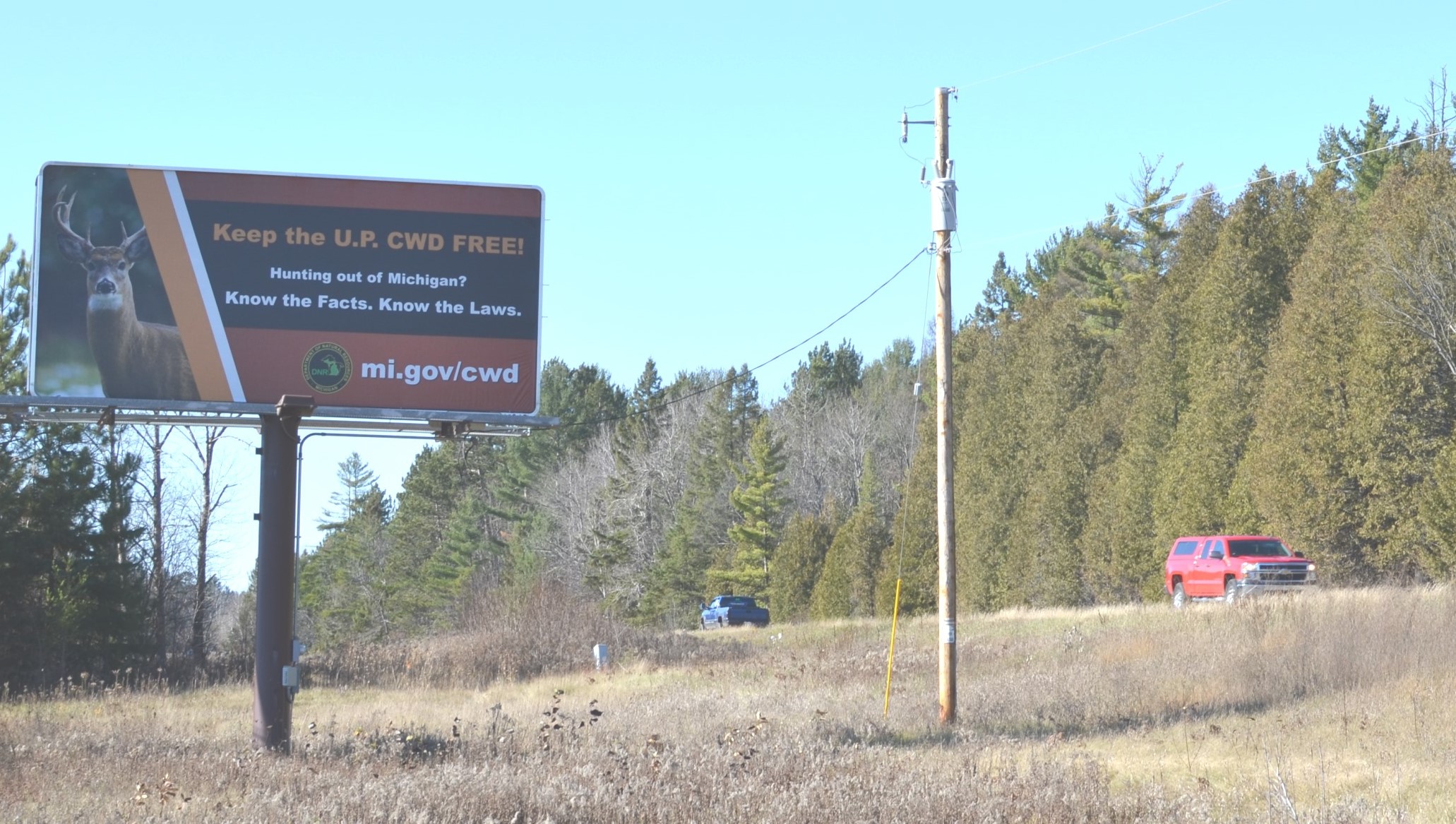
DNR officials are concerned CWD could be brought into the U.P. by those hunting in other states. From billboards and bumper stickers to an informational fact sheet and television and radio broadcasts, the DNR is working to inform the public about preventing CWD from occurring in the U.P.
For more information, visit www.michigan.gov/cwd.
/Note to editors: Accompanying photos are available below for download. Suggested captions for photos follow.
Bumper sticker: Bumper stickers are among the materials produced by the Michigan Department of Natural Resources to help educate the public on chronic wasting disease and keeping it out of the Upper Peninsula.
Media Meet: Michigan Department of Natural Resources staff members were interviewed by moderator Bill Hart for a Dec. 5 broadcast of “Media Meet” on WNMU-TV13 in Marquette. The program, which will be broadcast across the Upper Peninsula and into parts of northern Wisconsin, focused on chronic wasting disease and keeping it out of the U.P. Pictured from left, wildlife technician DNR David Dragon from the Crystal Falls office, DNR Deer Program biologist Ashley Autenrieth from Gaylord, program host Bill Hart and Terry Minzey DNR Upper Peninsula regional wildlife supervisor.

Thursday, September 17, 2015

Michigan - Deadline approaching to refund deer license purchases

The Michigan Department of Natural Resources reminds hunters that 5:30 p.m. Friday, Sept. 18, is the deadline to return unused deer and deer combination (“deer combo”) licenses for a refund.
The DNR allowed license returns for refund after antlerless deer hunting regulation changes were implemented by the Michigan Natural Resources Commission this summer. Some hunters had purchased licenses for the upcoming fall hunting seasons prior to the rule change.
The NRC eliminated the option to harvest antlerless deer during the archery seasons for hunters using deer or deer combo licenses in the Upper Peninsula. The decision makes deer and deer combo licenses used in the archery season “buck-only” licenses.
However, hunters with private-land antlerless deer licenses may still take an antlerless deer during any hunting season within three deer management units in the U.P. which will be open to antlerless deer hunting.
Those units are private land in Unit 055, which includes portions of Menominee and Delta counties; Unit 155, which includes parts of Marquette and Delta counties and Unit 122, which includes parts of Menominee, Iron and Dickinson counties.
Hunters can return deer and deer combo licenses for a refund if they would like, and new licenses could be purchased prior to the start of the deer seasons; however, this is not required.
To return a license for refund, hunters must bring all licenses bought during the original time of purchase back to the license outlet where they were purchased. For those who purchased licenses online, use the phone number below.
Since deer seasons begin Sept. 19, licenses are considered active after Friday’s deadline. To learn more about returning licenses, contact DNR licensing staff at 517-284-6057 or MDNR-E-License@michigan.gov.
More information on the Upper Peninsula DMUs is available in the 2015 Michigan Antlerless Deer Digest online. For more information on hunting seasons and regulations, visit www.michigan.gov/hunting.

Saturday, September 5, 2015

Michigan DNR’s Hunting Access Program awarded grant to increase hunting opportunities

The Michigan Department of Natural Resources' Hunting Access Program, which provides access to quality hunting lands near urban areas, soon will expand into the northern Lower Peninsula thanks to a new federal grant.
The Michigan Department of Natural Resources will receive $951,400 to expand its Hunting Access Program into the northern Lower Peninsula to increase private-land hunting opportunities. This grant, awarded by the U.S. Department of Agriculture’s Voluntary Public Access and Habitat Incentive Program, also will improve wildlife habitats by enhancing grassland, forest and food plots.

The Voluntary Public Access and Habitat Incentive Program encourages landowners to allow outdoor enthusiasts greater access to their privately owned land for hunting, bird watching, fishing and hiking. According to a 2013 study by the National Fish and Wildlife Foundation, outdoor recreation supports 6.1 million direct jobs across the country and $646 billion in spending each year. Deer hunting alone attracts more than 700,000 hunters to Michigan each year and contributes billions of dollars to the state’s economy.

Michigan's Hunting Access Program was created in 1977 to increase public hunting opportunities in southern Michigan, where 97 percent of the land base is privately owned. Through HAP, private landowners receive financial incentives for allowing hunters access to their lands. One of the oldest dedicated private-lands, public-access programs in the nation, HAP provides access to quality hunting lands near urban areas.

According to DNR wildlife biologist Mike Parker, “HAP enrollment will be targeted primarily in the agricultural areas in the northeast and western northern Lower Peninsula, where public land is a bit scarce. Grant funds will also be used to restore wildlife habitat on willing HAP properties, to improve opportunities for deer hunters, turkey hunters and small game hunters alike.”

Using funds from Michigan’s recent license restructuring, this new federal grant and an existing USDA grant, the DNR plans to continue expanding the program in the southern Lower Peninsula, the northern Lower Peninsula and the eastern Upper Peninsula over the next three years. 

Visit www.michigan.gov/hap to learn more about the program and to see a current list of private lands available for hunting in Michigan. The HAP Web page includes details about enrolled properties, including types of hunting allowed and aerial photos of the properties.

Thursday, August 6, 2015

New Upper Peninsula antlerless deer hunting regulations for archers

Changes involving antlerless deer hunting for archers will be in effect during the 2015-2016 hunting season in the Upper Peninsula, after a recent decision by the Michigan Natural Resources Commission.

Earlier this summer, the NRC decided to eliminate the option to harvest antlerless deer during the archery seasons for hunters using deer or deer combo licenses in the U.P.

The Michigan Department of Natural Resources has since received reports of some confusion over the regulations. The DNR has produced a Frequently Asked Questions page to help explain the changes.

The NRC’s decision makes deer and deer combo licenses used in the archery season “buck-only” licenses.

However, hunters with private-land antlerless deer licenses still may take an antlerless deer with a bow during any hunting season within the three deer management units (DMU) in the U.P. that will be open to antlerless deer hunting. Those units are:
  • DMU 055, which includes portions of Menominee and Delta counties and encompasses 917 square miles.
  • DMU 155, which includes parts of Marquette and Delta counties, covering a total of 265 square miles.
  • DMU 122, which includes parts of Menominee, Iron and Dickinson counties, with a total of 163 square miles.
More information on the DMUs is available in the 2015 Michigan Antlerless Deer Digest online.

There are no antlerless permits being issued for state-, county- or federally managed land or Commercial Forest Reserve land in the U.P. this year. Registration for antlerless deer hunting permits remains open through Aug. 15. Drawing results will be available online Sept. 4.

There were no changes to the regulations for the Liberty and Independence hunts. During these hunts, a deer or deer combo license may be used for an antlered or antlerless deer. Antler point restrictions do not apply.

Hunters can return deer and deer combo licenses for a refund if they would like and new licenses could be purchased prior to the start of the deer seasons; however, this is not required. After Sept. 20, the licenses are considered “used” and cannot be returned. To learn more about the process for returning licenses, contact DNR licensing staff at 517-284-6057 or MDNR-E-License@michigan.gov.

The Natural Resources Commission made its decision to limit the antlerless deer harvest as part of a continuing effort to aid the U.P.’s struggling deer population, which – following three successive winters with severe conditions – has declined to a level comparable to the early 1980s.

There have been roughly 5,000 to 6,300 antlerless deer harvested in the U.P. by archers over each of the past four years.
For more information on hunting seasons and regulations, visit www.michigan.gov/hunting. 

Wednesday, June 17, 2015

NRC approves 2015 U.P. antlerless deer hunting restrictions

Map of the U.P.
Map of the U.P. (Photo credit: Wikipedia)
The Michigan Natural Resources Commission decided to eliminate the harvest of antlerless deer during the archery season for hunters using deer or deer combo licenses in the Upper Peninsula.
The restriction, which does not affect the firearm deer season, will be in effect for the 2015-2016 season. The NRC made the decision at its monthly meeting in Monroe, Michigan, in an effort to aid the Upper Peninsula’s struggling deer population, which has declined to a level comparable to the early 1980s following three successive winters with severe conditions.
There have been roughly 5,000 to 6,300 antlerless deer harvested in the U.P. by archers over each of the past four years.
Although deer regulations currently are on a three-year cycle, elements such as weather and disease can cause regulations to be reviewed mid-cycle and adjusted when appropriate.
“The NRC asked the DNR Wildlife Division to present options to address the decline in deer in the U.P. and associated concerns by hunters,” said DNR deer management specialist Chad Stewart. “In May we brought forward six possible options, and the NRC chose to concentrate on two of those options.”
The NRC’s decision makes deer and deer combo licenses used in the archery season “buck-only” licenses. The other option considered by the NRC was to maintain the current regulations.
“Deer hunting is an important tradition in Michigan’s U.P. and a big economic driver for the entire state,” said Natural Resources Commission Chair John Matonich. “This decision by the NRC will ensure that tradition continues while also providing prudent protections for the U.P. deer population.”
The winter of 2014-2015 brought significant snowfall before the start of the firearm season, which persisted to depths of 20-30 inches across much of the region.  Additionally, temperatures of -10 to -20 degrees arrived in February, further stressing animals that had limited mobility because of the deep snow.
These latest wintry conditions followed the winters of 2012-2013 and 2013-2014, which were extremely hard on the U.P. deer population.
The DNR Wildlife Division polled neighboring states on their recent and future deer seasons, and found those states also are reducing antlerless quotas or opportunities to take antlerless deer during specific seasons.
“We will be working to communicate this information to all who hunt in the Upper Peninsula,” Stewart said. “We’ll need to make sure hunters everywhere are aware of the change because once they cross the Mackinac Bridge the rules for their 2015 deer licenses will change.”
Antlerless harvest still will be permitted through the allotment of private-land antlerless licenses in deer management units where it was decided that antlerless harvest should be maintained. This includes DMUs 055, 122 and 155.
Deer and deer combo licenses can be returned for a refund and new licenses could be purchased prior to the start of the deer seasons. After Sept. 20, the licenses are considered “used” and cannot be returned. To learn more about the process for returning licenses, contact DNR licensing staff at 517-284-6047 or MDNR-E-License@michigan.gov.
For more information on hunting seasons and regulations, visit: www.michigan.gov/hunting.
To stay up to date on regulation changes like this, sign up for DNR email updates to get important natural resource news sent directly to you, when it’s happening.

Thursday, February 19, 2015

Michigan records safest hunting season with no fatal incidents in 2014

For the first time, Michigan recorded no fatalities during all hunting seasons in 2014,
according to reports compiled by the Department of Natural Resources’ Law Enforcement Division. Ten incidents involving injuries were recorded in the state – nine in the Lower Peninsula and one in the Upper Peninsula.

“We had 10 incidents reported for 2014, which ties with last year for the fewest number of reportable hunting incidents since Michigan started tracking them in the 1940s," said Sgt. Tom Wanless of the DNR's Recreational Safety, Education and Enforcement Section.

"What makes 2014 the safest on record is that for the first time we had no fatalities," Wanless added. "Michigan’s hunter education program, and the dedicated volunteer instructors who are the backbone of it, is a big reason we have been experiencing a low number of hunting incidents.”

With more than 729,000 base licenses sold in 2014, Michigan’s hunting injury/fatality rate per license is .001 percent. The base license is required to purchase any hunting license.
Of the 10 incidents reported in 2014, four involved small game hunters, two involved waterfowl hunters and four involved deer hunters. One of the deer hunting incidents occurred during the early antlerless season in September and one was in December’s late antlerless season. Two incidents were reported during the firearm deer hunting season from Nov. 15-30. One incident took place Nov. 20 in Osceola County, while the other happened Nov. 25 in Oakland County at Bald Mountain Recreation Area.

Information on the hunting incidents recorded in 2014 and so far in 2015 can be found online at www.michigan.gov/conservationofficers under Law Enforcement Reports. 
 

Monday, November 24, 2014

Improving Deer Habitat

Upper Peninsula - Western Mackinac County

Two DNR staff doing habitat workOver 1,300 oak saplings were planted in western Mackinac County this spring to increase hard mast for deer.  The plantings were focused on areas that have been hit hard by beech bark disease (BBD), and also in deer wintering complexes.  BBD areas will see a large loss of beech nuts, and the oak acorns that are produced in the future will help to mitigate some of the loss from BBD.  “We were able to get saplings planted to help avoid problems with deer browse, and as a bonus they’ll also throw acorns sooner,” said DNR wildlife biologist Dave Jentoft.  “We had great cooperation with our sister division, the Forest Resources Division, in making these plantings happen.”
Northern Lower Peninsula - Kalkaska County

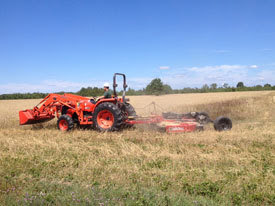
Field work being done on a tractorThe Fletcher area in southern Kalkaska County is a great destination this fall for deer hunters. Over 1,600 acres of public land is available to set up camp during firearm, late archery or even muzzleloader season. This spring over 470 acres were prescribed-burned in an effort to kill woody plants that are closing in on this large grassland complex. Over 120 acres were mowed, and numerous acres were planted to winter wheat, rape and turnips. Visit Mi-HUNT to explore this area from home, and make plans to visit in person to hunt the fall and early winter seasons.
Southwest Lower Peninsula - Cass County

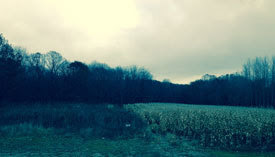
Fields where habitat work was completedOver the past year, staff members at the Crane Pond State Game Area have installed over 200 acres of food plots and other plantings for the benefit of wildlife on the game area. Food plots are placed in strategic locations to enhance recreational opportunities. The picture to the left shows a field border adjacent to a corn food plot. Such practices allow species such as deer, turkey and pheasants to have transitional and security cover adjacent to important high-calorie winter food sources. Field borders also provide valuable nesting and bedding cover and can greatly enhance the number of bird species using an area. This is just one example of the many habitat management practices implemented at the game area over this past year.

Southeast Lower Peninsula - St. Clair County

Funds from the license restructuring are helping the DNR Wildlife Division make habitat improvements for deer and other wildlife around the state. Port Huron State Game Area is no exception. With an increased budget for habitat work, more seasonal wildlife assistants were hired this year, allowing 9 additional acres at Port Huron SGA to be converted to food plots of corn and small grains. This brings the total acreage planted with food plots to 20. These employees also worked on improving parking lots and posting additional signage around the area to improve hunter accessibility.  Check out Port Huron State Game Area for an enhanced hunting experience this fall. 
Explore the public lands near you, and have a safe and memorable hunt!

Friday, December 20, 2013

Michigan DNR finds 2013 firearm deer hunters faced challenges, but persistence pays off

English: Michigan's Upper Peninsula
Michigan's Upper Peninsula (Photo credit: Wikipedia)
Michigan’s 2013 firearm deer season wrapped up last weekend, and challenging conditions and lower deer numbers in some areas have likely led to fewer deer being taken this year, the Department of Natural Resources announced today. Firearm season deer check-station activity declined in all regions of the state compared to 2012.
Each year the DNR generates preliminary estimates of the firearm deer harvest shortly after the season closes on Nov. 30. Those estimates are replaced by a rigorous assessment of harvest and participation over all deer seasons using an annual hunter mail survey.
The 2013 firearm deer season harvest appears to have decreased in all regions this year, but particularly in the Upper Peninsula and southern Lower Peninsula. Experiences can differ widely within regions; DNR biologists estimate the harvest (compared to 2012) was down perhaps 15 to 20 percent across the Upper Peninsula, decreased only slightly in the northern Lower Peninsula, and declined perhaps 10 percent in the southern Lower Peninsula.
“Deer populations in the Upper Peninsula are feeling the effects of late and heavy snowfall last winter, and in some areas of southern Michigan are still recovering from an extensive outbreak of epizootic hemorrhagic disease two summers ago,” said Brent Rudolph, DNR Wildlife Division Deer and Elk Program leader.
“A new antler point restriction in 12 counties of the northern Lower Peninsula has added protection for young bucks,” noted Ashley Autenrieth, Wildlife Division deer biologist for the northern regions, “so we expected buck harvest in that region to be lower for at least a year.”
Severe weather conditions, warmer-than-average temperatures and concentrations of standing corn that provide secure cover for deer also contributed to adverse hunting conditions in some locations. A recent national survey highlighted that persistence pays off, particularly when conditions are not ideal. Successful deer hunters hunted an average of 18 days, which is longer than the entire duration of Michigan’s firearm season.
Rudolph stressed the importance of cooperation with Michigan’s hunter harvest survey, which he called “a vital tool for Michigan’s deer program, and an important way in which data provided by hunters contributes to our information base.”
Hunters that do not receive a survey in the mail but wish to provide their hunting and harvest information may visitwww.michigan.gov/deer and select the Deer Harvest Reporting Form link. Hunters should only provide this information once they have completed all of their 2013 hunting activities, including seasons open through as late as Jan. 1, 2014.
For more information about hunting opportunities or deer management in Michigan, visit www.michigan.gov/hunting orwww.michigan.gov/deer.

Monday, July 15, 2013

Fewer Antlerless Deer Licenses Available in most Michigan Regions for upcoming Season

Antlerless Deer Permit News

Fewer antlerless deer permits will be issued in Michigan this year than last in some areas, but only by a small amount.  Michigan has quotas that separate permits by public vs. private land.


Southern Michigan Antlerless Quotas

On public land, the quota will decrease by 200 from 70,750 to 70,550.  The number of private land licenses will decrease more dramatically - from 637,900 to 483,400.

Northern Lower Penninsula Michigan Antlerless Quotas

Here, public land antlerless deer quotas will increase by 5,000 from last year's total.  This will bring the number available to 35,900.  On private land, the total will increase by almost 4,000 to 119,100.  The DNT cites milder winters as the reason for higher deer populations in the region, and thus the greater number of available licenses.

Upper Penninsula Michigan Antlerless Quotas

The UP will see fewer licenses for antlerless season available.  The private land quota will be down from 21,250 to 18,100, while public land quotas will go down from last year's 5,900 to 4,500.

Reasons for Decreased Quotas in Some Regions

The cause cited for DNR for stabilization of the herd to an extent is the prevalence of epizootic hemorrhagic disease (EHD).  Antlerless permits are largely a tool for stabilizing a deer herd, and as populations level off, it is normal for these tags to be reduced.

For additional information visit http://goo.gl/DBGbU


Friday, February 22, 2013

Michigan DNR now taking applications for deer habitat improvement grants

English: Michigan's Upper Peninsula
 (Photo credit: Wikipedia)

Sportsmen's clubs and other non-government organizations interested in deer habitat improvement on private land in the Upper Peninsula are encouraged to apply for Deer Habitat Improvement Partnership Initiative grants now through Sunday, March 31, the Michigan Department of Natural Resources announced today.

A total of $50,000 will be available in 2013 through the competitive DHIPI grant process. Project proposals from organizations with a formal mission to promote wildlife conservation and/or hunting seeking between $2,000 and $10,000 in funding are eligible for consideration.

Now in its fifth year, the DHIPI grant program is designed to attract and support proposals from non-government organizations interested in improving deer habitat on non-state-owned land in the Upper Peninsula, including private property and Commercial Forest Act-enrolled land. (Projects that provide foot access to the public are more likely to be successful.)

"There are three primary goals applicants should strive to meet," said DNR private lands wildlife biologist Bill Scullon. "The projects should produce tangible deer habitat improvements, build long-term partnerships with the DNR, and identify ways to showcase the benefits to the public."

Scullon said he encourages representatives of interested organizations to contact their local DNR wildlife biologist for help in developing competitive project proposals.

In 2012, six projects were funded in 11 Upper Peninsula counties, improving deer habitat on a total of 691 acres of private industrial forest and federal land.

The projects completed in 2012 ranged from planting red oak seedlings in Mackinac County to creating or improving wildlife openings in Delta, Menominee and Ontonagon counties. In addition to improving deer habitat, successful projects in Delta and Iron counties also provided improved access for youth and disabled hunters.

The DHIPI grant application packet can be accessed online by visiting www.michigan.gov/dnr-grants and clicking on the "Deer Habitat Improvement Partnership Initiative" link. Application deadline is Sunday, March 31; successful applicants will be notified by Monday, April 15. For more information, contact Bill Scullon at 906-563-9247 orscullonh@michigan.gov.

DHIPI grants are funded by the state's Deer Range Improvement Program (DRIP). Created by legislation in 1971, the DRIP fund is supported by a $1.50 allocation from each deer license sold (except for senior licenses), which equals $2.2 to $2.8 million in funding annually. This restricted funding is for the enhancement, maintenance, and acquisition of deer habitat statewide.