Showing posts with label Michigan Department of Natural Resources. Show all posts

Tuesday, September 13, 2016

Michigan: Suspect deer for chronic wasting disease identified in Ingham County

CWD
CWD (Photo credit: Wikipedia)

Hunters in DMU 333 reminded of the requirement to have harvested deer from the area checked

Since May 2015, the Michigan Department of Natural Resources has been actively conducting surveillance for chronic wasting disease (CWD). To date, more than 6,000 deer have been tested since the first positive was found, with seven cases of CWD confirmed.
However, a 3.5-year-old buck taken recently in Meridian Township is likely to be the eighth positive and the first discovered since March of this year. The sample is currently being tested by the U.S. Department of Agriculture’s National Veterinary Services Laboratory in Ames, Iowa, to finalize confirmation.
The suspect deer was taken as part of the DNR’s CWD management program through targeted sharpshooting, which actively removes deer that are more likely to be affected with the disease in and around areas where previously identified CWD-positive animals had been detected.
“This latest suspect positive reinforces the notion that the disease is still occurring in Meridian Township and perhaps elsewhere,” said Chad Stewart, DNR deer specialist. “We are counting on hunters to bring their deer in for testing so we have a better understanding about the scope of the disease.”
Due to positive deer also detected in DeWitt and Watertown townships, the Core CWD Area has been expanded to now include 17 townships. This area, which is referred to as Deer Management Unit (DMU) 333, consists of Lansing, Meridian, Williamstown, Delhi, Alaiedon and Wheatfield townships in Ingham County; DeWitt, Bath, Watertown, Eagle, Westphalia, Riley, Olive and Victor townships in Clinton County; Woodhull Township in Shiawassee County; and Oneida and Delta townships in Eaton County.  Hunters harvesting deer in these townships are required to submit the deer head for testing during business hours or check-station hours within 72 hours of harvest.
The CWD Management Zone also has expanded; it now includes Clinton, Eaton, Ingham, Ionia and Shiawassee counties.  The expanded Management Zone has been renamed DMU 419. The price for an antlerless license in this zone has been decreased 40 percent to encourage hunters to harvest more deer and voluntarily have them checked.
There will be five check stations accepting deer for CWD testing within DMU 333.  These check stations will be operating seven days a week (excluding major holidays).  A complete map of check stations, including locations and hours of operation, is available at mi.gov/cwd
Deer feeding and baiting is prohibited throughout the Core CWD Area and CWD Management Zone. 
CWD is a fatal neurological disease that affects white-tailed deer, mule deer, elk and moose. It is caused by the transmission of infectious, self-multiplying proteins (prions) contained in saliva and other body fluids of infected animals. Susceptible animals can acquire CWD by direct exposure to these fluids, from environments contaminated with these fluids or the carcass of a diseased animal. 
Some chronically CWD-infected animals will display abnormal behaviors, progressive weight loss and physical debilitation; however, deer can be infected for many years without showing internal or external symptoms. There is no cure; once a deer is infected with CWD, it will die. 
To date, there is no evidence that CWD presents any risk to non-cervids, including humans, either through contact with an infected animal or from handling venison. However, as a precaution, the U.S. Centers for Disease Control and the World Health Organization recommend that infected animals not be consumed as food by either humans or domestic animals. 
Anyone interested in learning more about how Michigan is managing CWD can view the new 2015-2016 Michigan Chronic Wasting Disease Management and Surveillance Report.  Additionally, the DNR is holding a Facebook Live event Sept. 20 at 12 p.m. EDT to answer questions about CWD, CWD management and the impacts the disease could have on the future of Michigan’s deer.  Follow the Michigan DNR’s Facebook page for more details.
The DNR provides bi-weekly CWD updates online at mi.gov/cwd. Announcements of additional CWD-positive deer will be posted online as well.

Saturday, August 13, 2016

Michigan Deer Hunters - REMINDER: Antlerless deer license applications on sale until Monday

The Michigan Department of Natural Resources reminds hunters that the application period for antlerless deer licenses ends Monday, Aug. 15.
Hunters may apply for one license in any open deer management unit (DMU) statewide; a nonrefundable $5 fee is charged at the time of application. Hunters may apply online at E-License, or at any authorized license agent or DNR Customer Service Center.
Drawing results and leftover license availability may be viewed beginning Sept. 1 at mi.gov/deer.
Any leftover antlerless deer licenses not issued in the drawing will be sold on a first-come, first-served basis beginningSept. 8 at 10 a.m. EDT until license quotas are met.
The 2016 antlerless deer license quotas for each DMU can be found at mi.gov/deer. Please note, DMU 333 has unlimited antlerless licenses that may be purchased without application beginning Sept. 8 at 10 a.m.
Young hunters, ages 9-16, also can purchase one junior antlerless deer license over the counter July 15-Aug. 15. No application is required. A 9-year-old must be 10 by Sept. 26 to purchase this license.
For additional information, the 2016 Michigan Antlerless Deer Digest is available online at mi.gov/dnrdigests.
Hunters also are reminded that the Michigan Natural Resources Commission expanded the Core Chronic Wasting Disease (CWD) Area to include 17 townships. This area, which will continue to be referred to as DMU 333, now will consist of Lansing, Meridian, Williamstown, Delhi, Alaiedon and Wheatfield townships in Ingham County; DeWitt, Bath, Watertown, Eagle, Westphalia, Riley, Olive and Victor townships in Clinton County; Woodhull Township in Shiawassee County, and Oneida and Delta townships in Eaton County.
The CWD Management Zone also has expanded; it now will include the remainder of Clinton, Eaton, Ingham and Shiawassee counties, as well as all of Ionia County. The expanded management zone will be referred to as DMU 419.
Additional deer-check stations, to be announced at a later date, will be available to hunters in the Core CWD Area.
To learn more about chronic wasting disease, please visit mi.gov/cwd.
Don’t forget to purchase $5 Pure Michigan Hunt applications. You can apply as many times as you wish. Three winners each will receive a prize package valued at over $4,000, including a rifle and crossbow, plus licenses for elk, bear and antlerless deer hunting. Visit mi.gov/pmh for more information. To purchase Pure Michigan Hunt applications, visit E-License.

Wednesday, July 27, 2016

Hunting Access Program seeks landowners in northern Lower Peninsula of Michigan

The Michigan Department of Natural Resources encourages landowners interested in making the most of their property and supporting local hunting traditions to consider enrolling their lands in the DNR's Hunting Access Program, which provides private-land hunting opportunities for hunters in southern Michigan, parts of the northern Lower Peninsula and the eastern Upper Peninsula. 
The DNR is looking to expand hunting opportunities on private lands in the northern Lower Peninsula in the following counties: Alcona, Alpena, Antrim, Arenac, Benzie, Charlevoix, Cheboygan, Emmet, Grand Traverse, Iosco, Leelanau, Manistee, Mason, Montmorency, Ogemaw, Oscoda, Otsego, Presque Isle and Wexford. 
“You can help promote wildlife population management, support the local economy, reduce wildlife conflicts, improve your land, and get paid to do it,” said DNR Hunting Access Program coordinator Monique Ferris. 
Landowners with at least 40 acres are eligible to enroll. 
“Providing access to hunting lands that are close to home is critical for supporting Michigan’s strong hunting heritage,” said Ferris. “Our commitment to providing access has more than tripled the number of farms enrolled in HAP the past three years. We now have over 170 farms and nearly 20,000 acres available for public hunting.” 
In the northeastern Lower Peninsula, Ferris said the DNR is hoping for increased Hunting Access Program property enrollments as landowners see the benefit HAP provides, particularly in areas where deer population management is needed, such as those areas affected by bovine tuberculosis.
The DNR received a $951,400 grant from the U.S. Department of Agriculture’s Voluntary Public Access and Habitat Incentive Program last year to expand HAP into the northern Lower Peninsula to increase private-land hunting opportunities.
The Voluntary Public Access and Habitat Incentive Program encourages property owners to voluntarily allow outdoor enthusiasts greater access to their privately owned land for hunting.
According to a 2013 study by the National Fish and Wildlife Foundation, outdoor recreation supports 6.1 million direct jobs across the country and $646 billion in spending each year.
“The Hunting Access Program is good for the economy,” said Ferris. “Hunters taking trips to HAP lands contribute $1.7 million annually to Michigan’s economy. The majority of the HAP hunter trips are within 25 miles of the hunter’s home, making HAP lands extremely accessible.” 
Michigan's Hunting Access Program was created in 1977 to increase public hunting opportunities in southern Michigan, where 97 percent of the land base is privately owned. Landowners enrolled in HAP receive an annual payment, up to $25 an acre, for allowing hunters to access their lands. One of the oldest dedicated private-lands, public-access programs in the nation, HAP provides access to quality hunting lands close to urban properties and in agricultural areas. Using funds from the new hunting license package and the new federal grant, the DNR plans to continue expanding the program over the next three years and now offers habitat improvement funds for landowners. 
Landowners have the ability to choose which types of hunting are allowed on their lands. Hunting options include:
  • All hunting.
  • Youth and apprentice hunting only.
  • Small game only.
  • Deer only.
  • Turkey only.
  • Elk only.
Landowners may choose more than one option, such as deer and turkey hunting only. Maximum payments will be given for the all hunting or youth and apprentice hunting options.
In order to control the number of hunters using HAP lands at any one time, hunters are required to register to hunt each time they visit the property. The landowner can select either a mandatory registration at their home or a hunter self-registration box, which the DNR will provide and install. The maximum number of hunters allowed on the property is determined by the total acreage, as well as the habitat type. Leases are on a two- to three-year period, with annual payments made each spring.
To ensure landowner and hunter satisfaction, HAP offers landowner liability protection. Public Act 451 of 1994 addresses the concerns some landowners have over sharing access to their land. In addition, HAP lands are patrolled by conservation officers, with an increased focus on patrolling during the busy fall hunting season.
Visit mi.gov/hap to learn more about the program and to see a current list of private lands available for hunting in Michigan. The HAP web page includes details about enrolled properties, including types of hunting allowed and aerial photos of the properties.  

Wednesday, June 8, 2016

DNR seeks input on updated Michigan Deer Management Plan

English: White-tailed deer

The Michigan Department of Natural Resources invites those interested in the management of Michigan’s white-tailed deer population to review and provide input on its draft updated Deer Management Plan.
The plan was created in 2010 through a process that involved substantial stakeholder input and incorporated the best scientific information possible.  A similar process was undertaken in 2015 to update the plan, ensuring that it remains current and reflects the current status of the deer program in Michigan.
“The updated plan will continue to provide strategic guidance to DNR staff for the management of white-tailed deer in Michigan,” said Chad Stewart, DNR deer, elk and moose program specialist.  
The plan supports the mission of the deer program by maintaining a healthy white-tailed deer population, using sound scientific management, maximizing recreational opportunities while minimizing negative effects on ecosystems and other wildlife species and without creating undue hardship to private interests.
The draft plan focuses on goals and objectives that are desirable, with defined actions outlined to achieve these goals and objectives. With this structure, the DNR has the ability to adopt an adaptive approach to deer management, accounting for differences between regions and incorporating changes in management techniques or technology to achieve a desired result.
“We’d like to thank all of the individuals, stakeholders and partners who have assisted in this process over the last year and a half,” Stewart said.
The draft updated plan is available on the DNR’s website at www.michigan.gov/deer. The plan will be available for review through July 8. Comments may be submitted to dnr-wildlife@michigan.gov or sent to DNR Wildlife Division, 525 West Allegan St., Lansing, MI 48909.

Sunday, May 15, 2016

Michigan confirms additional CWD-positive free-ranging, white-tailed deer, bringing the total to seven

Map of Michigan highlighting Ingham County
 (Photo credit: Wikipedia)

Landowner assistance critical to continued management of deadly disease

The Michigan Department of Natural Resources has confirmed two additional free-ranging deer have tested positive for chronic wasting disease (CWD), a fatal neurological disease that affects white-tailed deer, mule deer, elk and moose.
One of the newly confirmed CWD-positive deer is a 9-month-old male from Meridian Township (Ingham County), and the other is a 2 ¾-year-old female from Watertown Township (Clinton County).
Since May 2015, nearly 4,900 deer have been tested for CWD. Seven of these have tested positive for the disease. 
At this time, samples are being collected through road-kill pickup and professional sharpshooters from the U.S. Department of Agriculture (USDA) Wildlife Services. Since the initial case was confirmed, four of the last six positives were collected through efforts of USDA Wildlife Services staff. 
In total, sharpshooters have collected just over 630 deer from the Core CWD Area, which includes nine townships. Of those, 467 deer were taken from Meridian Township, 108 from Williamstown Township, 41 from Bath Township, 12 from Lansing Township, six from DeWitt Township, and none from the remaining townships. Another 33 have been taken outside the core from Watertown Township.
“The partnership with area landowners and USDA Wildlife Services is a critical component of our surveillance efforts to determine the distribution of this fatal disease,” said Chad Stewart, DNR deer specialist. “Now, with these additional CWD-positive deer, that support is needed more than ever.” 
Stewart continued, “The intensive removal of deer in these areas has a two-part benefit. One, it helps us understand prevalence rates and spread so we can make informed decisions on disease management moving forward; and two, by removing individual deer around areas with known disease occurrence, it reduces the potential for spread and accumulation in our deer herd, which has benefits not only locally, but on the periphery of the management zone as well.”
Landowners who would like to directly help with surveillance can apply for disease control permits, which allow a landowner to harvest deer on his or her own property and turn in the head to the DNR for testing. To apply for a disease control permit, contact the DNR Wildlife Disease Laboratory at 517-336-5030
Another option for landowners to help address this disease is allowing USDA Wildlife Services sharpshooters access to their property to collect samples. Sharpshooters work closely with landowners on the number and type of deer that can be taken, and they will conduct surveillance only on property where they have permission. To inquire about working with USDA sharpshooters, contact the DNR Rose Lake field office at 517-641-4092.
To date, there is no evidence that chronic wasting disease presents any risk to non-cervids, including humans, either through contact with an infected animal or from handling contaminated venison. However, as a precaution, the U.S. Centers for Disease Control and the World Health Organization recommend infected animals not be consumed as food by either humans or domestic animals. 
The DNR asks the public to continue to report deer that are unusually thin and exhibiting unusual behavior (for example, acting tame around humans and allowing someone to approach). 
To report a suspicious-looking deer, call the DNR Wildlife Division at 517-284-9453 between 7:30 a.m. and 4 p.m. After hours, call the DNR Report All Poaching hotline at 800-292-7800. Do not attempt to disturb, kill or remove the animal.
DNR staff will continue with road-kill collection in the Core CWD Area. To report road-kills found in the Core CWD Area, call the Wildlife Disease hotline at 517-614-9602. Leave a voicemail with location information and staff will attempt to pick up carcasses on the next open business day.  
The DNR provides CWD biweekly updates online at www.michigan.gov/cwd

Saturday, January 2, 2016

Michigan DNR lauds partners in continuing battle against chronic wasting disease

Deer suspected positive for CWD found in Watertown Township; Jan. 12public meeting set

With deer hunting seasons coming to a close, the Michigan Department of Natural Resources wants to thank the important partners who have emerged in the ongoing fight against chronic wasting disease (CWD) – a neurological disease always fatal once contracted by deer, elk or moose.
Earlier this year, Michigan’s first case of CWD in free-ranging white-tailed deer was confirmed in Meridian Township in Ingham County.
Two workers stopped along a roadside pick up a dead deer to be tested for chronic wasting disease.Since May, nearly 4,000 deer have been tested for CWD. Of those deer, four have been confirmed positive for the disease in Clinton and Ingham counties. One new suspected CWD-positive deer was found recently in Clinton County.
Although discovering CWD in Michigan’s wild deer herd was something wildlife officials had hoped to avoid, DNR deer program managers are pleased with the cooperation and commitment that have made surveillance of CWD more productive.
“From the individual who reported the initial sick deer, to U.S. Department of Agriculture Wildlife Services doing targeted surveillance, to the hunters who complied with regulations and checked their harvested deer, to the township officials who have supported DNR efforts - they are all important pieces to hopefully eradicating this disease in Michigan,” said Chad Stewart, DNR deer, moose and elk management specialist.
The latest suspected CWD-positive deer was located in Watertown Township, a new location for CWD in Michigan.
The DNR is trying to inform individuals near that area of the critical role they can play.
“An archery hunter brought his deer from Watertown Township into a DNR check station to have it aged and receive a successful hunter patch. He wasn’t going to have it tested,” Stewart said. “We suggested that he test just in case. If he hadn’t agreed, we may not have found another suspect.”
To inform area residents about what this most recent finding of the disease may mean for them, the DNR has scheduled a town hall meeting from 6 to 8 p.m.Tuesday, Jan. 12 in the DeWitt Charter Township Valley Farms Community Center, which is located at 16101 Brook Road in Lansing.
At the meeting, Stewart and Dr. Steve Schmitt, DNR wildlife veterinarian, will provide information on CWD, its impacts on deer and deer populations, and how the DNR has responded to the discovery of the disease thus far.
There will be plenty of time for questions.
“We would like to build the same type of support in DeWitt and Watertown townships that we have seen in Meridian,” Stewart said. “Township officials, hunters and landowners are critical to our plan.”
Schmitt said in many instances, misinformation, especially on electronic media, has caused resistance toA Michigan Department of Natural Resources staff worker stands near a folding table, assisting a hunter who is bringing a deer in for testing. DNR plans and actions to battle CWD.
Some groups do not believe CWD has a devastating impact on deer populations and instead think that by leaving deer alone they will grow resistant to the disease. On the contrary, some infected western deer populations have been reduced by half, with CWD contributing greatly to this decline.
“We have individuals and groups who want to provide their own opinions on this disease,” Schmitt said. “The information they are putting out is blatantly incorrect, and we want hunters and landowners to inform themselves through credible science.”
This disease is serious.
There will be no new hunting regulation changes from now through the end of the deer season as the DNR conducts CWD surveillance and decides what additional steps might need to be taken for next year's seasons.
CWD affects white-tailed deer, mule deer, elk and moose. It is caused by the transmission of infectious, self-multiplying proteins (prions) contained in saliva and other body fluids of infected animals.
Susceptible animals can acquire CWD by direct exposure to these fluids, or from environments contaminated with the fluids including soils, or the carcass of a diseased animal.
To date, there is no evidence the disease presents any risk to non-cervids, including humans, either through contact with an infected animal or from handling venison. However, as a precaution, the U.S. Centers for Disease Control and the World Health Organization recommend infected animals not be consumed as food by either humans or domestic animals.
Hunters submitting a deer head for testing will be able to find out the test results for their deer within seven to 10 days.
To learn more about CWD, visit www.michigan.gov/cwd.

Sunday, December 13, 2015

Early impressions from 2015 firearm season show deer harvest up in Lower Peninsula, down in Upper Peninsula

Each year, the Michigan Department of Natural Resources generates preliminary estimates of the firearm deer harvest shortly after the season closes. The 2015 firearm deer season wrapped up Nov. 30, with indications of mixed results throughout the state.
The harvest appears to have decreased in the Upper Peninsula and increased in the Lower Peninsula.
“We anticipated a poor harvest in the U.P. due to the drastically low deer population throughout much of the U.P. over the past couple of years,” said Ashley Autenrieth, DNR deer program biologist. “However, we’ve seen uncharacteristically high temperatures and low snowfall levels so far this fall, and if this continues, we hope the herd will begin rebounding.”
Although reports differ widely across and within regions, DNR biologists estimate the harvest, compared to 2014, was up perhaps as much as 17 percent in the Lower Peninsula, and declined approximately 19 percent in the U.P.
“Fortunately, the Lower Peninsula hasn’t had a drastic drop in deer numbers over the last few years,” said Chad Stewart, DNR deer management specialist.
“That, coupled with good wild apple and acorn production over the last two years, has made for good conditions for the deer herds in these areas,” Stewart said.
Warmer than average temperatures made for a more challenging hunt in the beginning of the season since deer don’t tend to be as active in warmer temperatures. Biologists noted, however, that many hunters stayed out longer to enjoy the weather, which may have helped the harvest.
Biologists saw excellent body condition and antler development on many of the bucks that were registered at check stations.
Although the U.P. saw lower harvest numbers, the bucks that were registered tended to be either 3 1/2 or 4 1/2 years old. This reflects the low numbers of younger age classes from winter effects and the continuing impact of predators.  
Regardless of preliminary impressions, Stewart stressed the importance of Michigan’s hunter harvest survey, which he called “a vital tool for Michigan’s deer program, and an important way in which data provided by hunters contributes to our information base.”
A rigorous assessment of harvest and participation over all deer seasons will occur using the annual hunter mail survey. The survey is mailed in early January to randomly selected hunters.
Hunters who do not receive a survey in the mail but wish to provide their hunting and harvest information may visit www.michigan.gov/deer and select the “Complete A Harvest Survey Online” link. Hunters should provide information only once they have completed all of their 2015 hunting activities, including seasons that are open as late as Jan. 1, 2016.
For more information about hunting opportunities or deer management in Michigan, visitwww.michigan.gov/hunting or www.michigan.gov/deer.

Tuesday, December 8, 2015

U.P. Focus: Firearm deer hunting season a mixed bag in the Upper Peninsula

Michigan Department of Natural Resources wildlife biologists said preliminary check station data shows mixed results for the firearm deer hunting season in the Upper Peninsula.
So far, indications are there was a drop in the overall harvest. However, with hunters across the region registering a higher proportion of mature bucks, many of those deer were beautiful bucks.
After three consecutive severe winters in the region, DNR biologists predicted hunters this firearm deer season would likely see fewer deer in the U.P., especially in the 1 ½- and 2 ½-year-old age classes.
“It was a challenging firearm deer hunting season, as anticipated,” said David Jentoft, a DNR wildlife biologist at the Sault Ste. Marie Field Office. “The number of bucks being checked is generally down, but check stations have seen a higher proportion of mature bucks coming in, particularly 3 ½- and 4 ½-year-olds.”
DNR biologists expected more mature bucks in the harvest, with the effects of the previous year’s harsh winter weather limiting the number of yearling bucks available in the U.P. deer population this year.
Early Statistics
Preliminary estimates indicate deer check stations in the U.P. registered deer totals down about 13.5 percent through the firearm deer hunting season, compared to last year.
Check station results are only one indicator the DNR uses to evaluate the deer season and not all of that data has been compiled yet. A clearer picture of the season is expected to emerge once camp and hunter surveys are returned in the weeks ahead.
Hunter posing with the first buck he's shot in seven years.The DNR check station at Escanaba was the busiest in the U.P., followed by Marquette. Escanaba staff checked a total of 321 deer and there were 165 deer checked at Marquette.
The percentage of bucks checked at those two stations varied widely, demonstrating the limitation of projecting general results across the region from individual stations. The Escanaba station was down about 25 percent from last year, while Marquette had an increase of 20 percent.
A similar situation occurred at the Mackinac Bridge. 
DNR wildlife division staff checked a total of 37 deer over the two days the check station at Bridge View Park in St. Ignace was open, compared to 51 there last year. That marks a dip of 27 percent.
However, a short distance away, Mackinac Bridge Authority toll booth workers informally counted a total of 1,481 deer on southbound vehicles over the firearm deer hunting season. That total represents a 5-percent decline from the 1,563 deer tallied last year.
Deer Health Improvement
Antler beam measurements, which generally indicate a buck’s overall fitness level, were greatly improved in the U.P. from the past two seasons.
“This shows that deer that came out of last winter were in pretty good shape, certainly better than the previous couple of seasons,” said Chad Stewart, DNR deer, elk and moose management specialist at the Rose Lake Wildlife Research Center in East Lansing. “Yearling antler beam growth is back now within the previous 10-year average after being significantly lower the last two years.”
Wolves
Wolves have an impact on the deer population in the U.P., but to what extent is not fully known.
A multiyear predator-prey study — being conducted by the DNR and Mississippi State University — is ongoing in an effort to better understand the predatory impacts to U.P. deer from wolves, coyotes, bears and bobcats.
Coyotes also play a significant role in deer predation. An individual wolf may kill more deer than a coyote. However, there are more coyotes on the landscape, which produces a larger impact on fawn mortality.
The predator-prey research has been conducted over the past six years in low and medium snowfall zones in the region and is moving north to study high snowfall areas next. 
Wolves in Michigan are currently federally protected as endangered species after a U.S. District Court ruling in December 2014.
Endangered species status for the wolf severely limits the tools the state can use toA hunter with his buck at the Mackinac Bridge check station. manage the species, including lethal control, as outlined in the state’s Wolf Management Plan. The federal court ruling prohibits the Michigan Natural Resources Commission from considering hunting as a management tool.
The DNR supports removing wolves from the endangered species list, as gray wolves reached targeted population recovery goals in Michigan, Minnesota and Wisconsin years ago.
Legislation is currently pending in the U.S. Congress which, if passed into law, would prohibit courts from overruling the Department of the Interior on delisting wolves in Michigan, Minnesota, Wisconsin and Wyoming. A similar measure was passed in 2011 for wolves in Idaho and Montana.
Meanwhile, the DNR continues to manage wolves according to the remaining provisions of Michigan’s recently updated Wolf Management Plan, including the use of nonlethal harassment techniques.
The only legal killing of wolves in Michigan is in defense of human life.
Continuing Action
The DNR, NRC and sporting groups continue to partner in efforts to improve the deer population.
Long-range work is being done to preserve and enhance critical winter range areas by the U.P. Wildlife Habitat Work Group and short-range measures have been undertaken to try to preserve a larger number of does surviving the winter, including reducing the number of antlerless tags available to hunters in the U.P.
This past summer, the NRC eliminated the ability to tag an antlerless deer with either the single deer license or combination deer license during the archery season in hopes this may assist in helping the deer herd recover.
That change was expected to reduce the deer harvest by 5,000 to 6,000 deer heading into the winter months. The decision came after extensive discussions and public comment on six potential regulation change options for this fall.
Those options the NRC considered included:
  • Option 1: Maintain the current hunting season and license structure in the U.P.
  • Option 2: Close the entire deer hunting season in the U.P.
  • Option 3: Eliminate the option of using a combination license when hunting in the U.P. (one buck) and eliminate the antlerless option during archery season when using the single deer license.
  • Option 4: Eliminate the antlerless option during archery season for hunters hunting on deer licenses, including the combination license.
  • Option 5: Eliminate the antlerless option for archers hunting on deer licenses, including the combination license, during the late archery season only.
  • Option 6: Eliminate the Liberty and Independence hunts in the U.P.
“The reduced harvest in the U.P., though disappointing for many, will help aid in the long-term recovery of the deer herd, as well as the efforts being made to improve habitat,” Stewart said. “We know the deer numbers in the U.P. are down lower than most want to see. However, an elevated harvest would not be conducive to our goals at this time, which is to grow the deer herd in the U.P.”
Weather
The firearm deer hunting season opened Nov. 15 to unseasonably warm temperatures in the 50s across the U.P. By mid-season, temperatures had cooled and many places received snowfall. But by Monday’sseason close, snow had melted from most areas.
“While we know deer numbers are low and we have taken several steps to help the herd recover, the most important component will be the weather,” said Ashley Autenrieth, DNR Deer Program biologist in Gaylord. “Luckily, this fall and going into this winter, we've seen above-average temperatures and very low snowfall levels. If the trend continues, we should see a mild winter which would be a great start to allowing the deer herd to recover."
License Sales
Deer hunting license sales by county of residence were down about 10 percent in the A hunter with his deer at the Newberry check station.U.P. since March 1. As of Monday’s season close, there had been 63,202 deer hunting licenses sold to U.P. residents, compared to 70,154 last year.
Marquette County had the highest number of residents buying deer licenses in the U.P. this year with 10,921, followed by Delta County with 9,975 and Menominee County with 9,298.
Muzzleloader and Late Archery Seasons
Muzzleloader season opens today in the U.P. and northern Lower Peninsula and closes Dec. 13. Late archery season opened Dec. 1 and continues through the end of the month. Prospects for hunters continue to remain mixed.
“Hunters still should not expect to see many deer, but those who are lucky enough to harvest a buck will likely be harvesting a 3 ½- to 4 ½-year-old buck since their numbers appear to be higher than younger age classes, due to the severe winters over the last few years," Autenrieth said.
For more information on deer hunting in Michigan, visit the DNR’s webpage at: www.michigan.gov/deer.

Monday, December 7, 2015

U.P. Focus: Panel discussion on ‘Keep the U.P. CWD Free!’ campaign airs next weekend

The Michigan Department of Natural Resources is reminding the public that broadcasts of WNMU-TV13’s “Media Meet” discussion on keeping the Upper Peninsula free from chronic wasting disease will air next weekend.
The program with DNR staff and host Bill Hart focuses on various efforts to educate the public on CWD and keeping it from reaching the U.P. The program will initially air at 6:30 p.m. EST Saturday, Dec. 12, and be rebroadcast at 2:30 p.m. Sunday, Dec. 13, and in January 2016.
Guests featured on the half-hour program include Ashley Autenrieth, DNR deer program biologist in Gaylord, Terry Minzey, DNR U.P. regional wildlife supervisor in Ishpeming, Dave Dragon, a DNR wildlife technician from the Crystal Falls office, and John Pepin, DNR deputy public information officer in Marquette.
The broadcast will reach viewers across the U.P. and parts of northern Wisconsin. A week after the initial broadcast, the television program will be available online at: http://wnmuvideo.nmu.edu/program/media-meet/.
Public Radio 90 will also air the program at 7:30 a.m. Dec. 13, repeating at 3:30 p.m. Dec. 14. The program will also be available on Public Radio 90’s podcast at: http://www.publicbroadcasting.net/wnmu/.jukebox?action=programs.
The DNR recently launched a public information and education campaign to try to keep chronic wasting disease from reaching the Upper Peninsula.
Discovered earlier this year in a free-ranging deer in the Lower Peninsula, CWD affects the central nervous system and is fatal to white-tailed deer, mule deer, elk and moose. There is no known treatment.
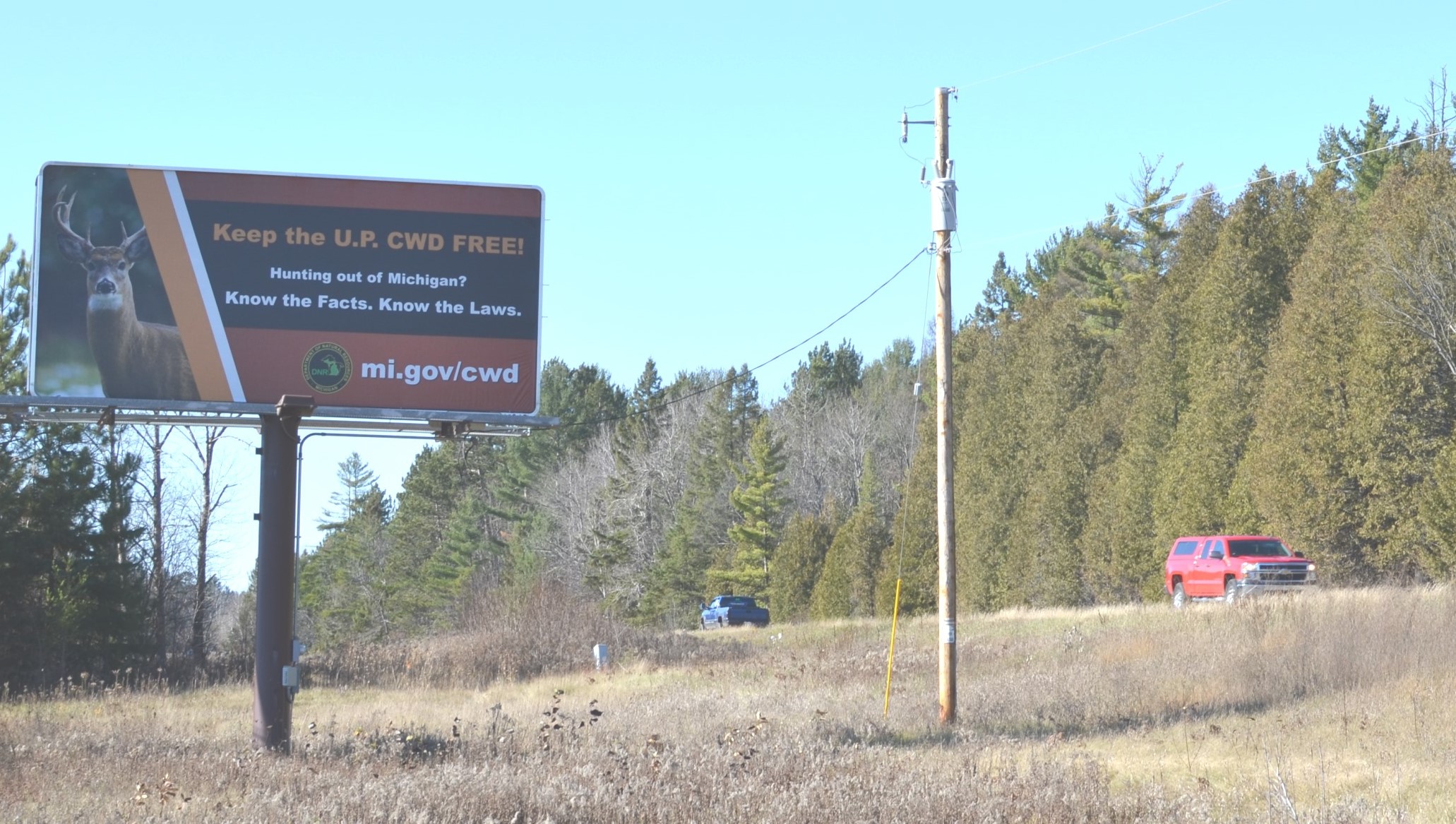
DNR officials are concerned CWD could be brought into the U.P. by those hunting in other states. From billboards and bumper stickers to an informational fact sheet and television and radio broadcasts, the DNR is working to inform the public about preventing CWD from occurring in the U.P.
For more information, visit www.michigan.gov/cwd.
/Note to editors: Accompanying photos are available below for download. Suggested captions for photos follow.
Bumper sticker: Bumper stickers are among the materials produced by the Michigan Department of Natural Resources to help educate the public on chronic wasting disease and keeping it out of the Upper Peninsula.
Media Meet: Michigan Department of Natural Resources staff members were interviewed by moderator Bill Hart for a Dec. 5 broadcast of “Media Meet” on WNMU-TV13 in Marquette. The program, which will be broadcast across the Upper Peninsula and into parts of northern Wisconsin, focused on chronic wasting disease and keeping it out of the U.P. Pictured from left, wildlife technician DNR David Dragon from the Crystal Falls office, DNR Deer Program biologist Ashley Autenrieth from Gaylord, program host Bill Hart and Terry Minzey DNR Upper Peninsula regional wildlife supervisor.