Showing posts with label Michigan. Show all posts

Saturday, August 13, 2016

Michigan Deer Hunters - REMINDER: Antlerless deer license applications on sale until Monday

The Michigan Department of Natural Resources reminds hunters that the application period for antlerless deer licenses ends Monday, Aug. 15.
Hunters may apply for one license in any open deer management unit (DMU) statewide; a nonrefundable $5 fee is charged at the time of application. Hunters may apply online at E-License, or at any authorized license agent or DNR Customer Service Center.
Drawing results and leftover license availability may be viewed beginning Sept. 1 at mi.gov/deer.
Any leftover antlerless deer licenses not issued in the drawing will be sold on a first-come, first-served basis beginningSept. 8 at 10 a.m. EDT until license quotas are met.
The 2016 antlerless deer license quotas for each DMU can be found at mi.gov/deer. Please note, DMU 333 has unlimited antlerless licenses that may be purchased without application beginning Sept. 8 at 10 a.m.
Young hunters, ages 9-16, also can purchase one junior antlerless deer license over the counter July 15-Aug. 15. No application is required. A 9-year-old must be 10 by Sept. 26 to purchase this license.
For additional information, the 2016 Michigan Antlerless Deer Digest is available online at mi.gov/dnrdigests.
Hunters also are reminded that the Michigan Natural Resources Commission expanded the Core Chronic Wasting Disease (CWD) Area to include 17 townships. This area, which will continue to be referred to as DMU 333, now will consist of Lansing, Meridian, Williamstown, Delhi, Alaiedon and Wheatfield townships in Ingham County; DeWitt, Bath, Watertown, Eagle, Westphalia, Riley, Olive and Victor townships in Clinton County; Woodhull Township in Shiawassee County, and Oneida and Delta townships in Eaton County.
The CWD Management Zone also has expanded; it now will include the remainder of Clinton, Eaton, Ingham and Shiawassee counties, as well as all of Ionia County. The expanded management zone will be referred to as DMU 419.
Additional deer-check stations, to be announced at a later date, will be available to hunters in the Core CWD Area.
To learn more about chronic wasting disease, please visit mi.gov/cwd.
Don’t forget to purchase $5 Pure Michigan Hunt applications. You can apply as many times as you wish. Three winners each will receive a prize package valued at over $4,000, including a rifle and crossbow, plus licenses for elk, bear and antlerless deer hunting. Visit mi.gov/pmh for more information. To purchase Pure Michigan Hunt applications, visit E-License.

Sunday, July 10, 2016

Michigan DNR announces expansion of Chronic Wasting Disease Core Area and Management Zone

Additional townships and counties are affected

The Michigan Natural Resources Commission expanded the Core Chronic Wasting Disease (CWD) Area to include 17 townships. This area, which will continue to be referred to as Deer Management Unit (DMU) 333, now will consist of Lansing, Meridian, Williamstown, Delhi, Alaiedon and Wheatfield townships in Ingham County; DeWitt, Bath, Watertown, Eagle, Westphalia, Riley, Olive and Victor townships in Clinton County; Woodhull Township in Shiawassee County, and Oneida and Delta townships in Eaton County.
The CWD Management Zone also has expanded; it now will include the remainder of Clinton, Eaton, Ingham and Shiawassee counties, as well as all of Ionia County. The expanded Management Zone will be referred to as DMU 419.
“With the detection of CWD-positive deer in the southern part of Clinton County, we need to better understand the magnitude of the disease in those areas,” said Chad Stewart, Department of Natural Resources deer specialist. “Expanding our surveillance to include those areas is key at this point, and we need help from landowners and hunters within the expanded zone to help us with this effort.”
Other regulation changes include:
  • Banning deer feeding and baiting on all properties within the Core CWD Area and Management Zone.
  • Opening Eaton and Ionia counties to the early antlerless deer season.
  • Allowing roadkill deer in the Core CWD Area to be possessed and kept with a DNR-issued salvage tag from a law enforcement officer or DNR employee, as long as the head is submitted to a DNR biologist, biologist appointee or check station.
Continuing from last year, other regulation reminders include:
  • Those hunting within the Core CWD Area are required to present the head of all hunter-harvested deerwithin 72 hours of harvest to a DNR deer check station.
  • Hunters leaving the Core CWD Area are required to present the entire carcass of all hunter-harvested deer originating from the Core CWD Area within 72 hours of harvest to a DNR deer check station. (A list of deer check stations is available at michigan.gov/deercheck.)
  • All live free-ranging deer from within the CWD Management Zone or Core CWD Area are prohibited from being rehabilitated. Permittees located within the CWD Management Zone or Core CWD Area may no longer rehabilitate deer.
CWD affects members of the deer family, including elk and moose. It is caused by the transmission of infectious, self-multiplying proteins (prions) contained in saliva and other body fluids of infected animals. Since the May 2015 discovery of chronic wasting disease in a free-ranging, Michigan white-tailed deer, more than 5,000 deer have been tested for CWD in order to gauge the extent of the disease across the landscape. Of those tested, seven deer were confirmed positive for the disease in Clinton and Ingham counties.
To date, there is no evidence that the disease presents any risk to non-cervids, including humans, either through contact with an infected animal or from handling venison. As a precaution, the U.S. Centers for Disease Control and the World Health Organization recommend infected animals not be consumed as food by either humans or domestic animals.
To learn more about CWD, visit mi.gov/cwd.
In an effort to end common CWD misconceptions, the DNR in mid-July will launch a 10-week CWD myth-busting campaign. Visit mi.gov/cwd for more information at that time.

Wednesday, June 8, 2016

DNR seeks input on updated Michigan Deer Management Plan

English: White-tailed deer

The Michigan Department of Natural Resources invites those interested in the management of Michigan’s white-tailed deer population to review and provide input on its draft updated Deer Management Plan.
The plan was created in 2010 through a process that involved substantial stakeholder input and incorporated the best scientific information possible.  A similar process was undertaken in 2015 to update the plan, ensuring that it remains current and reflects the current status of the deer program in Michigan.
“The updated plan will continue to provide strategic guidance to DNR staff for the management of white-tailed deer in Michigan,” said Chad Stewart, DNR deer, elk and moose program specialist.  
The plan supports the mission of the deer program by maintaining a healthy white-tailed deer population, using sound scientific management, maximizing recreational opportunities while minimizing negative effects on ecosystems and other wildlife species and without creating undue hardship to private interests.
The draft plan focuses on goals and objectives that are desirable, with defined actions outlined to achieve these goals and objectives. With this structure, the DNR has the ability to adopt an adaptive approach to deer management, accounting for differences between regions and incorporating changes in management techniques or technology to achieve a desired result.
“We’d like to thank all of the individuals, stakeholders and partners who have assisted in this process over the last year and a half,” Stewart said.
The draft updated plan is available on the DNR’s website at www.michigan.gov/deer. The plan will be available for review through July 8. Comments may be submitted to dnr-wildlife@michigan.gov or sent to DNR Wildlife Division, 525 West Allegan St., Lansing, MI 48909.

Sunday, May 15, 2016

Michigan confirms additional CWD-positive free-ranging, white-tailed deer, bringing the total to seven

Map of Michigan highlighting Ingham County
 (Photo credit: Wikipedia)

Landowner assistance critical to continued management of deadly disease

The Michigan Department of Natural Resources has confirmed two additional free-ranging deer have tested positive for chronic wasting disease (CWD), a fatal neurological disease that affects white-tailed deer, mule deer, elk and moose.
One of the newly confirmed CWD-positive deer is a 9-month-old male from Meridian Township (Ingham County), and the other is a 2 ¾-year-old female from Watertown Township (Clinton County).
Since May 2015, nearly 4,900 deer have been tested for CWD. Seven of these have tested positive for the disease. 
At this time, samples are being collected through road-kill pickup and professional sharpshooters from the U.S. Department of Agriculture (USDA) Wildlife Services. Since the initial case was confirmed, four of the last six positives were collected through efforts of USDA Wildlife Services staff. 
In total, sharpshooters have collected just over 630 deer from the Core CWD Area, which includes nine townships. Of those, 467 deer were taken from Meridian Township, 108 from Williamstown Township, 41 from Bath Township, 12 from Lansing Township, six from DeWitt Township, and none from the remaining townships. Another 33 have been taken outside the core from Watertown Township.
“The partnership with area landowners and USDA Wildlife Services is a critical component of our surveillance efforts to determine the distribution of this fatal disease,” said Chad Stewart, DNR deer specialist. “Now, with these additional CWD-positive deer, that support is needed more than ever.” 
Stewart continued, “The intensive removal of deer in these areas has a two-part benefit. One, it helps us understand prevalence rates and spread so we can make informed decisions on disease management moving forward; and two, by removing individual deer around areas with known disease occurrence, it reduces the potential for spread and accumulation in our deer herd, which has benefits not only locally, but on the periphery of the management zone as well.”
Landowners who would like to directly help with surveillance can apply for disease control permits, which allow a landowner to harvest deer on his or her own property and turn in the head to the DNR for testing. To apply for a disease control permit, contact the DNR Wildlife Disease Laboratory at 517-336-5030
Another option for landowners to help address this disease is allowing USDA Wildlife Services sharpshooters access to their property to collect samples. Sharpshooters work closely with landowners on the number and type of deer that can be taken, and they will conduct surveillance only on property where they have permission. To inquire about working with USDA sharpshooters, contact the DNR Rose Lake field office at 517-641-4092.
To date, there is no evidence that chronic wasting disease presents any risk to non-cervids, including humans, either through contact with an infected animal or from handling contaminated venison. However, as a precaution, the U.S. Centers for Disease Control and the World Health Organization recommend infected animals not be consumed as food by either humans or domestic animals. 
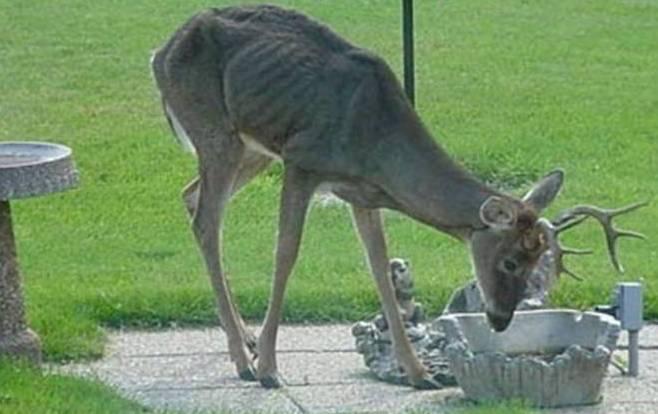
The DNR asks the public to continue to report deer that are unusually thin and exhibiting unusual behavior (for example, acting tame around humans and allowing someone to approach). 
To report a suspicious-looking deer, call the DNR Wildlife Division at 517-284-9453 between 7:30 a.m. and 4 p.m. After hours, call the DNR Report All Poaching hotline at 800-292-7800. Do not attempt to disturb, kill or remove the animal.
DNR staff will continue with road-kill collection in the Core CWD Area. To report road-kills found in the Core CWD Area, call the Wildlife Disease hotline at 517-614-9602. Leave a voicemail with location information and staff will attempt to pick up carcasses on the next open business day.  
The DNR provides CWD biweekly updates online at www.michigan.gov/cwd

Tuesday, December 8, 2015

U.P. Focus: Firearm deer hunting season a mixed bag in the Upper Peninsula

Michigan Department of Natural Resources wildlife biologists said preliminary check station data shows mixed results for the firearm deer hunting season in the Upper Peninsula.
So far, indications are there was a drop in the overall harvest. However, with hunters across the region registering a higher proportion of mature bucks, many of those deer were beautiful bucks.
After three consecutive severe winters in the region, DNR biologists predicted hunters this firearm deer season would likely see fewer deer in the U.P., especially in the 1 ½- and 2 ½-year-old age classes.
“It was a challenging firearm deer hunting season, as anticipated,” said David Jentoft, a DNR wildlife biologist at the Sault Ste. Marie Field Office. “The number of bucks being checked is generally down, but check stations have seen a higher proportion of mature bucks coming in, particularly 3 ½- and 4 ½-year-olds.”
DNR biologists expected more mature bucks in the harvest, with the effects of the previous year’s harsh winter weather limiting the number of yearling bucks available in the U.P. deer population this year.
Early Statistics
Preliminary estimates indicate deer check stations in the U.P. registered deer totals down about 13.5 percent through the firearm deer hunting season, compared to last year.
Check station results are only one indicator the DNR uses to evaluate the deer season and not all of that data has been compiled yet. A clearer picture of the season is expected to emerge once camp and hunter surveys are returned in the weeks ahead.
Hunter posing with the first buck he's shot in seven years.The DNR check station at Escanaba was the busiest in the U.P., followed by Marquette. Escanaba staff checked a total of 321 deer and there were 165 deer checked at Marquette.
The percentage of bucks checked at those two stations varied widely, demonstrating the limitation of projecting general results across the region from individual stations. The Escanaba station was down about 25 percent from last year, while Marquette had an increase of 20 percent.
A similar situation occurred at the Mackinac Bridge. 
DNR wildlife division staff checked a total of 37 deer over the two days the check station at Bridge View Park in St. Ignace was open, compared to 51 there last year. That marks a dip of 27 percent.
However, a short distance away, Mackinac Bridge Authority toll booth workers informally counted a total of 1,481 deer on southbound vehicles over the firearm deer hunting season. That total represents a 5-percent decline from the 1,563 deer tallied last year.
Deer Health Improvement
Antler beam measurements, which generally indicate a buck’s overall fitness level, were greatly improved in the U.P. from the past two seasons.
“This shows that deer that came out of last winter were in pretty good shape, certainly better than the previous couple of seasons,” said Chad Stewart, DNR deer, elk and moose management specialist at the Rose Lake Wildlife Research Center in East Lansing. “Yearling antler beam growth is back now within the previous 10-year average after being significantly lower the last two years.”
Wolves
Wolves have an impact on the deer population in the U.P., but to what extent is not fully known.
A multiyear predator-prey study — being conducted by the DNR and Mississippi State University — is ongoing in an effort to better understand the predatory impacts to U.P. deer from wolves, coyotes, bears and bobcats.
Coyotes also play a significant role in deer predation. An individual wolf may kill more deer than a coyote. However, there are more coyotes on the landscape, which produces a larger impact on fawn mortality.
The predator-prey research has been conducted over the past six years in low and medium snowfall zones in the region and is moving north to study high snowfall areas next. 
Wolves in Michigan are currently federally protected as endangered species after a U.S. District Court ruling in December 2014.
Endangered species status for the wolf severely limits the tools the state can use toA hunter with his buck at the Mackinac Bridge check station. manage the species, including lethal control, as outlined in the state’s Wolf Management Plan. The federal court ruling prohibits the Michigan Natural Resources Commission from considering hunting as a management tool.
The DNR supports removing wolves from the endangered species list, as gray wolves reached targeted population recovery goals in Michigan, Minnesota and Wisconsin years ago.
Legislation is currently pending in the U.S. Congress which, if passed into law, would prohibit courts from overruling the Department of the Interior on delisting wolves in Michigan, Minnesota, Wisconsin and Wyoming. A similar measure was passed in 2011 for wolves in Idaho and Montana.
Meanwhile, the DNR continues to manage wolves according to the remaining provisions of Michigan’s recently updated Wolf Management Plan, including the use of nonlethal harassment techniques.
The only legal killing of wolves in Michigan is in defense of human life.
Continuing Action
The DNR, NRC and sporting groups continue to partner in efforts to improve the deer population.
Long-range work is being done to preserve and enhance critical winter range areas by the U.P. Wildlife Habitat Work Group and short-range measures have been undertaken to try to preserve a larger number of does surviving the winter, including reducing the number of antlerless tags available to hunters in the U.P.
This past summer, the NRC eliminated the ability to tag an antlerless deer with either the single deer license or combination deer license during the archery season in hopes this may assist in helping the deer herd recover.
That change was expected to reduce the deer harvest by 5,000 to 6,000 deer heading into the winter months. The decision came after extensive discussions and public comment on six potential regulation change options for this fall.
Those options the NRC considered included:
  • Option 1: Maintain the current hunting season and license structure in the U.P.
  • Option 2: Close the entire deer hunting season in the U.P.
  • Option 3: Eliminate the option of using a combination license when hunting in the U.P. (one buck) and eliminate the antlerless option during archery season when using the single deer license.
  • Option 4: Eliminate the antlerless option during archery season for hunters hunting on deer licenses, including the combination license.
  • Option 5: Eliminate the antlerless option for archers hunting on deer licenses, including the combination license, during the late archery season only.
  • Option 6: Eliminate the Liberty and Independence hunts in the U.P.
“The reduced harvest in the U.P., though disappointing for many, will help aid in the long-term recovery of the deer herd, as well as the efforts being made to improve habitat,” Stewart said. “We know the deer numbers in the U.P. are down lower than most want to see. However, an elevated harvest would not be conducive to our goals at this time, which is to grow the deer herd in the U.P.”
Weather
The firearm deer hunting season opened Nov. 15 to unseasonably warm temperatures in the 50s across the U.P. By mid-season, temperatures had cooled and many places received snowfall. But by Monday’sseason close, snow had melted from most areas.
“While we know deer numbers are low and we have taken several steps to help the herd recover, the most important component will be the weather,” said Ashley Autenrieth, DNR Deer Program biologist in Gaylord. “Luckily, this fall and going into this winter, we've seen above-average temperatures and very low snowfall levels. If the trend continues, we should see a mild winter which would be a great start to allowing the deer herd to recover."
License Sales
Deer hunting license sales by county of residence were down about 10 percent in the A hunter with his deer at the Newberry check station.U.P. since March 1. As of Monday’s season close, there had been 63,202 deer hunting licenses sold to U.P. residents, compared to 70,154 last year.
Marquette County had the highest number of residents buying deer licenses in the U.P. this year with 10,921, followed by Delta County with 9,975 and Menominee County with 9,298.
Muzzleloader and Late Archery Seasons
Muzzleloader season opens today in the U.P. and northern Lower Peninsula and closes Dec. 13. Late archery season opened Dec. 1 and continues through the end of the month. Prospects for hunters continue to remain mixed.
“Hunters still should not expect to see many deer, but those who are lucky enough to harvest a buck will likely be harvesting a 3 ½- to 4 ½-year-old buck since their numbers appear to be higher than younger age classes, due to the severe winters over the last few years," Autenrieth said.
For more information on deer hunting in Michigan, visit the DNR’s webpage at: www.michigan.gov/deer.

Monday, December 7, 2015

U.P. Focus: Panel discussion on ‘Keep the U.P. CWD Free!’ campaign airs next weekend

The Michigan Department of Natural Resources is reminding the public that broadcasts of WNMU-TV13’s “Media Meet” discussion on keeping the Upper Peninsula free from chronic wasting disease will air next weekend.
The program with DNR staff and host Bill Hart focuses on various efforts to educate the public on CWD and keeping it from reaching the U.P. The program will initially air at 6:30 p.m. EST Saturday, Dec. 12, and be rebroadcast at 2:30 p.m. Sunday, Dec. 13, and in January 2016.
Guests featured on the half-hour program include Ashley Autenrieth, DNR deer program biologist in Gaylord, Terry Minzey, DNR U.P. regional wildlife supervisor in Ishpeming, Dave Dragon, a DNR wildlife technician from the Crystal Falls office, and John Pepin, DNR deputy public information officer in Marquette.
The broadcast will reach viewers across the U.P. and parts of northern Wisconsin. A week after the initial broadcast, the television program will be available online at: http://wnmuvideo.nmu.edu/program/media-meet/.
Public Radio 90 will also air the program at 7:30 a.m. Dec. 13, repeating at 3:30 p.m. Dec. 14. The program will also be available on Public Radio 90’s podcast at: http://www.publicbroadcasting.net/wnmu/.jukebox?action=programs.
The DNR recently launched a public information and education campaign to try to keep chronic wasting disease from reaching the Upper Peninsula.
Discovered earlier this year in a free-ranging deer in the Lower Peninsula, CWD affects the central nervous system and is fatal to white-tailed deer, mule deer, elk and moose. There is no known treatment.
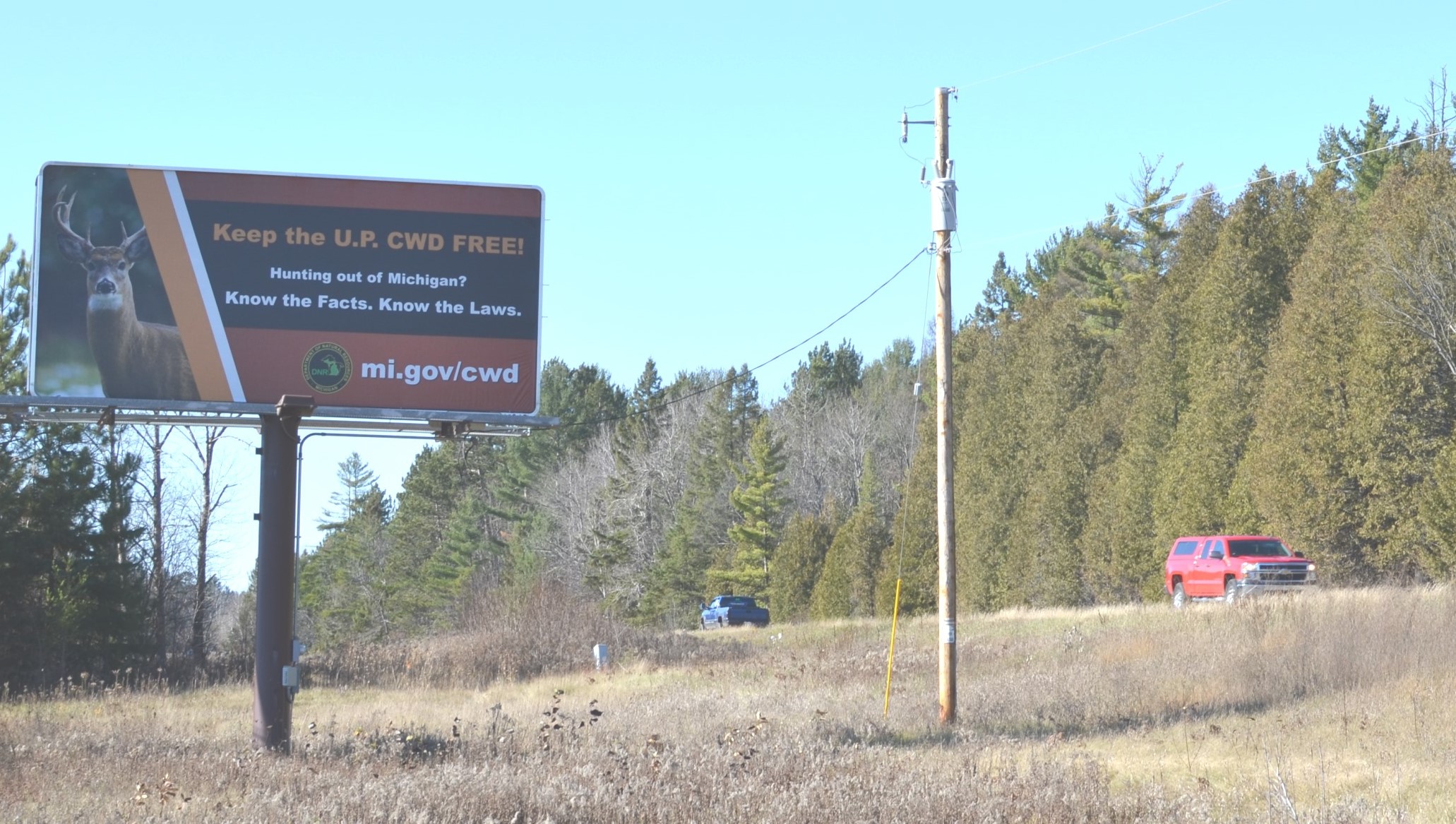
DNR officials are concerned CWD could be brought into the U.P. by those hunting in other states. From billboards and bumper stickers to an informational fact sheet and television and radio broadcasts, the DNR is working to inform the public about preventing CWD from occurring in the U.P.
For more information, visit www.michigan.gov/cwd.
/Note to editors: Accompanying photos are available below for download. Suggested captions for photos follow.
Bumper sticker: Bumper stickers are among the materials produced by the Michigan Department of Natural Resources to help educate the public on chronic wasting disease and keeping it out of the Upper Peninsula.
Media Meet: Michigan Department of Natural Resources staff members were interviewed by moderator Bill Hart for a Dec. 5 broadcast of “Media Meet” on WNMU-TV13 in Marquette. The program, which will be broadcast across the Upper Peninsula and into parts of northern Wisconsin, focused on chronic wasting disease and keeping it out of the U.P. Pictured from left, wildlife technician DNR David Dragon from the Crystal Falls office, DNR Deer Program biologist Ashley Autenrieth from Gaylord, program host Bill Hart and Terry Minzey DNR Upper Peninsula regional wildlife supervisor.

Friday, October 30, 2015

Michigan DNR reminds deer hunters of license structure

With Michigan's archery deer season in full swing and firearm season set to begin Nov. 15, the Department of Natural Resources reminds hunters of changes to the state's hunting license structure that took effect in 2014.
Available deer licenses include:
  • Single deer license, valid throughout archery, firearm and muzzleloader seasons. This license has replaced the separate archery and firearm licenses. Hunters who buy a single deer license may not buy a second single deer license or the deer combo license.
  • Deer combo license, which includes two kill tags, one regular and one restricted. Hunters who want two deer licenses must buy the deer combo license instead of the single deer license. The deer combo license is valid for use during the archery, firearm and muzzleloader seasons. A hunter can use both kill tags in the firearm seasons, both in the archery season or one in each season.
  • Antlerless deer license, available based on license quotas set for each Deer Management Unit (DMU).
To see how the single deer and deer combo licenses may be used in each deer season, based on which DMU a hunter wishes to hunt, see the Antler Point Restriction Regulations map and chart on pages 32 and 33 of the 2015 Hunting and Trapping Digest.
A base license now is required for all hunters. The base license provides critical funding for habitat and conservation work on both public and private land and supports the work of conservation officers and field staff to ensure safe, legal hunting practices are followed. The purchase of a base license includes small game hunting. Whether they choose to hunt small game or not, hunters' base license dollars will be used to enhance and expand hunting opportunities, which benefits hunters of all species.
More information about Michigan’s hunting license structure – including license pricesfrequently asked questions and details about how license dollars will be invested – is available atwww.michigan.gov/dnr under "In the Know."
For more details about hunting seasons, licenses and regulations, see the Hunting and Trapping Digest and Antlerless Deer Digest at www.mi.gov/dnrdigests.
Those who have questions or need help determining which licenses to buy may contact their nearest DNR Customer Service Center.

Tuesday, September 29, 2015

Michigan DNR seeks information on deer killed in city of Norton Shores

Michigan Department of Natural Resources conservation officers are asking for the public’s help in obtaining information about 18 deer that were killed in the city of Norton Shores between October 2014 and September 2015.
The Norton Shores Police Department and the DNR have received the following reports:
  • A resident in the area of Treeline Drive found one dead deer Oct. 26, 2014, and two dead deer May 14, 2015.
  • On Aug. 31, 2015, a resident on Easthill Drive reported finding a dead deer in the yard, and a total of 11 dead deer since February 2014.
  • On Sept. 13, 2015, the Easthill Drive resident found two more dead deer.
  • A resident on Hilltop Drive also reported finding two dead deer since last year.
The deer were shot with a small-caliber rifle. Most of the deer were killed outside of the state’s deer hunting seasons.
Anyone with information about any of these incidents is encouraged to call the DNR's Report All Poaching (RAP) Line at 1-800-292-7800. Information may be left anonymously. Tips also can be sent to the DNR via the online reporting form available on the DNR website www.michigan.gov/conservationofficers.

Thursday, September 17, 2015

Michigan - Deadline approaching to refund deer license purchases

The Michigan Department of Natural Resources reminds hunters that 5:30 p.m. Friday, Sept. 18, is the deadline to return unused deer and deer combination (“deer combo”) licenses for a refund.
The DNR allowed license returns for refund after antlerless deer hunting regulation changes were implemented by the Michigan Natural Resources Commission this summer. Some hunters had purchased licenses for the upcoming fall hunting seasons prior to the rule change.
The NRC eliminated the option to harvest antlerless deer during the archery seasons for hunters using deer or deer combo licenses in the Upper Peninsula. The decision makes deer and deer combo licenses used in the archery season “buck-only” licenses.
However, hunters with private-land antlerless deer licenses may still take an antlerless deer during any hunting season within three deer management units in the U.P. which will be open to antlerless deer hunting.
Those units are private land in Unit 055, which includes portions of Menominee and Delta counties; Unit 155, which includes parts of Marquette and Delta counties and Unit 122, which includes parts of Menominee, Iron and Dickinson counties.
Hunters can return deer and deer combo licenses for a refund if they would like, and new licenses could be purchased prior to the start of the deer seasons; however, this is not required.
To return a license for refund, hunters must bring all licenses bought during the original time of purchase back to the license outlet where they were purchased. For those who purchased licenses online, use the phone number below.
Since deer seasons begin Sept. 19, licenses are considered active after Friday’s deadline. To learn more about returning licenses, contact DNR licensing staff at 517-284-6057 or MDNR-E-License@michigan.gov.
More information on the Upper Peninsula DMUs is available in the 2015 Michigan Antlerless Deer Digest online. For more information on hunting seasons and regulations, visit www.michigan.gov/hunting.

Saturday, September 5, 2015

Michigan DNR’s Hunting Access Program awarded grant to increase hunting opportunities

The Michigan Department of Natural Resources' Hunting Access Program, which provides access to quality hunting lands near urban areas, soon will expand into the northern Lower Peninsula thanks to a new federal grant.
The Michigan Department of Natural Resources will receive $951,400 to expand its Hunting Access Program into the northern Lower Peninsula to increase private-land hunting opportunities. This grant, awarded by the U.S. Department of Agriculture’s Voluntary Public Access and Habitat Incentive Program, also will improve wildlife habitats by enhancing grassland, forest and food plots.

The Voluntary Public Access and Habitat Incentive Program encourages landowners to allow outdoor enthusiasts greater access to their privately owned land for hunting, bird watching, fishing and hiking. According to a 2013 study by the National Fish and Wildlife Foundation, outdoor recreation supports 6.1 million direct jobs across the country and $646 billion in spending each year. Deer hunting alone attracts more than 700,000 hunters to Michigan each year and contributes billions of dollars to the state’s economy.

Michigan's Hunting Access Program was created in 1977 to increase public hunting opportunities in southern Michigan, where 97 percent of the land base is privately owned. Through HAP, private landowners receive financial incentives for allowing hunters access to their lands. One of the oldest dedicated private-lands, public-access programs in the nation, HAP provides access to quality hunting lands near urban areas.

According to DNR wildlife biologist Mike Parker, “HAP enrollment will be targeted primarily in the agricultural areas in the northeast and western northern Lower Peninsula, where public land is a bit scarce. Grant funds will also be used to restore wildlife habitat on willing HAP properties, to improve opportunities for deer hunters, turkey hunters and small game hunters alike.”

Using funds from Michigan’s recent license restructuring, this new federal grant and an existing USDA grant, the DNR plans to continue expanding the program in the southern Lower Peninsula, the northern Lower Peninsula and the eastern Upper Peninsula over the next three years. 

Visit www.michigan.gov/hap to learn more about the program and to see a current list of private lands available for hunting in Michigan. The HAP Web page includes details about enrolled properties, including types of hunting allowed and aerial photos of the properties.

Sunday, August 9, 2015

Michigan DNR confirms third deer positive for CWD; hunter participation is critical this fall

Map of Michigan highlighting Ingham County
Map of Michigan highlighting Ingham County (Photo credit: Wikipedia)
Michigan Department of Natural Resources announced that a third free-ranging deer in Meridian Township (Ingham County) has tested positive for chronic wasting disease (CWD). The deer was a 5-year-old doe. All three CWD-positive deer detected thus far have been discovered within a mile of one another.
“As we stated with the second positive deer, this news is not surprising,” said Dr. Steve Schmitt, DNR wildlife veterinarian. “The good news is that all three deer came from the same small area.” Genetic analyses carried out by Michigan State University’s Molecular Ecology Laboratory indicate that all three positive animals were related as part of an extended family. Previous research has shown that CWD often is transmitted within family groups because of their close contact.
Hunters are critical to helping the DNR understand the prevalence and geographic distribution of the disease.
“We have focused our efforts thus far in the area around the first case,” Schmitt continued. ”We need individuals who have always hunted in Ingham County and surrounding counties to keep hunting. The DNR can’t fight this disease without their support. Hunters need to have their deer checked and tested so we can determine if this disease is established over a broad area or just persisting in a local pocket.”
In addition, it is critical that if an individual hunts outside Michigan in a state or province that has CWD in their free-ranging deer, elk, or moose that only the following parts of deer, elk, or moose carcasses are brought into Michigan:
  • Deboned meat.
  • Antlers.
  • Antlers attached to a skull cap cleaned of all brain and muscle tissue.
  • Hides.
  • Upper canine teeth.
  • Finished taxidermy mount.
If a hunter is notified by another state or province that a deer, elk, or moose that was brought into Michigan tested positive for CWD, that hunter must contact the DNR Wildlife Disease Lab within two business days (8 a.m. to 5 p.m.) at 517-336-5030.
CWD is a fatal neurological disease that affects white-tailed deer, mule deer, elk and moose. It is caused by the transmission of infectious, self-multiplying proteins (prions) contained in saliva and other body fluids of infected animals. Susceptible animals can acquire CWD by direct exposure to these fluids, or from environments contaminated with these fluids or the carcass of a diseased animal.
Some chronically CWD-infected animals will display abnormal behaviors, progressive weight loss and physical debilitation. There is no cure; once a deer is infected with CWD, it will die.

To date, there is no evidence that chronic wasting disease presents any risk to non-cervids, including humans, either through contact with an infected animal or from handling venison. However, as a precaution, the U.S. Centers for Disease Control and the World Health Organization recommend that infected animals not be consumed as food by either humans or domestic animals.
The DNR provides CWD weekly updates online at www.michigan.gov/cwd. Announcements of additional CWD-positive deer within that same area will be listed online. Additional news updates will be issued if a CWD-positive deer is found outside the immediate area.