Showing posts with label Chronic wasting disease. Show all posts

Wednesday, April 6, 2022

CWD detected in a wild deer in Grand Rapids, Minnesota


The discovery of a wild white-tailed deer infected with CWD within the city of Grand Rapids is prompting the DNR to update its response plan to better reflect a statewide approach to disease surveillance, management, control and education.

The health of Minnesota’s wild deer herd remains a top priority for DNR, and the department always has looked at CWD as a disease that could impact the entire state yet implemented aggressive disease management actions as needed in each area where CWD was found.

This new discovery doesn’t make CWD a statewide problem, but it does mean we need to take more of a statewide approach.

There now are eight areas spread across Minnesota, from north to south, where CWD has been found in wild or farmed deer. Despite these detections, the disease remains rare in Minnesota. Fewer than 1% of deer have tested positive for CWD in areas where the disease has consistently been detected during the past five years.

We’ll be seeking public input as we explore and implement enhanced efforts at statewide surveillance, information and education.

More details: Learn more about the DNR’s response to CWD

Tuesday, July 14, 2020

Full Ahead: Modeling CWD in Wisconsin

The Southwest Wisconsin CWD, Deer and Predator Study is entering its second phase. Most of the fieldwork is finished, so now researchers are diving into the analysis portion of the project as data keeps rolling in.
This CWD study is the largest, most comprehensive deer research project ever performed in Wisconsin, and it is also one of the biggest CWD studies in the world. Dan Storm, Deer Research Scientist at the Wisconsin Department of Natural Resources (WDNR) and lead of the deer side of the project, said, “Its scale shows how seriously CWD is being taken.”
Storm continued, “CWD is here in a big way, and the problem is getting worse. Prevalence is increasing over time in the [counties] where it already exists and is spreading geographically. CWD is impacting a greater and greater portion of the deer population and portion of the people who interact with deer.”
Since its launch in 2016, the CWD Study has been focused on setting up the infrastructure needed for this project. The purpose of the capture component (Phase 1) of this project was to get the data generation machine flowing. GPS collars will continue to transmit their location until the animal dies or the collar’s battery runs out in 2-3 years, so the collaring phase was just the start of data generation, not the end. The animals need to keep living out their lives, and the GPS collars will continue to send us data about how they live and how they die.
Fortunately, the researchers have already received enough data from animals collared in past years to move into Phase 2 of the project. Phase 2 is where researchers begin to make sense of the stream of data they’ve been collecting. Storm said, “We’ve got a lot of good, quality data for this project. The more animals you catch, the more you can learn.” And if the 1,200+ animals that were captured and collared for this study are any indication, there is a lot researchers will learn about CWD in Phase 2.
Measuring bobcat

What’s in store during Phase 2?

While data continues to flow in, Storm and his counterpart on the predator side of the study, Nathan Roberts, Furbearer Research Scientist at the WDNR, are ramping up the project’s data analysis phase. This phase aims to create a model for how CWD impacts our deer in Wisconsin. Roberts said, “We’ve realized that these [CWD] questions are really complicated. We can’t just look at a few variables at a time.”
Storm added, “These models are [therefore] very data hungry, because we have to account for so many different factors. Take survival, for instance. Right off the bat, you have differences in survival for each sex, age and CWD status. Just by having three different attributes to look at, you’ve already increased the sample size you need a bunch. Every little bit of complexity that’s added, increases the sample size needed.”
Roberts explained, “It is similar to how we think about human disease. You can look at the impacts of a disease on people, but that doesn’t tell you the whole story. To have a better understanding of what is going on, you need to look at some of the other factors like the impact of age or preexisting conditions. It’s the same with deer. You might think of predation even as a preexisting condition. We want to look at these important questions, not in isolation, but [together] with all these other factors that have the potential to impact the population.” Fortunately, Phase 1 was so successful at collaring a large sample size that the researchers will be able to look at CWD’s impact in a way that wouldn’t have been possible otherwise.

Why is modeling CWD so complicated?

CWD has the potential to change the likelihood that an infected deer dies from other causes, such as hunting, predation, and weather.
Let’s think of the deer population as a bag with ten marbles in it. Each year, three marbles are removed to represent annual deaths: one marble for hunting, one for predation and one for weather. At the same time, three marbles are added to represent that year’s new births, and the balance is maintained.
However, if CWD+ deer die more often during harsh winters, then two marbles need to be removed for weather (instead of one). Now, a total of four marbles are removed each year, yet only three are added. After a few years, there won’t be many marbles left in the bag.
Without incorporating these other variables and the potential of CWD to interact with them, researchers can’t fully understand the impact of CWD on deer.
Roberts said, “If we looked at these variables in isolation, it’s not very complicated. There [already] are models for individual factors like hunting or weather. What is unique here is that this study is comprehensive. We are integrating several sources of data into a single model.” With a large sample size and good analytical approach, such a comprehensive model is possible.
The researchers are currently at the beginning steps of building their model using the data that has already been collected, and more data will continue to flow in from the collars while the model is being built. Once the model is built and tested, the researchers will use the full dataset to analyze the effect CWD is having on the Wisconsin deer population.
David MacFarland, Wildlife Research Team Leader at the WDNR, said, “We are only at the halfway point. We still have a long road ahead of us.”

Upcoming Milestones in Phase 2

While we wait for the project to finish, we can look forward to a couple intermediate milestones. One upcoming milestone is the analysis of fawn survival. Since no new fawns are being collared, the monitoring period for these deer will finish soon, and the data can be analyzed.
Another milestone that our volunteers and nature lovers will enjoy is the analysis of juvenile dispersal. The year following their births, juveniles will begin dispersing around a larger area. In a few months, researchers will see the most recent batch of juveniles begin to disperse. Roberts said, “Each life stage presents different sets of challenges [for deer] and looking at each life stage gives us a fuller picture of the factors that influence deer populations throughout their lives.”
In addition to learning more about specific life stages of our deer, the researchers have also been expanding the team through collaborations. MacFarland mentioned bringing on research collaborators from the University of Wisconsin system and US Geological Survey during Phase 2. Two important collaborators, Alison Ketz, Assistant Scientist in the Department of Forestry and Wildlife Ecology at the University of Wisconsin-Madison, and Dan Walsh, Quantitative Ecologist at the U.S. Geological Survey’s National Wildlife Health Center, will play key roles in the model-building team.
Holding Fawn

Using our momentum

Phase 2 of the Southwest Wisconsin CWD, Deer and Predator Study is now underway and gaining initial momentum. The project’s success during Phase 1 set up the second phase to also be successful, and the researchers are confident that the project is in a great place. What we learn from this CWD study will better inform deer management decisions across the state, so stay tuned!
Roberts said, “In Wisconsin, wildlife are very important to our public. Wildlife and our communities are intertwined, so the public is very interested, not only in wildlife but having the information we need to make informed decisions regarding the management of wildlife.”
deer in the distance
As a final thought, MacFarland said,
“If you care about deer, you should care about this project. CWD is a critical issue for deer management in the state. Like it or not, it is here and influencing our deer population.
If you are someone who values the ecosystems of the state, you should value this project. Deer are a primary influencer on our ecosystems. Not only on wildlife but on vegetation and other elements of the ecosystems. By understanding deer and their impacts, we learn about these critical ecosystems in the state.
If you care about conservation in Wisconsin, you should care about this project. The funding model we have for wildlife conservation across all of North America is based on funding through the sale of hunting licenses. Deer are the primary source of funding in Wisconsin. If there is something that is negatively impacting deer and therefore hurting deer hunting, then it’s negatively impacting the funding available for everything else we do in the state. The money that is generated not only funds deer management, but it funds prairie management, bird management, and the management of other important species.”
Stay tuned in this upcoming year for more from this study on the impact of CWD in Wisconsin.

What aspects of this project get the researchers excited?

MacFarland: “This project has been cool, because it is an example of what we can do as an agency and what we can do as a research group. The scale of this project is bordering on unprecedented, in terms of the number of animals collared and the scope of the project. This project is a testament to what is possible as an agency, especially when we have the cooperation of citizens.”
Storm: “For me, the biggest thing to learn [in Phase 2] is the main question: What really is the impact of CWD on the deer population? There are also so many other things [to learn] like how species interact with the landscape and how being infected influences how deer move across the landscape.”
Roberts: “I’m really excited to have a better understanding of the indirect impacts of carnivores on deer. We know that carnivores eat deer, nothing too surprising there. But with the work we are doing, we are able to look beyond that first level question of do they eat deer and ask what the potential indirect effects are. Does the type of habitat that they are using influence how deer move on the landscape? Being able to look at the indirect impacts of these species that all share the same landscape, that’s really fascinating, and I’m excited to see what we learn there.”
“That and… bobcats and coyotes are both secretive animals, because they are very cautious and elusive. They are common, but people don’t get to see them often. In this study, we have been able to look closely at those species in a way we haven’t been able to before. The number of animals and the technology we are using has really allowed us to look into the lives of these animals and the population as a whole. That’s been really fascinating to me.”

Tuesday, September 13, 2016

Michigan: Suspect deer for chronic wasting disease identified in Ingham County

CWD
CWD (Photo credit: Wikipedia)

Hunters in DMU 333 reminded of the requirement to have harvested deer from the area checked

Since May 2015, the Michigan Department of Natural Resources has been actively conducting surveillance for chronic wasting disease (CWD). To date, more than 6,000 deer have been tested since the first positive was found, with seven cases of CWD confirmed.
However, a 3.5-year-old buck taken recently in Meridian Township is likely to be the eighth positive and the first discovered since March of this year. The sample is currently being tested by the U.S. Department of Agriculture’s National Veterinary Services Laboratory in Ames, Iowa, to finalize confirmation.
The suspect deer was taken as part of the DNR’s CWD management program through targeted sharpshooting, which actively removes deer that are more likely to be affected with the disease in and around areas where previously identified CWD-positive animals had been detected.
“This latest suspect positive reinforces the notion that the disease is still occurring in Meridian Township and perhaps elsewhere,” said Chad Stewart, DNR deer specialist. “We are counting on hunters to bring their deer in for testing so we have a better understanding about the scope of the disease.”
Due to positive deer also detected in DeWitt and Watertown townships, the Core CWD Area has been expanded to now include 17 townships. This area, which is referred to as Deer Management Unit (DMU) 333, consists of Lansing, Meridian, Williamstown, Delhi, Alaiedon and Wheatfield townships in Ingham County; DeWitt, Bath, Watertown, Eagle, Westphalia, Riley, Olive and Victor townships in Clinton County; Woodhull Township in Shiawassee County; and Oneida and Delta townships in Eaton County.  Hunters harvesting deer in these townships are required to submit the deer head for testing during business hours or check-station hours within 72 hours of harvest.
The CWD Management Zone also has expanded; it now includes Clinton, Eaton, Ingham, Ionia and Shiawassee counties.  The expanded Management Zone has been renamed DMU 419. The price for an antlerless license in this zone has been decreased 40 percent to encourage hunters to harvest more deer and voluntarily have them checked.
There will be five check stations accepting deer for CWD testing within DMU 333.  These check stations will be operating seven days a week (excluding major holidays).  A complete map of check stations, including locations and hours of operation, is available at mi.gov/cwd
Deer feeding and baiting is prohibited throughout the Core CWD Area and CWD Management Zone. 
CWD is a fatal neurological disease that affects white-tailed deer, mule deer, elk and moose. It is caused by the transmission of infectious, self-multiplying proteins (prions) contained in saliva and other body fluids of infected animals. Susceptible animals can acquire CWD by direct exposure to these fluids, from environments contaminated with these fluids or the carcass of a diseased animal. 
Some chronically CWD-infected animals will display abnormal behaviors, progressive weight loss and physical debilitation; however, deer can be infected for many years without showing internal or external symptoms. There is no cure; once a deer is infected with CWD, it will die. 
To date, there is no evidence that CWD presents any risk to non-cervids, including humans, either through contact with an infected animal or from handling venison. However, as a precaution, the U.S. Centers for Disease Control and the World Health Organization recommend that infected animals not be consumed as food by either humans or domestic animals. 
Anyone interested in learning more about how Michigan is managing CWD can view the new 2015-2016 Michigan Chronic Wasting Disease Management and Surveillance Report.  Additionally, the DNR is holding a Facebook Live event Sept. 20 at 12 p.m. EDT to answer questions about CWD, CWD management and the impacts the disease could have on the future of Michigan’s deer.  Follow the Michigan DNR’s Facebook page for more details.
The DNR provides bi-weekly CWD updates online at mi.gov/cwd. Announcements of additional CWD-positive deer will be posted online as well.

Thursday, May 26, 2016

Wisconsin Natural Resources Board approves 2016 deer harvest quotas and season structure

The Wisconsin Natural Resources Board approved deer hunting season framework and antlerless deer quotas for 2016 at its May 25 meeting in Madison. Final season framework reflects recommendations from County Deer Advisory Councils.

Ten deer management units will not have an antlerless quota (each within the Northern and Central Forest zones), while the rest of Wisconsin will have a quota of 256,775 antlerless deer (compared to 224,735 in 2015).

A Holiday Hunt will be held in 13 counties and provide for an additional antlerless-only opportunity for firearm hunters from Dec. 24 to Jan.1. In addition, junior license holders in Ashland, Sawyer and Forest counties will not be allowed to harvest antlerless deer – these councils exercised their right to submit this recommendation in an effort to encourage increased herd growth.

As a reminder, bonus antlerless permit sales for the Forest zones begin Monday, Aug.15 at 10 a.m. Central Farmland Zone permits will go on sale Aug. 16, and Southern Farmland Zone bonus permits will be made available Aug. 17.
The department’s deer hunting webpage will be updated within the coming weeks with a number of helpful resources regarding hunting 2016 quotas and season framework. For more information, including an updated carcass tagging FAQ, search keyword “deer.”

Thursday, May 19, 2016

MDC reminds public to not feed deer in CWD counties

Regulation banning feeding deer in 29 counties starts May 30.
JEFFERSON CITY, Mo. – The Missouri Department of Conservation (MDC) reminds landowners, deer hunters, and others that a regulation banning the feeding of deer becomes effective on May 30 for 29 counties in north-central, central, and east-central Missouri.
Grain, salt products, minerals, and other consumable products used to attract deer are now prohibited year-round in the following 29 counties: Adair, Boone, Callaway, Carroll, Chariton, Crawford, Cole, Cooper, Franklin, Gasconade, Jefferson, Knox, Linn, Livingston, Macon, Miller, Moniteau, Morgan, Osage, Putnam, St. Charles, St. Louis, Randolph, Schuyler, Scotland, Shelby, Sullivan, Washington, and Warren.  
Exceptions to the regulation include feeding wildlife within 100 feet of any residence or occupied building, feed placed in a manner that excludes access by deer, and feed and minerals used solely for normal agricultural, forest management, or wildlife food-plot-production practices.
The feeding ban is one step MDC is taking to limit the spread of Chronic Wasting Disease (CWD), a fatal neurological disease that infects only deer and other members of the deer family. The disease has no vaccine or cure and is 100-percent fatal. CWD is spread from deer to deer and the potential for transmission increases when deer gather in larger, concentrated numbers, such as at feeding sites.
The 29 counties affected by the feeding ban comprise the Department’s CWD Management Zone. The zone consists of counties within or that touch a radius of approximately 25 miles from where CWD has been found. According to MDC, 33 free-ranging deer in Missouri have tested positive for the disease with 21 found in Macon County, 9 in Adair, one in Cole, one in Franklin, and one in Linn.

Other MDC actions to limit the spread of CWD

The ban on feeding deer is one of several actions MDC is taking to help limit the spread of CWD. MDC also collects tissue samples from several thousand harvested, sick, and road-killed wild deer around the state each year to test for CWD. The sampling efforts focus both on areas where CWD has been found and on broader, statewide testing.
The Department will increase its CWD sampling and testing efforts in north-central, central, and east-central Missouri this fall by requiring hunters who harvest deer in one of the 29 CWD-Management-Zone counties during the opening weekend of the fall firearms deer season (Nov. 12 and 13) to present their deer (or the head with at least six inches of the neck intact) for CWD testing at one of 75 MDC sampling locations on the day of harvest. The testing is free and hunters can also get free test results. Sampling locations will be listed in the Department’s 2016 Fall Deer & Turkey Hunting Regulations and Information booklet and online at mdc.mo.gov.
MDC has also removed the antler-point restriction in all CWD-Management-Zone counties starting this fall so young bucks are no longer protected from harvest. Young bucks can potentially spread the disease to new areas as they search for territories and mates.
The Department has also increased the availability of firearms antlerless permits from 1 to 2 in all CWD-Management-Zone counties starting this fall to help prevent undesired population increases in local deer numbers.
MDC also strongly discourages the removal of deer carcasses from CWD-Management-Zone counties. Moving carcasses of potentially infected deer out of the immediate area where they were harvested and improperly disposing of them can also spread the disease. Certain carcass parts, such as boned out meat, are okay to move because the protein that causes CWD is not concentrated in these parts.
Learn more about CWD at mdc.mo.gov/CWD.

Sunday, May 15, 2016

North Dakota 2015 Deer Season Summarized

The Mule Deer is one of many species first nam...

A total of 39,470 North Dakota deer hunters took approximately 26,700 deer during the 2015 deer gun hunting season, according to a post-season survey conducted by the State Game and Fish Department.

Game and Fish made available 43,275 deer gun licenses last year. Overall hunter success was 68 percent, with each hunter spending an average of 4.3 days in the field.

Hunter success for antlered white-tailed deer was 70 percent, and antlerless whitetail was 64 percent.

Mule deer buck success was 86 percent. No mule deer doe licenses were issued in 2015.

Hunters with any-antlered or any-antlerless licenses generally harvest white-tailed deer, as these licenses are predominantly in units with mostly whitetails. Buck hunters had a success rate of 75 percent, while doe hunters had a success rate of 67 percent.

A total of 826 muzzleloader licenses were issued in 2015, and 745 hunters that participated harvested 348 white-tailed deer (194 antlered, 154 antlerless). Hunter success was 47 percent, with each hunter spending an average of 5.9 days in the field.

A record 25,703 archery licenses (23,710 resident, 1,993 nonresident) were issued in 2015. In total, 21,680 bow hunters harvested 7,527 deer (6,777 whitetails, 750 mule deer), for a success rate of 35 percent. Bucks accounted for 75 percent of the deer harvested with a bow. Archers spent an average of 10.7 days afield.

In addition, 4,004 youth licenses were issued in 2015. During the youth season, 3,487 hunters harvested 1,832 deer (393 bucks, 1,439 does). Hunter success was 52 percent, and each hunter spent an average of 2.9 days in the field. Youth hunters in the regular deer gun season harvested an additional 240 deer (196 bucks, 44 does) for an overall success rate of 59 percent.

The department is in the process of determining recommendations for licenses in the 2016 deer proclamation. The proclamation will be sent to the governor’s office for approval in late April.

In addition to harvest rates and winter aerial surveys, the department monitors a number of other population indices to determine license numbers, including depredation reports, hunter observations, input at advisory board meetings, and comments from the public, landowners and department field staff.

Michigan confirms additional CWD-positive free-ranging, white-tailed deer, bringing the total to seven

Map of Michigan highlighting Ingham County
 (Photo credit: Wikipedia)

Landowner assistance critical to continued management of deadly disease

The Michigan Department of Natural Resources has confirmed two additional free-ranging deer have tested positive for chronic wasting disease (CWD), a fatal neurological disease that affects white-tailed deer, mule deer, elk and moose.
One of the newly confirmed CWD-positive deer is a 9-month-old male from Meridian Township (Ingham County), and the other is a 2 ¾-year-old female from Watertown Township (Clinton County).
Since May 2015, nearly 4,900 deer have been tested for CWD. Seven of these have tested positive for the disease. 
At this time, samples are being collected through road-kill pickup and professional sharpshooters from the U.S. Department of Agriculture (USDA) Wildlife Services. Since the initial case was confirmed, four of the last six positives were collected through efforts of USDA Wildlife Services staff. 
In total, sharpshooters have collected just over 630 deer from the Core CWD Area, which includes nine townships. Of those, 467 deer were taken from Meridian Township, 108 from Williamstown Township, 41 from Bath Township, 12 from Lansing Township, six from DeWitt Township, and none from the remaining townships. Another 33 have been taken outside the core from Watertown Township.
“The partnership with area landowners and USDA Wildlife Services is a critical component of our surveillance efforts to determine the distribution of this fatal disease,” said Chad Stewart, DNR deer specialist. “Now, with these additional CWD-positive deer, that support is needed more than ever.” 
Stewart continued, “The intensive removal of deer in these areas has a two-part benefit. One, it helps us understand prevalence rates and spread so we can make informed decisions on disease management moving forward; and two, by removing individual deer around areas with known disease occurrence, it reduces the potential for spread and accumulation in our deer herd, which has benefits not only locally, but on the periphery of the management zone as well.”
Landowners who would like to directly help with surveillance can apply for disease control permits, which allow a landowner to harvest deer on his or her own property and turn in the head to the DNR for testing. To apply for a disease control permit, contact the DNR Wildlife Disease Laboratory at 517-336-5030
Another option for landowners to help address this disease is allowing USDA Wildlife Services sharpshooters access to their property to collect samples. Sharpshooters work closely with landowners on the number and type of deer that can be taken, and they will conduct surveillance only on property where they have permission. To inquire about working with USDA sharpshooters, contact the DNR Rose Lake field office at 517-641-4092.
To date, there is no evidence that chronic wasting disease presents any risk to non-cervids, including humans, either through contact with an infected animal or from handling contaminated venison. However, as a precaution, the U.S. Centers for Disease Control and the World Health Organization recommend infected animals not be consumed as food by either humans or domestic animals. 
The DNR asks the public to continue to report deer that are unusually thin and exhibiting unusual behavior (for example, acting tame around humans and allowing someone to approach). 
To report a suspicious-looking deer, call the DNR Wildlife Division at 517-284-9453 between 7:30 a.m. and 4 p.m. After hours, call the DNR Report All Poaching hotline at 800-292-7800. Do not attempt to disturb, kill or remove the animal.
DNR staff will continue with road-kill collection in the Core CWD Area. To report road-kills found in the Core CWD Area, call the Wildlife Disease hotline at 517-614-9602. Leave a voicemail with location information and staff will attempt to pick up carcasses on the next open business day.  
The DNR provides CWD biweekly updates online at www.michigan.gov/cwd

Saturday, January 2, 2016

Michigan DNR lauds partners in continuing battle against chronic wasting disease

Deer suspected positive for CWD found in Watertown Township; Jan. 12public meeting set

With deer hunting seasons coming to a close, the Michigan Department of Natural Resources wants to thank the important partners who have emerged in the ongoing fight against chronic wasting disease (CWD) – a neurological disease always fatal once contracted by deer, elk or moose.
Earlier this year, Michigan’s first case of CWD in free-ranging white-tailed deer was confirmed in Meridian Township in Ingham County.
Two workers stopped along a roadside pick up a dead deer to be tested for chronic wasting disease.Since May, nearly 4,000 deer have been tested for CWD. Of those deer, four have been confirmed positive for the disease in Clinton and Ingham counties. One new suspected CWD-positive deer was found recently in Clinton County.
Although discovering CWD in Michigan’s wild deer herd was something wildlife officials had hoped to avoid, DNR deer program managers are pleased with the cooperation and commitment that have made surveillance of CWD more productive.
“From the individual who reported the initial sick deer, to U.S. Department of Agriculture Wildlife Services doing targeted surveillance, to the hunters who complied with regulations and checked their harvested deer, to the township officials who have supported DNR efforts - they are all important pieces to hopefully eradicating this disease in Michigan,” said Chad Stewart, DNR deer, moose and elk management specialist.
The latest suspected CWD-positive deer was located in Watertown Township, a new location for CWD in Michigan.
The DNR is trying to inform individuals near that area of the critical role they can play.
“An archery hunter brought his deer from Watertown Township into a DNR check station to have it aged and receive a successful hunter patch. He wasn’t going to have it tested,” Stewart said. “We suggested that he test just in case. If he hadn’t agreed, we may not have found another suspect.”
To inform area residents about what this most recent finding of the disease may mean for them, the DNR has scheduled a town hall meeting from 6 to 8 p.m.Tuesday, Jan. 12 in the DeWitt Charter Township Valley Farms Community Center, which is located at 16101 Brook Road in Lansing.
At the meeting, Stewart and Dr. Steve Schmitt, DNR wildlife veterinarian, will provide information on CWD, its impacts on deer and deer populations, and how the DNR has responded to the discovery of the disease thus far.
There will be plenty of time for questions.
“We would like to build the same type of support in DeWitt and Watertown townships that we have seen in Meridian,” Stewart said. “Township officials, hunters and landowners are critical to our plan.”
Schmitt said in many instances, misinformation, especially on electronic media, has caused resistance toA Michigan Department of Natural Resources staff worker stands near a folding table, assisting a hunter who is bringing a deer in for testing. DNR plans and actions to battle CWD.
Some groups do not believe CWD has a devastating impact on deer populations and instead think that by leaving deer alone they will grow resistant to the disease. On the contrary, some infected western deer populations have been reduced by half, with CWD contributing greatly to this decline.
“We have individuals and groups who want to provide their own opinions on this disease,” Schmitt said. “The information they are putting out is blatantly incorrect, and we want hunters and landowners to inform themselves through credible science.”
This disease is serious.
There will be no new hunting regulation changes from now through the end of the deer season as the DNR conducts CWD surveillance and decides what additional steps might need to be taken for next year's seasons.
CWD affects white-tailed deer, mule deer, elk and moose. It is caused by the transmission of infectious, self-multiplying proteins (prions) contained in saliva and other body fluids of infected animals.
Susceptible animals can acquire CWD by direct exposure to these fluids, or from environments contaminated with the fluids including soils, or the carcass of a diseased animal.
To date, there is no evidence the disease presents any risk to non-cervids, including humans, either through contact with an infected animal or from handling venison. However, as a precaution, the U.S. Centers for Disease Control and the World Health Organization recommend infected animals not be consumed as food by either humans or domestic animals.
Hunters submitting a deer head for testing will be able to find out the test results for their deer within seven to 10 days.
To learn more about CWD, visit www.michigan.gov/cwd.

Wednesday, December 16, 2015

Missouri Department of Conservation proposes new regulations for CWD management zones

Chronic Wasting Disease (CWD) has been found in Adair, Cole, Linn, Macon and, most recently, Franklin counties. MDC's proposed CWD management zones, highlighted in orange, include all counties within a 25-mile radius of where a CWD-positive deer has been found. 
Proposed regulations would require testing of deer harvested during the opening weekend of the November portion of the fall firearms deer season and implement a ban on feeding deer in CWD management zones.
JEFFERSON CITY, Mo. – At its meeting on Dec. 11, the Missouri Conservation Commission approved recommendations for regulation changes to help limit the spread of Chronic Wasting Disease (CWD). The disease has been found in free-ranging deer from Adair, Cole, Macon, and, most recently, Franklin counties.
The proposed regulations would require mandatory sampling and testing for CWD of harvested deer taken in MDC's CWD management zones during the opening weekend of the November portion of the 2016 fall firearms deer season, Nov. 12 and 13.
The proposed regulations would also prohibit the feeding of deer and use of deer attractants such as grain, salt, and mineral products in MDC's CWD management zones. Feeding deer unnaturally concentrates deer in a small area, which can help spread the disease. Exceptions to the regulation include feeding of wildlife within 100 feet of any residence or occupied building, feed placed in a manner that excludes access by deer, feed and minerals used solely for normal agricultural, forest management, or wildlife food-plot-production practices.
MDC's proposed CWD management zones include all counties within a 25-mile radius of where a CWD-positive deer has been found. Those 27 counties in northeast, central, and east-central Missouri can be found on the MDC website at www.mdc.mo.gov/CWDManagementZones.
A regulation banning supplemental feeding of deer has been in place since 2012 in Adair, Chariton, Linn, Macon, Randolph, and Sullivan counties in Northeast Missouri, where the first cases of CWD in the state were found.
Missouri's rulemaking process includes a 30-day public comment period. Full verbiage of the proposed regulation changes will be posted on the MDC website after Jan. 1, 2016. Comments related to the proposed regulation changes can be submitted to the Conservation Department from Jan. 16 through Feb. 14, 2016 at http://mdc.mo.gov/node/24141%20.
MDC continues to ask hunters who harvest deer in the CWD management zones to avoid moving deer carcasses out of the zones, to properly dispose of deer carcasses, to report deer that appear sick or diseased to MDC staff, and to have all deer harvested in the CWD management zones sampled and tested for CWD.
Chronic Wasting Disease infects only deer and other members of the deer family by causing degeneration of brain tissue, which slowly leads to death. The disease has no vaccine or cure and is 100-percent fatal. For more information on CWD, visit the MDC website atwww.mdc.mo.gov/CWD.

Tuesday, December 15, 2015

Chronic wasting disease confirmed in Crawford County, Wisconsin buck harvested on private land

MADISON -- The Wisconsin Department of Natural Resources Tuesday confirmed test results showing chronic wasting disease in a 3 1/2 year old buck harvested on private land in Crawford County.
Tami Ryan, DNR wildlife health section chief, said the result represents the first positive test for CWD detected in the county. The buck appeared healthy at the time of the kill, which is not unusual with CWD detections as it takes up to 16 to 18 months before infected animals display symptoms.
"Crawford County is already classified as a CWD-affected county, so the finding will not result in any regulatory changes," Ryan said. "We have interviewed the hunter to confirm the location, which is in the town of Clayton, west of Richland Center. The deer was harvested 13 miles from the nearest previous positive test result."
Crawford County and the surrounding counties of Vernon, Richland and Grant are already classified as CWD affected counties and have baiting and feeding bans in place.
DNR appreciates the assistance from hunters in providing samples from their harvest to advance monitoring efforts, Ryan said. CWD monitoring remains a priority for DNR and the department continues to work with cooperating taxidermists and meat processors within targeted surveillance areas. The department also has piloted new self-serve kiosks around the state to make it more convenient for hunters to submit deer heads for testing.
"Hunters have played a key role in expanding our knowledge of CWD in Wisconsin," Ryan said. "Their willingness to deliver samples is absolutely essential to disease monitoring efforts that inform our understanding of CWD distribution and prevalence."
Test results are generally returned within three to four weeks. To learn more about CWD in Wisconsin, search the DNR website, dnr.wi.gov for keyword "CWD." For information about restrictions on moving carcasses from areas affected by chronic wasting disease, search "carcass movement." The website also contains more information about "sampling and registration" and locations where samples can be delivered, by searching "hunting registration stations."
Wisconsin's deer hunt continues through Jan. 31 for archery and crossbow harvest in some metro subunits.

Monday, December 14, 2015

Suspect deer confirmed positive for chronic wasting disease in Clinton County, Michigan

Deer was harvested in Dewitt Township; Eaton County hunters urged to voluntarily check deer and stop baiting and feeding of deer

As of Thursday, the Michigan Department of Natural Resources reports a total of 3,695 deer in Michigan this year have been tested for chronic wasting disease (CWD). Four deer have been confirmed positive for the disease, with the fourth positive just recently found.
During the firearm deer season, a hunter from Dewitt Township (Clinton County) in the Core CWD Area brought a 1 1/2-year-old buck into the DNR’s Rose Lake deer check station. The U.S. Department of Agriculture’s National Veterinary Services Laboratory in Ames, Iowa, confirmed the deer as CWD positive.
Because the deer was harvested within 10 miles of the Eaton County border, the DNR strongly encourages all hunters within Eaton County to voluntarily stop baiting and feeding, continue hunting and, most importantly, bring harvested deer into a DNR check station.
“Deer hunters in DMU 333 have been a great help by bringing in their deer to be tested. We couldn’t be more thankful or impressed with their dedication to the resource,” said Chad Stewart, DNR deer specialist. “We continue to need their help and are also asking Eaton County hunters to join our efforts. In addition, we have begun conversations with DeWitt Township, and they, too, are becoming great partners in this fight against CWD.”
There will be no mandatory regulation changes from now through the end of the deer season, as the DNR conducts CWD surveillance and decides what additional steps might be needed for the 2016 season.
CWD is a fatal neurological disease that affects white-tailed deer, mule deer, elk and moose. It is caused by the transmission of infectious, self-multiplying proteins (prions) contained in saliva and other body fluids of infected animals. Susceptible animals can acquire CWD by direct exposure to these fluids, or from environments contaminated with these fluids or the carcass of a diseased animal. 
Some chronically CWD-infected animals will display abnormal behaviors, progressive weight loss and physical debilitation; however, deer can be infected without showing internal or external symptoms for many years. There is no cure; once a deer is infected with CWD, it will die. 
To date, there is no evidence that chronic wasting disease presents any risk to non-cervids, including humans, either through contact with an infected animal or from handling venison. However, as a precaution, the U.S. Centers for Disease Control and the World Health Organization recommend that infected animals not be consumed as food by either humans or domestic animals. 
The DNR provides weekly CWD updates at mi.gov/cwd. Announcements of additional CWD-positive deer also will be posted online.

Monday, December 7, 2015

U.P. Focus: Panel discussion on ‘Keep the U.P. CWD Free!’ campaign airs next weekend

The Michigan Department of Natural Resources is reminding the public that broadcasts of WNMU-TV13’s “Media Meet” discussion on keeping the Upper Peninsula free from chronic wasting disease will air next weekend.
The program with DNR staff and host Bill Hart focuses on various efforts to educate the public on CWD and keeping it from reaching the U.P. The program will initially air at 6:30 p.m. EST Saturday, Dec. 12, and be rebroadcast at 2:30 p.m. Sunday, Dec. 13, and in January 2016.
Guests featured on the half-hour program include Ashley Autenrieth, DNR deer program biologist in Gaylord, Terry Minzey, DNR U.P. regional wildlife supervisor in Ishpeming, Dave Dragon, a DNR wildlife technician from the Crystal Falls office, and John Pepin, DNR deputy public information officer in Marquette.
The broadcast will reach viewers across the U.P. and parts of northern Wisconsin. A week after the initial broadcast, the television program will be available online at: http://wnmuvideo.nmu.edu/program/media-meet/.
Public Radio 90 will also air the program at 7:30 a.m. Dec. 13, repeating at 3:30 p.m. Dec. 14. The program will also be available on Public Radio 90’s podcast at: http://www.publicbroadcasting.net/wnmu/.jukebox?action=programs.
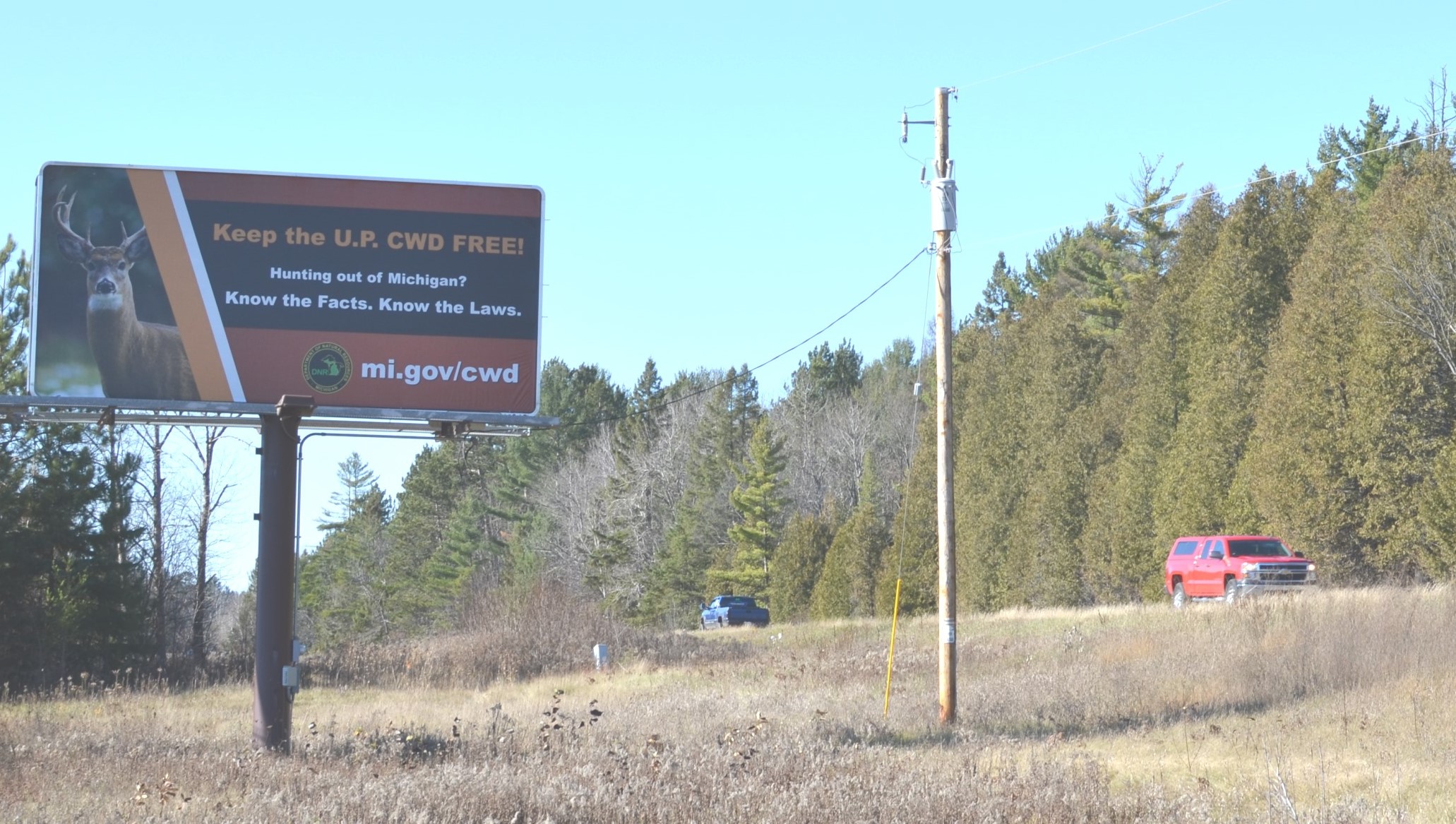
The DNR recently launched a public information and education campaign to try to keep chronic wasting disease from reaching the Upper Peninsula.
Discovered earlier this year in a free-ranging deer in the Lower Peninsula, CWD affects the central nervous system and is fatal to white-tailed deer, mule deer, elk and moose. There is no known treatment.
DNR officials are concerned CWD could be brought into the U.P. by those hunting in other states. From billboards and bumper stickers to an informational fact sheet and television and radio broadcasts, the DNR is working to inform the public about preventing CWD from occurring in the U.P.
For more information, visit www.michigan.gov/cwd.
/Note to editors: Accompanying photos are available below for download. Suggested captions for photos follow.
Bumper sticker: Bumper stickers are among the materials produced by the Michigan Department of Natural Resources to help educate the public on chronic wasting disease and keeping it out of the Upper Peninsula.
Media Meet: Michigan Department of Natural Resources staff members were interviewed by moderator Bill Hart for a Dec. 5 broadcast of “Media Meet” on WNMU-TV13 in Marquette. The program, which will be broadcast across the Upper Peninsula and into parts of northern Wisconsin, focused on chronic wasting disease and keeping it out of the U.P. Pictured from left, wildlife technician DNR David Dragon from the Crystal Falls office, DNR Deer Program biologist Ashley Autenrieth from Gaylord, program host Bill Hart and Terry Minzey DNR Upper Peninsula regional wildlife supervisor.