Showing posts with label Deer hunting. Show all posts

Thursday, July 29, 2021

Minnesota Deer Notes

Deer hunting season details available

Ready to plan ahead for the fall? Check out the details for the 2021 season in the Minnesota Hunting and Trapping regulations handbook, now available on the DNR website. Printed copies of the handbook will be delivered to hunting license vendors the first week of August.

Hunting licenses go on sale Sunday, Aug. 1. You can buy your license at any DNR license agent, by telephone at 888-665-4236, or online at mndnr.gov/buyalicense.

Archery deer season opens S

Saturday, Sept. 18, and firearms deer season opens Saturday, Nov. 6. Find out more on the deer hunting page.


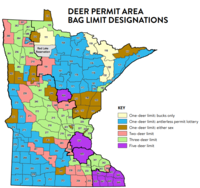
map of Minnesota deer permit areas with bag limit designations

Deer bag limit name changes

Bag-limit labels have been changed to make the limits clearer:

  • "Lottery" is now "antlerless permit lottery" (one-deer limit)
  • "Hunter choice" is now "either-sex" (one-deer limit)
  • "Managed" is now "two-deer limit"
  • "Intensive" is now "three-deer limit"
  • "Unlimited antlerless" is now "five-deer limit"

"Bucks only" remains the same, with the one-deer limit. Areas that were previously under an unlimited antlerless bag limit are now a five-deer limit.


Early antlerless season expands

The DNR has expanded the early antlerless deer season, Oct. 21-24, to include more deer permit areas in central and southeastern Minnesota. The season increases opportunities for hunters in areas where deer populations are above population goals or where there is an increased risk of chronic wasting disease spreading. Permit areas open during the hunt are 213, 214, 215, 221, 227, 236, 277, 341, 342, 343, 604, 605, 643, 645, 646, 647, 648, 649, 655 and 701. Early antlerless permits go on sale Aug. 1.


snapshot of some DPAs with new boundaries for 2021

Check your deer permit area boundary

Several deer permit area boundaries in southwest and northeast Minnesota have changed based input from the public, tribal communities and DNR staff. The permit areas affected are: 169, 171, 173, 179, 184, 197, 237, 259, 275, 276, 277, 281, 282, 283 and 295.

Changes are depicted on the 2021 Deer Season Area Map and hunters should double-check the boundaries of any permit areas where they plan to hunt, as well as bag limits in those areas.

Key CWD changes for the 2021 season

  • Mandatory sampling of deer harvested in chronic wasting disease zones will resume this year during the opening weekends of both firearms A and B seasons.
  • The names of the zones are simplified to three tiers: management zone, control zone and surveillance zone. 
  • The surveillance zone has expanded following detections of the disease in wild and captive deer, adding deer permit areas 110, 184, 197, 233 and 342, and a portion of deer permit area 169.
  • Late chronic wasting disease hunts are scheduled for Dec. 17-19 and Dec. 31-Jan. 2; additional details will be posted on the DNR website closer to hunt dates.

Check out the regulations book (PDF) and the webpage for more information.


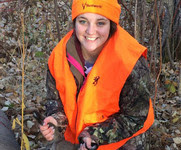
young hunter dressed in blaze orange

Apply for special youth deer hunts

Minnesota has special hunting opportunities for youth deer hunters. There is a limited number of permits for each hunt, with the individual hunts taking place on various dates during the fall in state parks and a national wildlife refuge. Adults must accompany youth during these hunts. Hunters may apply for special youth hunt permits through Friday, Aug. 20. Special youth deer hunts are different from the statewide youth deer season that does not require an application and takes place Oct. 21-24.


statewide map of goal-setting blocks

Deer population goals released

Results of the second year of deer population goal-setting are now available online. This year focused on portions of southwest and northeast Minnesota. Thank you to those of you who participated in the virtual engagement options this year!

Next year will focus on deer permit areas in the northeast, north-central and southeast portions of the state (noted in green in the map) and will start later this winter. Stay tuned for details of when and how you can provide your input for those areas and check out the deer populations and goals webpage for more information.


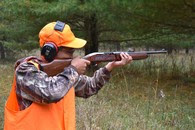
hunter dressed in blaze orange with ear protection

Webinar: How to get certified in firearms safety

Do you know someone who wants to go hunting this fall? Join a chat with DNR conservation officers officers at noon Wednesday, Aug. 4, to discuss Minnesota hunter safety requirements, including how to get certified in firearms safety.

The webinar is part of the Minnesota Outdoor Skills and Stewardship Series that aims to give participants quick, relevant information on upcoming seasons and events, and skills to help enjoy these opportunities. Registration is free.


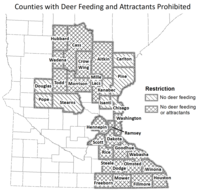
areas where deer feeding and attractant bans are in place

Feeding ban reminder

Feeding and attractant bans are critical in limiting the spread of chronic wasting disease in wild deer. Due to the detection of CWD in Beltrami county, the deer feeding ban is expected to expand to include Beltrami County and neighboring counties this fall.

Currently there are deer feeding or attractant bans in the following counties: Aitkin, Carlton, Cass, Chisago, Crow Wing, Dakota, Dodge, Douglas, Fillmore, Freeborn, Goodhue, Hennepin, Houston, Hubbard, Isanti, Kanabec, Mille Lacs, Morrison, Mower, Olmsted, Pine, Pope, Ramsey, Rice, Scott, Stearns, Steele, Todd, Wabasha, Wadena, Washington and Winona.

Learn more about what you need to do to help our wild deer, and the difference is between feeding and attracting deer, on the deer feeding ban webpage.

Wednesday, July 22, 2020

Announcements for Minnesota Deer Hunters

Hunting regulations available

Hunters, you're all set to plan ahead for the fall!

The DNR has released the 2020 Minnesota Hunting and Trapping regulations handbook, now available on the DNR website.

Deer hunters this season will generally see more harvest opportunities. Deer hunting regulations and permit area maps are on the DNR deer hunting page.

Hunting licenses go on sale Saturday, Aug. 1. You can buy your license at any DNR license agent, by telephone at 888-665-4236, or online at mndnr.gov/buyalicense.


Statewide youth deer season continues

The popular youth deer hunting season continues and will happen statewide Oct. 15-18. During last year’s inaugural statewide youth season, nearly 5,700 young deer hunters harvested a deer, which represented a 77% increase from the previous season when it was limited to fewer areas.


Check your deer permit area boundary

Several deer permit area boundaries in north-central and northwestern Minnesota have changed due to input from the public and DNR staff during the deer population goal-setting process, or in response to CWD spread. Hunters should double check the boundaries of any permit areas where they plan to hunt.


a buck in tall grass

Read up on CWD testing changes

There are significant changes to the regulations related to chronic wasting disease, as the DNR continues its aggressive management of CWD and also is ensuring hunter and staff safety by implementing sampling changes that allow for social distancing and community mitigation measures.


Sign up for deer virtual open house

Anyone interested in discussing deer and deer management can tune in to a virtual open house 6-7 p.m. Tuesday, Aug. 18, hosted by the DNR. Registration for the event is required and available on the deer open house webpage. Attendees are encouraged to submit questions in advance on their registration form.


a young hunter holding a deer she harvested

Apply for special youth deer hunts

Check out these special deer hunting opportunities for youth—there are a limited number of permits for each hunt, in state parks and a wildlife area. Adults must accompany youth. Remember to apply for these special hunts (PDF) by the Aug. 14 deadline.

Friday, July 10, 2020

Updated Deer Hunting Info from Indiana

Don't miss out on deer hunting in Indiana this year. Mark calendars with relevant dates and start thinking through your hunting plans.

Two resources we recommend for Indiana deer hunters are Indiana's DNR update page on hunting applications located HERE

Another great resource for basic deer hunting information, as well as general outdoors information geared towards families is found at FAMILY-OUTDOORS

Happy Hunting!

Friday, July 3, 2020

Missouri: Get fall deer and turkey hunting info from new MDC booklet

Get it online at huntfish.mdc.mo.gov/fall-deer-and-turkey-hunting-regulations-and-information.

JEFFERSON CITY, Mo. – Missouri deer and turkey hunters can get the most current information on upcoming fall hunting from the Missouri Department of Conservation’s (MDC) 2020 Fall Deer and Turkey Hunting & Regulations Information booklet, available where permits are sold and online at huntfish.mdc.mo.gov/fall-deer-and-turkey-hunting-regulations-and-information.

The booklet has detailed information on fall deer and turkey hunting seasons, limits, permits, managed hunts, regulations, conservation areas to hunt, post-harvest instructions, chronic wasting disease (CWD) updates, and more.

Changes for the upcoming seasons, detailed in the booklet, include:

  • Flood-prone areas in southeast Missouri are closed to hunting, except waterfowl, during deer and turkey seasons when river levels exceed certain limits.
  • To slow the spread of CWD, there are new carcass transportation regulations.
  • Clark County has been added to the CWD Management Zone.
  • During Nov. 14–15, hunters who harvest a deer in the CWD Management Zone must take it on the day of harvest to a CWD sampling station. MDC is monitoring the COVID-19 pandemic and will re-evaluate by Nov. 1 mandatory CWD sampling requirements. For the latest information, please visit mo.gov/cwd.
  • The antler-point restriction has been removed for Clark County and inside the Columbia city limits.
  • Nonresident permit prices have gone up.
  • Hunters may no longer use a Firearms Antlerless Deer Hunting Permit in Atchison County.
  • Hunters may now fill two Firearms Antlerless Deer Hunting Permits in Lincoln and Montgomery counties, and in Cass County outside the urban zone.
  • To qualify for no-cost resident landowner permits, you now must own at least 20 acres in one contiguous tract.
  • Nonresidents who own at least 75 acres in one contiguous tract in Missouri may now buy deer and turkey hunting permits at reduced prices.
  • To get landowner permits, you must submit information about your property by filling out a Landowner Permit Application.
  • Qualifying landowners may now receive two Resident Landowner Firearms Antlerless Deer Hunting Permits in Newton County.
  • Archery Antlerless Deer Hunting Permits may now be used in Scott County.
  • New managed deer hunts have been added, and others have been removed or modified.
  • Deer hunting regulations have changed for some conservation areas.
  • A limited elk hunting season will be held in Carter, Reynolds, and Shannon counties.
  • There is a new definition for handgun.

Buy Missouri hunting and fishing permits from numerous vendors around the state, online at huntfish.mdc.mo.gov/permits, or through MDC’s free mobile app, MO Hunting, available for download through Google Play or the App Store.

Thursday, June 25, 2020

Minnesota Deer Notes - June 25, 2020 (Minnesota DNR)

In this issue, we have multiple study updates, details on the expanding deer feeding and attractant bans, notes on the 2019 season harvest report, summaries from the spring deer open houses and a reminder to leave fawns alone when they're on their own.


Deer hunting season information

We hope you’re staying safe and are looking forward to future hunting seasons. Currently, there are no changes to upcoming hunting season dates. As with any evolving situation, this is subject to change, so stay tuned to the DNR channels (including the DNR’s COVID-19 response webpage, through social media and also in this newsletter) for any adjustments.

As we move closer to the deer hunting season, it’s also a good time to talk about how the outdoors are for all. We encourage you to do your part to keep the outdoors safe and welcoming to everyone: people of every color, people with disabilities, and of all backgrounds, genders, traditions and experience levels.

Please check out our learn-to-hunt information and share with people who might be interested in trying hunting out: it’s available for anyone who wants to learn more about archery deer hunting or firearms deer hunting. For non-hunters, we also encourage people to check the DNR Recreation Compass to discover ways and places to find outdoor adventures.


Map of Minnesota counties under a feeding and/or attractant ban

Keep our deer herd healthy by following deer feeding and attractant bans

Have you heard? Starting July 1, six additional counties will be added to deer feeding and attractant bans after the discovery of chronic wasting disease in a wild deer in Dakota County. Feeding and attracting deer will not be allowed in Dakota, Hennepin, Ramsey, Rice, Scott and Washington counties. These bans are an important part of the DNR’s response to CWD — limiting close contact between deer helps prevent the spread of the fatal disease. Learn more about what you need to do to help our wild deer, and a full list of the counties included, on the deer feeding ban webpage.


Update: Neonicotinoid study

Thank you to all of the hunters who submitted spleens for Minnesota Deer Neonictinoid Project! Nearly 800 spleens were sent in from across the state. Check out this map to see the spatial distribution of all of the spleens.

All teeth and spleen samples are at currently at their respective labs for diagnostics and we are patiently waiting on results. We expect all diagnostic results to come in at the end of summer.

For any questions, please contact Patrick Hagen at patrick.hagen@state.mn.us or 651-395-0077.


Deer open house conversation recap

Wondering what issues came up at deer open houses earlier this year? Summaries for each area are now posted on the deer open house webpage. Stay tuned for details for how you can participate in a deer open house this August!


Map showing the path of a doe fawn that has moved north from Fillmore County, through Olmsted County, to Wabasha County

Update: Southeast deer movement study

DNR biologists continue to monitor the 28 deer (19 does, 9 bucks) collared in 2019 and the additional 46 fawns (27 does, 19 bucks) collared in February 2020.

Currently, DNR biologists are watching for spring dispersal of deer, which usually happens between April and July as fawns leave their birthplaces to establish their own adult home ranges. Based on past years' results, we expect that nearly half of the fawns will have moved away from their birthplaces by the end of July.

While most fawns' travels average 11 miles, some move farther. One doe fawn, collared near Chatfield this February, has moved about 30 miles so far. This week, she was tracked near Hammond. That dispersal movement is shown on this map.

Learn more and watch for updates on the newly updated study webpage.


2019 season harvest report now available

The full 2019 harvest report can be downloaded on the deer reports and statistics webpage. Some key takeaways:

  • A total of 187,587 deer were harvested last season.
  • During the inaugural statewide youth season, 5,829 deer were harvested.
  • Overall, the season was very similar to the 2018 season, with comparable total number harvested and success rates. A total of 101,910 antlered bucks and 85,677 antlerless deer were harvested in 2019. There was an 8% increase in antlered buck harvest and 9% decrease in antlerless deer harvest compared to last year.

Fawn curled up in vegetation (close-up)

Let fawns be

Most fawns are born from mid-May to mid-June, so please avoid disturbing them. Fawns do not attempt to evade predators during their first few weeks of life. Instead, they remain still to avoid being seen. During these times, fawns are learning critical survival skills from their mothers but are often left on their own while their mothers are foraging nearby. Be assured deer fawns do fine even if they look abandoned or fragile.

Tuesday, September 13, 2016

Michigan: Suspect deer for chronic wasting disease identified in Ingham County

CWD
CWD (Photo credit: Wikipedia)

Hunters in DMU 333 reminded of the requirement to have harvested deer from the area checked

Since May 2015, the Michigan Department of Natural Resources has been actively conducting surveillance for chronic wasting disease (CWD). To date, more than 6,000 deer have been tested since the first positive was found, with seven cases of CWD confirmed.
However, a 3.5-year-old buck taken recently in Meridian Township is likely to be the eighth positive and the first discovered since March of this year. The sample is currently being tested by the U.S. Department of Agriculture’s National Veterinary Services Laboratory in Ames, Iowa, to finalize confirmation.
The suspect deer was taken as part of the DNR’s CWD management program through targeted sharpshooting, which actively removes deer that are more likely to be affected with the disease in and around areas where previously identified CWD-positive animals had been detected.
“This latest suspect positive reinforces the notion that the disease is still occurring in Meridian Township and perhaps elsewhere,” said Chad Stewart, DNR deer specialist. “We are counting on hunters to bring their deer in for testing so we have a better understanding about the scope of the disease.”
Due to positive deer also detected in DeWitt and Watertown townships, the Core CWD Area has been expanded to now include 17 townships. This area, which is referred to as Deer Management Unit (DMU) 333, consists of Lansing, Meridian, Williamstown, Delhi, Alaiedon and Wheatfield townships in Ingham County; DeWitt, Bath, Watertown, Eagle, Westphalia, Riley, Olive and Victor townships in Clinton County; Woodhull Township in Shiawassee County; and Oneida and Delta townships in Eaton County.  Hunters harvesting deer in these townships are required to submit the deer head for testing during business hours or check-station hours within 72 hours of harvest.
The CWD Management Zone also has expanded; it now includes Clinton, Eaton, Ingham, Ionia and Shiawassee counties.  The expanded Management Zone has been renamed DMU 419. The price for an antlerless license in this zone has been decreased 40 percent to encourage hunters to harvest more deer and voluntarily have them checked.
There will be five check stations accepting deer for CWD testing within DMU 333.  These check stations will be operating seven days a week (excluding major holidays).  A complete map of check stations, including locations and hours of operation, is available at mi.gov/cwd
Deer feeding and baiting is prohibited throughout the Core CWD Area and CWD Management Zone. 
CWD is a fatal neurological disease that affects white-tailed deer, mule deer, elk and moose. It is caused by the transmission of infectious, self-multiplying proteins (prions) contained in saliva and other body fluids of infected animals. Susceptible animals can acquire CWD by direct exposure to these fluids, from environments contaminated with these fluids or the carcass of a diseased animal. 
Some chronically CWD-infected animals will display abnormal behaviors, progressive weight loss and physical debilitation; however, deer can be infected for many years without showing internal or external symptoms. There is no cure; once a deer is infected with CWD, it will die. 
To date, there is no evidence that CWD presents any risk to non-cervids, including humans, either through contact with an infected animal or from handling venison. However, as a precaution, the U.S. Centers for Disease Control and the World Health Organization recommend that infected animals not be consumed as food by either humans or domestic animals. 
Anyone interested in learning more about how Michigan is managing CWD can view the new 2015-2016 Michigan Chronic Wasting Disease Management and Surveillance Report.  Additionally, the DNR is holding a Facebook Live event Sept. 20 at 12 p.m. EDT to answer questions about CWD, CWD management and the impacts the disease could have on the future of Michigan’s deer.  Follow the Michigan DNR’s Facebook page for more details.
The DNR provides bi-weekly CWD updates online at mi.gov/cwd. Announcements of additional CWD-positive deer will be posted online as well.

Tuesday, August 16, 2016

Wisconsin: Sneak peeks from the 2016 Deer Show

MADISON - Three early segments from Deer Hunt Wisconsin 2016 with Dan Small will help hunters prepare for another fall deer hunt - these short videos are now available and will allow viewers to get ready for deer season on-the-go.
These early segments give hunters a sneak peek before the full Deer Show airs later this fall. Early segments include Farmland Zone tags, Bonus Antlerless tags, and Snapshot Wisconsin. Additional early segments will be shared in September, and hunters should stay tuned for the full program, which will air later this fall.

Farmland zone tags
Video Credit: DNR

Bonus antlerless tags
Video Credit: DNR


Snapshot Wisconsin
Video Credit: DNR

Saturday, August 13, 2016

Michigan Deer Hunters - REMINDER: Antlerless deer license applications on sale until Monday

The Michigan Department of Natural Resources reminds hunters that the application period for antlerless deer licenses ends Monday, Aug. 15.
Hunters may apply for one license in any open deer management unit (DMU) statewide; a nonrefundable $5 fee is charged at the time of application. Hunters may apply online at E-License, or at any authorized license agent or DNR Customer Service Center.
Drawing results and leftover license availability may be viewed beginning Sept. 1 at mi.gov/deer.
Any leftover antlerless deer licenses not issued in the drawing will be sold on a first-come, first-served basis beginningSept. 8 at 10 a.m. EDT until license quotas are met.
The 2016 antlerless deer license quotas for each DMU can be found at mi.gov/deer. Please note, DMU 333 has unlimited antlerless licenses that may be purchased without application beginning Sept. 8 at 10 a.m.
Young hunters, ages 9-16, also can purchase one junior antlerless deer license over the counter July 15-Aug. 15. No application is required. A 9-year-old must be 10 by Sept. 26 to purchase this license.
For additional information, the 2016 Michigan Antlerless Deer Digest is available online at mi.gov/dnrdigests.
Hunters also are reminded that the Michigan Natural Resources Commission expanded the Core Chronic Wasting Disease (CWD) Area to include 17 townships. This area, which will continue to be referred to as DMU 333, now will consist of Lansing, Meridian, Williamstown, Delhi, Alaiedon and Wheatfield townships in Ingham County; DeWitt, Bath, Watertown, Eagle, Westphalia, Riley, Olive and Victor townships in Clinton County; Woodhull Township in Shiawassee County, and Oneida and Delta townships in Eaton County.
The CWD Management Zone also has expanded; it now will include the remainder of Clinton, Eaton, Ingham and Shiawassee counties, as well as all of Ionia County. The expanded management zone will be referred to as DMU 419.
Additional deer-check stations, to be announced at a later date, will be available to hunters in the Core CWD Area.
To learn more about chronic wasting disease, please visit mi.gov/cwd.
Don’t forget to purchase $5 Pure Michigan Hunt applications. You can apply as many times as you wish. Three winners each will receive a prize package valued at over $4,000, including a rifle and crossbow, plus licenses for elk, bear and antlerless deer hunting. Visit mi.gov/pmh for more information. To purchase Pure Michigan Hunt applications, visit E-License.