Showing posts with label Minnesota Deer Hunting. Show all posts

Wednesday, April 6, 2022

CWD detected in a wild deer in Grand Rapids, Minnesota


The discovery of a wild white-tailed deer infected with CWD within the city of Grand Rapids is prompting the DNR to update its response plan to better reflect a statewide approach to disease surveillance, management, control and education.

The health of Minnesota’s wild deer herd remains a top priority for DNR, and the department always has looked at CWD as a disease that could impact the entire state yet implemented aggressive disease management actions as needed in each area where CWD was found.

This new discovery doesn’t make CWD a statewide problem, but it does mean we need to take more of a statewide approach.

There now are eight areas spread across Minnesota, from north to south, where CWD has been found in wild or farmed deer. Despite these detections, the disease remains rare in Minnesota. Fewer than 1% of deer have tested positive for CWD in areas where the disease has consistently been detected during the past five years.

We’ll be seeking public input as we explore and implement enhanced efforts at statewide surveillance, information and education.

More details: Learn more about the DNR’s response to CWD

Friday, February 11, 2022

Get your 2 Cents Worth in On Minnesota Deer Hunting


Too often, we as outdoorsmen and women wait until after decisions are made - even when our opinion has been solicited - to get in our 2 cents worth.  Minnesota DNR is asking stakeholders to offer their ideas. Find information on the outdoors at Family-Outdoors.

Share your opinions on deer population trends by Feb. 13

Do you have an interest in deer management? Help us shape deer population goals for 28 of Minnesota's 130 deer permit areas by giving your feedback online through Sunday, Feb. 13. We’re looking for your input on deer population trends in the areas where you live, work and recreate. Regardless of your affiliation or interactions with deer, we want your opinions.

More details: Share your thoughts about deer populations

Friday, January 21, 2022

Minnesota DNR seeks input on deer population goals


Get insight into deer population goal setting next week during webinars scheduled for the 28 deer permit areas that will have their goals adjusted in 2022.

Affected areas are in portions of the southeast, Arrowhead and north central areas of Minnesota. Webinars are scheduled:

  • Monday, Jan. 24, for north central DPAs
  • Wednesday, Jan. 26, for northeast DPAs
  • Thursday, Jan. 27, for southeast DPAs

People are strongly encouraged to attend the webinar for their DPA before formulating their responses to the online questionnaire on goal setting. At each webinar, the DNR will present additional information about each goal-setting block, seek participant input and answer questions. 

The DNR establishes deer population goals — how much of an increase or decrease is desired in a deer population in a particular DPA — as part of managing the state’s wild deer.

More details: Learn about deer population goal setting

Thursday, July 29, 2021

Minnesota Deer Notes

Deer hunting season details available

Ready to plan ahead for the fall? Check out the details for the 2021 season in the Minnesota Hunting and Trapping regulations handbook, now available on the DNR website. Printed copies of the handbook will be delivered to hunting license vendors the first week of August.

Hunting licenses go on sale Sunday, Aug. 1. You can buy your license at any DNR license agent, by telephone at 888-665-4236, or online at mndnr.gov/buyalicense.

Archery deer season opens S

Saturday, Sept. 18, and firearms deer season opens Saturday, Nov. 6. Find out more on the deer hunting page.


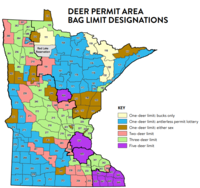
map of Minnesota deer permit areas with bag limit designations

Deer bag limit name changes

Bag-limit labels have been changed to make the limits clearer:

  • "Lottery" is now "antlerless permit lottery" (one-deer limit)
  • "Hunter choice" is now "either-sex" (one-deer limit)
  • "Managed" is now "two-deer limit"
  • "Intensive" is now "three-deer limit"
  • "Unlimited antlerless" is now "five-deer limit"

"Bucks only" remains the same, with the one-deer limit. Areas that were previously under an unlimited antlerless bag limit are now a five-deer limit.


Early antlerless season expands

The DNR has expanded the early antlerless deer season, Oct. 21-24, to include more deer permit areas in central and southeastern Minnesota. The season increases opportunities for hunters in areas where deer populations are above population goals or where there is an increased risk of chronic wasting disease spreading. Permit areas open during the hunt are 213, 214, 215, 221, 227, 236, 277, 341, 342, 343, 604, 605, 643, 645, 646, 647, 648, 649, 655 and 701. Early antlerless permits go on sale Aug. 1.


snapshot of some DPAs with new boundaries for 2021

Check your deer permit area boundary

Several deer permit area boundaries in southwest and northeast Minnesota have changed based input from the public, tribal communities and DNR staff. The permit areas affected are: 169, 171, 173, 179, 184, 197, 237, 259, 275, 276, 277, 281, 282, 283 and 295.

Changes are depicted on the 2021 Deer Season Area Map and hunters should double-check the boundaries of any permit areas where they plan to hunt, as well as bag limits in those areas.

Key CWD changes for the 2021 season

  • Mandatory sampling of deer harvested in chronic wasting disease zones will resume this year during the opening weekends of both firearms A and B seasons.
  • The names of the zones are simplified to three tiers: management zone, control zone and surveillance zone. 
  • The surveillance zone has expanded following detections of the disease in wild and captive deer, adding deer permit areas 110, 184, 197, 233 and 342, and a portion of deer permit area 169.
  • Late chronic wasting disease hunts are scheduled for Dec. 17-19 and Dec. 31-Jan. 2; additional details will be posted on the DNR website closer to hunt dates.

Check out the regulations book (PDF) and the webpage for more information.


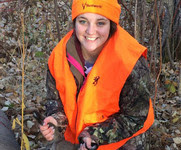
young hunter dressed in blaze orange

Apply for special youth deer hunts

Minnesota has special hunting opportunities for youth deer hunters. There is a limited number of permits for each hunt, with the individual hunts taking place on various dates during the fall in state parks and a national wildlife refuge. Adults must accompany youth during these hunts. Hunters may apply for special youth hunt permits through Friday, Aug. 20. Special youth deer hunts are different from the statewide youth deer season that does not require an application and takes place Oct. 21-24.


statewide map of goal-setting blocks

Deer population goals released

Results of the second year of deer population goal-setting are now available online. This year focused on portions of southwest and northeast Minnesota. Thank you to those of you who participated in the virtual engagement options this year!

Next year will focus on deer permit areas in the northeast, north-central and southeast portions of the state (noted in green in the map) and will start later this winter. Stay tuned for details of when and how you can provide your input for those areas and check out the deer populations and goals webpage for more information.


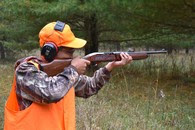
hunter dressed in blaze orange with ear protection

Webinar: How to get certified in firearms safety

Do you know someone who wants to go hunting this fall? Join a chat with DNR conservation officers officers at noon Wednesday, Aug. 4, to discuss Minnesota hunter safety requirements, including how to get certified in firearms safety.

The webinar is part of the Minnesota Outdoor Skills and Stewardship Series that aims to give participants quick, relevant information on upcoming seasons and events, and skills to help enjoy these opportunities. Registration is free.


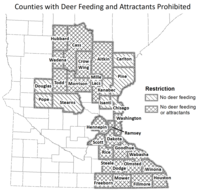
areas where deer feeding and attractant bans are in place

Feeding ban reminder

Feeding and attractant bans are critical in limiting the spread of chronic wasting disease in wild deer. Due to the detection of CWD in Beltrami county, the deer feeding ban is expected to expand to include Beltrami County and neighboring counties this fall.

Currently there are deer feeding or attractant bans in the following counties: Aitkin, Carlton, Cass, Chisago, Crow Wing, Dakota, Dodge, Douglas, Fillmore, Freeborn, Goodhue, Hennepin, Houston, Hubbard, Isanti, Kanabec, Mille Lacs, Morrison, Mower, Olmsted, Pine, Pope, Ramsey, Rice, Scott, Stearns, Steele, Todd, Wabasha, Wadena, Washington and Winona.

Learn more about what you need to do to help our wild deer, and the difference is between feeding and attracting deer, on the deer feeding ban webpage.

Tuesday, July 28, 2020

Minnesota Hunters will have more opportunities to harvest deer this season

Hunters can start planning ahead for the deer season with the release of the 2020 Minnesota Hunting and Trapping regulations handbook, now available on the Minnesota Department of Natural Resources deer hunting page at mndnr.gov/hunting/deer.

“This season, hunters in general will see more chances to harvest deer,” said Barbara Keller, DNR big game program leader. “These opportunities are due to increases in deer populations in much of the state and as part of our response to chronic wasting disease in southern Minnesota.”

Hunting licenses go on sale Saturday, Aug. 1, and are available at any DNR license agent, by telephone at 888-665-4236, or online at mndnr.gov/buyalicense.

The popular youth deer hunting season continues and will happen statewide Oct. 15-18. During last year’s inaugural statewide youth season, nearly 5,700 young deer hunters harvested a deer, which represented a 77 percent increase from the previous season when it was limited to fewer areas.

“Positive early hunting experiences go a long way toward starting or continuing a rewarding fall tradition,” Keller said. “We’re excited to be able to continue providing this great opportunity that helps adults introduce youth to all that deer hunting has to offer.”

Other deer season changes include:

  • The DNR has expanded the early antlerless deer season, Oct. 15-18, to include more deer permit areas in central and southeastern Minnesota. The season increases opportunities for hunters in areas where deer populations are above population goals, or where there is an increased risk of chronic wasting disease spreading. Permit areas open during the hunt are 213, 214, 215, 341, 342, 343, 344, 604, 605, 643, 645, 646, 647, 648, 649 and 655.
  • Several deer permit area boundaries in north-central and northwestern Minnesota have changed due to input from the public and DNR staff during the deer population goal-setting process, or in response to CWD spread. Hunters should double check the boundaries of any permit areas where they plan to hunt.

CWD testing requirements

There are significant changes to the regulations related to chronic wasting disease, as the DNR continues its aggressive management of CWD and also ensuring hunter and staff safety by implementing sampling changes that allow for social distancing and community mitigation measures.

The DNR has created additional CWD testing areas due to the detection of CWD in both wild and captive deer in new areas last year. While sampling is voluntary this season, a move the DNR made to mitigate the risk of spreading coronavirus during the COVID-19 pandemic, the DNR highly encourages hunters in these sampling areas to participate in testing their harvested wild deer. The DNR remains confident that hunter cooperation will allow the agency to detect the disease.

Since fall 2017, the DNR has required hunters to have their deer tested for CWD in certain areas of the state to monitor the disease and discover new areas where it may have spread. Rather than having staffed sampling stations as in the past, the DNR will set up a network of self-service stations where hunters can drop off samples. Full details will be available on the CWD webpage closer to the start of the season.

On July 1, deer feeding and attractant bans were expanded to include the metro area. In addition, due to the spread of CWD, the antler point restrictions in southeastern Minnesota have been temporarily lifted and cross-tagging, also known as party hunting, will be allowed in southeastern Minnesota for antlered bucks.

As in previous years, the DNR is enforcing carcass movement restrictions in disease management and control zones to limit the spread of disease.

Additional regulation changes are detailed on the DNR’s deer hunting webpage at mndnr.gov/hunting/deer.

Wednesday, July 22, 2020

Announcements for Minnesota Deer Hunters

Hunting regulations available

Hunters, you're all set to plan ahead for the fall!

The DNR has released the 2020 Minnesota Hunting and Trapping regulations handbook, now available on the DNR website.

Deer hunters this season will generally see more harvest opportunities. Deer hunting regulations and permit area maps are on the DNR deer hunting page.

Hunting licenses go on sale Saturday, Aug. 1. You can buy your license at any DNR license agent, by telephone at 888-665-4236, or online at mndnr.gov/buyalicense.


Statewide youth deer season continues

The popular youth deer hunting season continues and will happen statewide Oct. 15-18. During last year’s inaugural statewide youth season, nearly 5,700 young deer hunters harvested a deer, which represented a 77% increase from the previous season when it was limited to fewer areas.


Check your deer permit area boundary

Several deer permit area boundaries in north-central and northwestern Minnesota have changed due to input from the public and DNR staff during the deer population goal-setting process, or in response to CWD spread. Hunters should double check the boundaries of any permit areas where they plan to hunt.


a buck in tall grass

Read up on CWD testing changes

There are significant changes to the regulations related to chronic wasting disease, as the DNR continues its aggressive management of CWD and also is ensuring hunter and staff safety by implementing sampling changes that allow for social distancing and community mitigation measures.


Sign up for deer virtual open house

Anyone interested in discussing deer and deer management can tune in to a virtual open house 6-7 p.m. Tuesday, Aug. 18, hosted by the DNR. Registration for the event is required and available on the deer open house webpage. Attendees are encouraged to submit questions in advance on their registration form.


a young hunter holding a deer she harvested

Apply for special youth deer hunts

Check out these special deer hunting opportunities for youth—there are a limited number of permits for each hunt, in state parks and a wildlife area. Adults must accompany youth. Remember to apply for these special hunts (PDF) by the Aug. 14 deadline.

Thursday, July 9, 2020

Minnesota Deer feeding and attractants bans

Feeding and attractant bans are in place across the state to prevent concentrations of wild deer in areas with a higher risk for disease. These bans are precautionary steps the DNR took after deer that tested positive for chronic wasting disease were found both in the wild and on deer farms. Feeding bans encompass wider areas because food sources can concentrate deer and allow for close contact – one of the mechanisms for CWD spread.

  • Deer feeding includes: placement or distribution of grains, fruits, vegetables, nuts, hay and other food that is capable of attracting or enticing deer. 
  • Deer attractants are: natural or manufactured products that are capable of attracting or enticing deer, including salt, minerals, liquid food scents, or any product that contains or claims to contain cervid urine (example “doe in heat”), blood, gland oil, feces or other bodily fluid. 

People who feed birds or small mammals must do so in a manner that prevents deer access. Place the food at least six feet above ground level. Food placed as a result of normal agricultural practices is generally exempt from the feeding ban. Cattle operators should take steps that minimize contact between deer and cattle. (Learn more about unintended effects of feeding deer.)

Thursday, June 25, 2020

Minnesota Deer Notes - June 25, 2020 (Minnesota DNR)

In this issue, we have multiple study updates, details on the expanding deer feeding and attractant bans, notes on the 2019 season harvest report, summaries from the spring deer open houses and a reminder to leave fawns alone when they're on their own.


Deer hunting season information

We hope you’re staying safe and are looking forward to future hunting seasons. Currently, there are no changes to upcoming hunting season dates. As with any evolving situation, this is subject to change, so stay tuned to the DNR channels (including the DNR’s COVID-19 response webpage, through social media and also in this newsletter) for any adjustments.

As we move closer to the deer hunting season, it’s also a good time to talk about how the outdoors are for all. We encourage you to do your part to keep the outdoors safe and welcoming to everyone: people of every color, people with disabilities, and of all backgrounds, genders, traditions and experience levels.

Please check out our learn-to-hunt information and share with people who might be interested in trying hunting out: it’s available for anyone who wants to learn more about archery deer hunting or firearms deer hunting. For non-hunters, we also encourage people to check the DNR Recreation Compass to discover ways and places to find outdoor adventures.


Map of Minnesota counties under a feeding and/or attractant ban

Keep our deer herd healthy by following deer feeding and attractant bans

Have you heard? Starting July 1, six additional counties will be added to deer feeding and attractant bans after the discovery of chronic wasting disease in a wild deer in Dakota County. Feeding and attracting deer will not be allowed in Dakota, Hennepin, Ramsey, Rice, Scott and Washington counties. These bans are an important part of the DNR’s response to CWD — limiting close contact between deer helps prevent the spread of the fatal disease. Learn more about what you need to do to help our wild deer, and a full list of the counties included, on the deer feeding ban webpage.


Update: Neonicotinoid study

Thank you to all of the hunters who submitted spleens for Minnesota Deer Neonictinoid Project! Nearly 800 spleens were sent in from across the state. Check out this map to see the spatial distribution of all of the spleens.

All teeth and spleen samples are at currently at their respective labs for diagnostics and we are patiently waiting on results. We expect all diagnostic results to come in at the end of summer.

For any questions, please contact Patrick Hagen at patrick.hagen@state.mn.us or 651-395-0077.


Deer open house conversation recap

Wondering what issues came up at deer open houses earlier this year? Summaries for each area are now posted on the deer open house webpage. Stay tuned for details for how you can participate in a deer open house this August!


Map showing the path of a doe fawn that has moved north from Fillmore County, through Olmsted County, to Wabasha County

Update: Southeast deer movement study

DNR biologists continue to monitor the 28 deer (19 does, 9 bucks) collared in 2019 and the additional 46 fawns (27 does, 19 bucks) collared in February 2020.

Currently, DNR biologists are watching for spring dispersal of deer, which usually happens between April and July as fawns leave their birthplaces to establish their own adult home ranges. Based on past years' results, we expect that nearly half of the fawns will have moved away from their birthplaces by the end of July.

While most fawns' travels average 11 miles, some move farther. One doe fawn, collared near Chatfield this February, has moved about 30 miles so far. This week, she was tracked near Hammond. That dispersal movement is shown on this map.

Learn more and watch for updates on the newly updated study webpage.


2019 season harvest report now available

The full 2019 harvest report can be downloaded on the deer reports and statistics webpage. Some key takeaways:

  • A total of 187,587 deer were harvested last season.
  • During the inaugural statewide youth season, 5,829 deer were harvested.
  • Overall, the season was very similar to the 2018 season, with comparable total number harvested and success rates. A total of 101,910 antlered bucks and 85,677 antlerless deer were harvested in 2019. There was an 8% increase in antlered buck harvest and 9% decrease in antlerless deer harvest compared to last year.

Fawn curled up in vegetation (close-up)

Let fawns be

Most fawns are born from mid-May to mid-June, so please avoid disturbing them. Fawns do not attempt to evade predators during their first few weeks of life. Instead, they remain still to avoid being seen. During these times, fawns are learning critical survival skills from their mothers but are often left on their own while their mothers are foraging nearby. Be assured deer fawns do fine even if they look abandoned or fragile.

Friday, November 4, 2011

Minnesota Hunters must register deer in person in CWD management and surrounding zones

Distribution of Chronic Wasting Disease in the...Image via Wikipedia
Minnesota deer hunters who harvest a deer in and adjacent to the area’s Chronic Wasting Disease (CWD) Management Zone must register their deer in person at check stations located throughout the area. Registration is necessary so the DNR can extract a lymph node tissue sample for CWD testing.

Hunters who harvest deer within the CWD Management Zone (deer permit area 602) cannot remove the carcass from the zone until a CWD-negative test result is reported. Testing typically takes three business days to complete and results can be accessed by hunters online.

Some deer parts can be moved outside the deer permit area 602 without a negative CWD test result. These parts include:
  • Meat that is boned out or that is cut and wrapped, either commercially or privately.
  • Quarters or other portions of meat with no part of the spinal column or head attached.
  • Antlers or clean (no brain tissue attached) skull plates with antlers attached.
  • Finished taxidermy mounts.

Hunters planning to eventually transport a deer out of the CWD zone should plan ahead and secure a place to store their deer while awaiting test results. Some venison processors may not take deer until a CWD test is completed.

Erdman’s County Market in Kasson has offered to store deer carcasses for hunters awaiting CWD test results, but individuals will need to discuss available space and charges with store management.

Other deer permit areas where in-person registration is required for CWD testing but carcass movement restrictions are not in place are areas 233, 293, 341, 342, 343 and 344. Electronic registration via telephone or Internet is not available in these areas.

Check stations will be open from 9 a.m. to 7 p.m. throughout the nine-day firearms season, which begins Saturday, Nov. 5, and concludes Sunday, Nov. 13.

Stations within the CWD zone are located at Greenway Co-op, Pine Island; Archery HQ, Rochester; Gander Mountain, Rochester; Hardware Hank, Kasson; and Neptune Bar & Grill, Zumbro Falls.

Stations outside the CWD zone are located at Mills Fleet Farm, Owatonna; Holiday Station, Faribault; Bohman Venison Processing, Owatonna; Dennison Depot, Dennison; Nerstrand Big Woods State Park; Jerry’s Ace Hardware, Kenyon; Northside Bait & Tackle, Cannon Falls; Althoff Hardware, Cannon Falls; Quality Hardware, Wannamingo; 4 Season Sports, Red Wing; Wise Ace Hardware, Lake City; Big Bear Get N Go, Lake City; Becklund’s Auto Repair, Millville; Prairie Bait, Wabasha; River Valley Outfitters, Wabasha; Eagle View Bar & Grill, Minneiska; Kreofsky’s Building Supply, Planview; Elba Valley Express, Elba; Maurer Brothers Tavern, Elba; Good Sports Tavern, St. Charles; Mills Fleet Farm, Rochester; and MSX Nexgen, Chatfield.

CWD was discovered in one hunter harvested deer near Pine Island last fall. Since then, DNR has taken steps to determine the potential extent of the disease and significantly decrease deer populations in the area to limit the potential spread of CWD.

Complete information about CWD and DNR efforts to manage it is availableonline.