Showing posts with label venison. Show all posts

Thursday, October 9, 2014

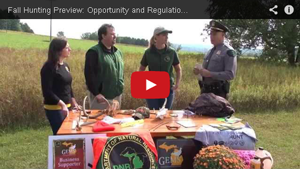
Fall Hunting Preview: Opportunity and Regulations Roundtable


Video player thumbnail imageAre you up to speed on the deer hunting regulations for this season? Curious about the additional hunting opportunities available to you this fall? Ever wonder about the most common hunting violations that conservation officers see? These issues and more are covered in our latest video, Fall Hunting Preview: Opportunity and Regulations Roundtable. So sit back with a warm beverage on a cool fall afternoon to watch the video from beginning to end, or click the times listed in the video description to view individual topics that catch your interest. 
English: crop of File:Bgforhunting.jpg Taken b...


Also, don't forget to tweet your harvest photos this deer season using the hashtag #MiDeerPic, or share your favorite hunting memories and mentoring experiences using the hashtag#MoreToTheHunt, because there is always more to the hunt than the harvest!

Finally, we encourage Michigan hunters to support Sportsmen Against Hunger when you purchase your license this hunting season. Just tell your license vendor you would like to donate to MSAH. Your donation will be used to help process venison donated to the program. Hunters can also support the program by donating a legally taken deer to one of the supporting processors across the state. Each year venison processed through this program helps provide a healthy source of protein in over 100,000 meals. For more information go to www.sportsmenagainsthunger.org. Let’s keep this important tradition of helping others that need a hand going and growing stronger.

Thursday, April 17, 2014

More than 90,000 pounds of donated venison sent to food pantries statewide in 2013

Venison Steaks 29,80 p/kg @ Baars Poelier, Mar...

 Hunters, meat processors and food pantries helped the Wisconsin Department of Natural Resources and its partners donate more than 90,000 pounds of venison to those in need in 2013.
"We are very proud to be part of this community-based program," said DNR Secretary Cathy Stepp. "Anytime we can have a safe, successful deer hunt and donate valuable food to our pantries it's a win-win for Wisconsin."
More than 2,000 deer were donated through the DNR deer donation program and processed packages of ground venison were distributed to food pantries statewide. The number of deer donated decreased by 27 percent compared to 2012, likely a result of fewer deer harvested.
"Regardless of the number of deer donated, the program is always considered a success," said DNR wildlife damage biologist Dan Hirchert.
"The deer donation program was designed to provide an outlet for surplus deer - whether hunters consume their own deer or donate to those in need, the meat is being put to great use," Hirchert said.
Since the program began in 2000, hunters have donated more than 85,000 deer and more than 3.8 million pounds of venison. The collected meat is distributed to Wisconsin families in need of food assistance. The program relies on cooperation with counties across the state, U.S. Department of Agriculture-Wildlife Services and community programs like Hunt for the Hungry and Target Hunger. These organizations help organize donations, coordinate processing, and distribute venison.
For more information about the DNR's deer donation program and more on how people can help, search the DNR website dnr.wi.govfor keywords "deer donation."

Monday, September 16, 2013

Help feed the hungry with donation to Michigan Sportsmen Against Hunger

Venison Steaks 29,80 p/kg @ Baars Poelier, Mar...
Venison Steaks. (Photo credit: Wikipedia)
The Department of Natural Resources has made changes to the license sales system, making it easier for hunters and anglers to automatically add $1 to their license purchase as a donation to Michigan Sportsmen Against Hunger (MSAH) - a program that supports the processing and distribution of venison to food banks and kitchens in Michigan.
Anyone can be a part of this ongoing effort to help those in need. Last year more than 26,000 pounds of donated venison was processed using funds provided through this donation program. The ground venison was then passed on to local food banks and food kitchens throughout Michigan. “It was enough venison to supply over 100,000 meals with a source of nutritious protein,” said Raymond Rustem, DNR contact for Michigan Sportsmen Against Hunger. “With the new system, if just one out of 10 hunters each donated $1 this year we could easily double or triple that amount.”
Donating is easier than ever. When making a license purchase, interested hunters and anglers should let the license agent know that they would like to donate $1 to help Michigan Sportsmen Against Hunger. The license agent will automatically add $1 to the license purchase total. If making the license purchase online, the buyer should click “Yes” when asked to donate to Sportsmen Against Hunger.
“Today, we have the opportunity to continue a tradition started by hunters before us, who hunted to provide food for early settlements in Michigan," said Dean Hall, president of Michigan Sportsmen Against Hunger. "Hunter donations of funds or venison can help those who are experiencing hard times.”
To donate a deer, get more information about the program or find the nearest processor, visit the MSAH website at www.sportsmenagainsthunger.org.
Individuals who do not fish or hunt can also support this program. Visit the Michigan estore www.michigan.gov/estore, click on “Tax deductible donations” and then on "Help Feed the Hungry" and fill in the information about the donation.
Donors are reminded to save any receipts or forms. Donations to Michigan Sportsmen Against Hunger can be used when itemizing income deductions on federal tax forms.
"Many people continue to struggle in this economy," said Rustem. "Donating to this important effort is a simple way to help."

Since 1991, Michigan Sportsmen Against Hunger has been working to create linkages among donors, wild game processors and charities that feed needy individuals. MSAH is an all-volunteer organization and is led by sportsmen and women concerned about making a positive difference in the community. Together, they have assembled a network of processors and charities across Michigan to help channel wild game donations into the hands of those in need.

Sunday, April 28, 2013

More than 140,000 pounds of donated venison goes to food pantries statewide in Wisconsin


An increasing number of hunters and meat processors from all around the state donated their deer and volunteered their time to provide venison to people in need in 2012.
More than 3,000 deer were donated through the Wisconsin Department of Natural Resources deer donation program, which were then processed and distributed to food pantries statewide.
Participation in the donation program was up 8 percent over 2011, likely a result of increased hunter turnout.
“This year was a success thanks to the generosity of participating hunters, meat processors and volunteers alike,” said Noah Balgooyen, DNR Wildlife Damage Program biologist. “Over 140,000 pounds of ground venison was distributed to Wisconsin families in need of food assistance.”
Since the program started in 2000, hunters have donated over 80,000 deer, totaling more than 3.5 million pounds of venison. The program relies on cooperation with counties across the state, USDA-Wildlife Services, and community programs such as Hunt for the Hungry and Target Hunger Venison Donation program who help organize the donations, the processing, and ultimately the delivery to food pantries.
For more information about the DNR’s deer donation program and how you can help, search the DNR website for keywords “deer donation.”

Friday, January 27, 2012

Ohio: Investigation Leads to Guilty Plea for Miami County Deer Processor

Map of Ohio highlighting Miami County
Image via Wikipedia

NEW CARLISLE, OH –An investigation into the selling of venison by Happy Jack’s deer processing recently resulted in a guilty plea in the Miami County Municipal Court, according to the Ohio Department of Natural Resources (ODNR) Division of Wildlife.
Division of Wildlife law enforcement received information that Happy Jack’s was selling deer meat contrary to Ohio Administrative Code. The Division of Wildlife initiated a plain clothes investigation.  On multiple occasions during the investigation Happy Jack’s sold deer summer sausage and trail sticks to a Division of Wildlife Investigator.  A search warrant was obtained for Happy Jack’s facility and a large amount of deer meat in various stages of processing as well as records and a computer were seized and held as evidence.

On December 19, 2011 Jack W. Orth 68, New Carlisle, owner and operator of Happy Jack’s, pled guilty to wildlife charges stemming from a 2011 investigation into the selling of deer meat. Mr. Orth along with his attorney appeared in the Miami County Municipal Court before Judge Elizabeth Gutmann and pled guilty to one charge of the sale of deer meat and guilty to one charge of failing to keep accurate records.  As part of the sentence, Judge Gutmann ordered a $50 fine on each charge plus court costs, restitution in the amount of $350 and she also ordered that the deer meat seized during the search warrant be forfeited to the Bethany Center in Piqua, Ohio.

Also charged in the investigation was Benjamin J Campbell 25, of Huber Heights, Ohio with sale of deer meat.  Benjamin Campbell appeared in the Miami County Municipal Court before Judge Mel Kemmer and pled guilty to the sale of deer meat.  Judge Kemmer ordered a $25 fine plus court costs.

On January 13, 2012 approximately 521 packages of deer trail sticks and summer sausage as well as 698 pounds of ground venison were donated to the Bethany Center located at 339 South Street, Piqua, Ohio 45356 (937)615-9762. The Bethany Center is an ecumenical non-profit organization whose purpose is to serve those in need. Their services include a soup kitchen, food pantry, and clothing bank.

A portion of the 698 pounds seized in the case had not been processed. Through the generosity of Ted Davis, Davis Meats in Sidney, and the Shelby County Chapter of Whitetails Unlimited the processing costs and labor were covered and the processing of the venison completed.

Anonymous tips to the county wildlife officer from concerned hunters sparked the undercover investigation into illegal activities at Happy Jack’s. Hunters can also report wildlife violations to through the Turn-In-A-Poacher (TIP) Program. Established in 1982 TIP allows Ohioans to call a toll-free number from anywhere in the state to report wildlife violations.  Calls regarding wildlife violations can be placed anonymously at 1-800-POACHER (800-762-2437). 

Thursday, January 26, 2012

Adams County Ohio Food Pantry Receives Venison Donation

Venison Steaks 29,80 p/kg @ Baars Poelier, Mar...
Image via Wikipedia

WEST UNION, OH – The Southwest Ohio Chapter of Safari Club International (SCI) along with Adams County Farmers and Hunters Feeding the Hungry (FHFH) and the Ohio Department of Natural Resources (ODNR) Division of Wildlife donated venison to help needy families in Adams County today. 

Hunters wishing to donate their deer to a food bank or outreach center are, in most cases, required to pay for the processing of the venison.  Organizations such as SCI and FHFH partner with private meat processors to help absorb the cost of deer processing in many communities.

These efforts have resulted in a large donation of venison to the Second Blessing Food Pantry located in West Union, OH.  The donation totaled about 750 lbs. of ground venison. The two organizations have made donations in Adams County totaling 2000 lbs. during 2011-2012 with future donations planned. Food pantries generally receive very little red meat donations and venison is a healthy low in cholesterol alternative.
Hunters in Ohio still have time to harvest multiple deer during the 2011-2012 deer seasons.  For more information on donating venison, visit www.wildohio.com. For information about SCI or FHFH visitwww.sciswo.org or http://www.fhfh.org/Home.asp

Thursday, December 1, 2011

From field to freezer the right way

Field Dressing of a White-tailed Deer. Hiawath...
Image via Wikipedia
A hunter will tell you that the freezer full of meat that a harvested deer provides throughout the year is one of the most rewarding aspects of the deer hunting experience. It’s not difficult to take a deer from the field to the freezer, but some care and effort is required. 
            First and foremost, hunters must be properly licensed. To hunt deer in Oklahoma, residents must possess an appropriate hunting license. Additionally, hunters must carry a valid deer license for each deer hunted. Nonresident deer hunters are exempt from a hunting license while hunting deer, but they must possess an appropriate nonresident deer license or proof of exemption. Holders of nonresident lifetime hunting and combination licenses are not exempt from purchasing deer licenses. Licenses are available online at wildlifedepartment.com or at sporting goods dealers and other businesses across the state. 
            Upon harvesting a deer, all hunters, including lifetime license holders, must immediately attach their name and hunting license number as well as the date and time of harvest to their deer. The attached item can be anything, such as a business card, as long as it contains the required information and remains attached to the carcass until it is checked. In addition, all annual license holders are required to complete the “Record of Game” section on their license form. 
            All deer must be checked at the nearest open hunter check station, with an authorized Wildlife Department employee or online at wildlifedepartment.com within 24 hours of leaving the hunt area. Once checked, the deer will be issued a carcass tag or online confirmation number, which must remain with the carcass to its final destination or through processing and storage at commercial processing or storage facilities.
            Deer should be field-dressed, or “hog-dressed,” as soon as possible to prevent spoilage of the meat. After field dressing, hunters may opt to butcher their own deer or have a reputable meat processor prepare it for them. In either case, the meat should be kept clean, cool and dry until it reaches the freezer. 
            “The second you harvest that deer, the clock starts ticking,” said Lance Meek, hunter education coordinator for the Wildlife Department. “You need to get it cleaned and cool as soon as possible. Dirt, heat and moisture are three things you’ll want to keep away from and off of your deer meat all the way through field dressing and processing. The better you care for your venison in the hours immediately after a harvest, the better it will taste throughout the coming year when you go to the freezer for a cut of venison for the dinner table.”
            To learn more about deer hunting in Oklahoma, log on to wildlifedepartment.com.

Tuesday, November 29, 2011

WI: Lots of hunting left, many antlerless deer permits available, consider donating venison


“What a great opening weekend!” Kurt Thiede, DNR administrator
MADISON – “’Trophy’ can mean different things to different people; whether it’s the buck of a lifetime, a young buck, a first deer or an antlerless deer,” said Kurt Thiede, Department of Natural Resources administrator of the wildlife management program. “The important thing is that folks participated this past weekend and many were successful…that is what will keep our hunting tradition strong in this state.”
With another five days left in the popular gun deer season that includes what is a long Thanksgiving weekend for many people, there is a lot of hunting opportunity left according to Thiede. The traditional nine-day gun hunt runs through Sunday Nov. 27.
“If you hunt in an area where you saw a lot of antlerless deer on opening weekend, which may be in the chronic wasting disease management zone or in a herd control unit and you have an antlerless tag available, please consider filling that tag,” says Thiede. “Many units still have antlerless tags available and they can be purchased from our license vendors. In addition to the rest of this regular deer gun season, we also have the four-day early December antlerless gun hunt, the 10-day muzzleloader hunt, the late archery season, and in the CWD zones - the Holiday hunt. Food pantries are looking for donations.”
Thiede encourages hunters to donate deer to the state’s venison donation program. Early donations are running slower than in past years – perhaps because of having no earn-a-buck this year -- but demand is strong for the high quality food. Wisconsin meat processors and civic groups all across Wisconsin participate in the program. There is no cost to hunters other than transporting a deer carcass to a registration station and then to a participating processor.
“Your harvest can be donated to help feed the hungry or, it could mean a little extra free range and lean meat for your freezer, or maybe some always popular venison sausage,” says Thiede. “Also, it truly helps keep our valuable deer herd in balance and healthy.
Jerry Stoddard, owner of Stoddard Country Grove Market in Cottage Grove, and Dick Dickman, owner of Dick’s Quality Meats in Mt. Horeb, participate in the pantry donation program which provides venison to local food pantries.
“In the past, people have been really good about donating,” Dickman said. This fall, Dickman said that the number of deer being brought to his market during archery season have been good. “They’re out there,” said Dickman. “And they’re all big deer.”
Once the venison is processed, community groups assist in distributing the packages of ground venison to food pantries
Michelle Friedrich with the Southwest Community Action Partnership (SWCAP) in Dodgeville and the Target Hunger point person stresses the need for deer donation. “Being able to provide venison to needy families helps to fill a very real need,” she said. “When we have venison, it flies out the door.” Last year, Target Hunger received more than 58,000 pounds of venison from 1,300 donated deer. Their goal is to reach 2,000 deer donations this season.
list of participating processors is available online. Hunters are encouraged to call ahead to check business hours and if the processor has space available.
Pantry donation locations within the Chronic Wasting Disease Management Zone (CWD-MZ) will also sample and register deer. The DNR recommends that hunters who wish to donate a deer that was harvested in the CWD-MZ take it to a processor who operates within the CWD-MZ as well.
“We skin them, bone them and freeze them in crates with the registration tags,” says Stoddard of a testing process that determines if the deer has CWD. If the test is negative the meat is ground into hamburger for distribution or if positive it is disposed of in an approved manner.
“It’s a great program and food pantries really, really appreciate it,” says Dickman who gives all of his donated venison to SWCAP. “It’s all being done right,” he adds.
“With the big opening day behind us, and as we look ahead to the rest of the fall and winter, please consider taking to the field with family and friends to extend the tradition a while longer,” says Thiede. “So as this deer season rolls on I wish you all a very Happy Thanksgiving, and of course….Go Packers, Go Badgers, and Go Hunting!”

Friday, November 4, 2011

Minnesota venison donation program available for deer hunters in 2011

A white-tailed deerImage via Wikipedia
Program allows hunters to donate venison to Minnesota food shelves

With thousands of Minnesota deer hunters preparing for the start of the firearms season this weekend, the Minnesota Hunter Harvested Venison Donation Program is once again gearing up to provide hunters with the option to donate venison to help feed hungry Minnesotans.

The venison donation program is operated by the Minnesota Department of Agriculture (MDA) in partnership with the Minnesota Department of Natural Resources (DNR) and state food shelves.

The program provides a source of protein to people in need while helping reduce local deer populations. Minnesota hunters donated 556 deer to the program in 2010, which provided 19,725 pounds of processed venison to Minnesota food shelves.

To be eligible to donate venison to the program, hunters must have their deer processed at a state-registered meat processing plant that has agreed to participate in the program.

A list of processors can be found on the “In The Spotlight” section of the main MDA website. Hunters are strongly advised to contact the processor before bringing in a deer to make sure they are still able to handle the animal. Only entire carcasses with the hide attached can be donated. Cut and wrapped meat will not be accepted for donation. Hunters and processors must also adhere to specific standards designed to prevent food-borne illness.

Processors may only accept carcasses for donation that are:
  • Free from signs of illness;
  • Field dressed with the hide intact;
  • Free of visible decomposition or contamination; and
  • Properly identified with a Minnesota DNR registration tag.

Processors will reject deer for the donation program that appear to have been mishandled in any way.

Monday, September 26, 2011

Hunters Encouraged to Donate Venison in Northeast Ohio


AKRON, OH - Farmers and Hunters Feeding the Hungry (FHFH), a ministry that provides nutritious venison to the hungry through food banks and local feeding programs now has eleven participating coordinators in Northeast Ohio. FHFH helps hunters return to their heritage as food-providers by transforming deer - renewable resources- into meals for the hungry.
Hunters in Northeast Ohio can contact the following coordinators to arrange deer donations at participating butchers. Hunters may also find information on 20 northeast Ohio drop-off locations at www.fhfh.org.
Ashland CountyDarrell Christine, 419-571-9839, darrellchris@hotmail.com
Ashtabula, Geauga & Lake counties: Jason Traggiai, 440-548-5904,traggiai@windstream.net
Carroll County: Mark Oboy, 740-269-3024, mvoboy@eohio.net  
Columbiana, Mahoning, & Trumbull counties: Carol Bretz, 330-424-7221, ext. 101,bretz@caaofcc.org
                         
Cuyahoga, Erie, & Lorain counties: Pete Banks, 440-988-5495pete@fhfh.org   
Holmes County: Dustin Taylor, 330-231-3295, DustinMTaylor@gmail.com
Portage County: David Walstad, 330-256-1368, northernohiofhfh@yahoo.com 
Stark County: TimothyWedekamm330-705-9260TWedekamm@neo.rr.com
Trumbull CountyRobert Hanusosky, 330-583-0088,rublinehunter@aol.com
Tuscarawas CountyDeweyThompson, 740-502-5568, dl-thompson@sbcglogal.net
Wayne CountyFred Bradford & Dennis Derflinger, Fred 330-201-4117, Dennis 330-464-0284 fjbradfordllc@gmail.comderfsdv@sssnet.com           
Successful hunters donate deer to partnering butcher shops that are licensed and inspected by the health department or USDA. Regional food banks as well as local feeding programs and ministries that feed the hungry pick up the packaged, frozen meat from the butcher shop. Local FHFH chapters raise money to cover the butchering costs so that hunters can donate their deer free of charge. FHFH then matches that amount with grant monies from Division of Wildlife.
           
FHFH began in 1997 and blossomed from one Maryland County to over half of the states in the nation. Since its inception, FHFH has provided nutritious meat for millions of meals to the food banks and agencies that serve the poor across the country. FHFH is a 501(c)(3) organization. All contributions are tax-deductible as allowed by law.
Anyone interested in becoming a local Ohio FHFH coordinator or a participating meat processor should visit the "Local FHFH" page at www.fhfh.org.