Thursday, July 29, 2021

Operation Deer Watch Launches Aug. 1 Wisconsinites Collect Scientific Data To Inform Deer Management


MADISON, Wis. – The Wisconsin Department of Natural Resources (DNR) will launch Operation Deer Watch on Aug. 1, allowing citizen scientists around Wisconsin to report deer sightings in their area, which provides crucial data for deer management.

Participation in Operation Deer Watch is simple, requires no registration and can be done using a computer or mobile device. DNR researchers ask participants to report deer sightings, including bucks, does and fawns, between Aug. 1 and Sept. 30 via an easy-to-use online form.

Data collected provides insights into the reproductive status of Wisconsin's deer herd and helps shape deer management for the state.

Many participants carry a printable tally sheet with them in the car to record sightings and then enter their results online later. For safety, participants should only record sightings when their vehicle is stopped, not while driving.

"This is a fun and useful opportunity for everyone to enjoy Wisconsin's plentiful wildlife," said Brian Dhuey, DNR Wildlife Population And Harvest Assessment Specialist. "The DNR encourages everyone interested in deer, from hunters and trappers to outdoor enthusiasts, to take part."

County Deer Advisory Councils also use data from the survey to develop deer season framework, harvest quotas and permit level recommendations.

Learn more about Operation Deer Watch by visiting the DNR webpage here.

Minnesota Deer Notes

Deer hunting season details available

Ready to plan ahead for the fall? Check out the details for the 2021 season in the Minnesota Hunting and Trapping regulations handbook, now available on the DNR website. Printed copies of the handbook will be delivered to hunting license vendors the first week of August.

Hunting licenses go on sale Sunday, Aug. 1. You can buy your license at any DNR license agent, by telephone at 888-665-4236, or online at mndnr.gov/buyalicense.

Archery deer season opens S

Saturday, Sept. 18, and firearms deer season opens Saturday, Nov. 6. Find out more on the deer hunting page.


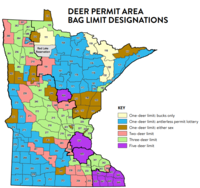
map of Minnesota deer permit areas with bag limit designations

Deer bag limit name changes

Bag-limit labels have been changed to make the limits clearer:

  • "Lottery" is now "antlerless permit lottery" (one-deer limit)
  • "Hunter choice" is now "either-sex" (one-deer limit)
  • "Managed" is now "two-deer limit"
  • "Intensive" is now "three-deer limit"
  • "Unlimited antlerless" is now "five-deer limit"

"Bucks only" remains the same, with the one-deer limit. Areas that were previously under an unlimited antlerless bag limit are now a five-deer limit.


Early antlerless season expands

The DNR has expanded the early antlerless deer season, Oct. 21-24, to include more deer permit areas in central and southeastern Minnesota. The season increases opportunities for hunters in areas where deer populations are above population goals or where there is an increased risk of chronic wasting disease spreading. Permit areas open during the hunt are 213, 214, 215, 221, 227, 236, 277, 341, 342, 343, 604, 605, 643, 645, 646, 647, 648, 649, 655 and 701. Early antlerless permits go on sale Aug. 1.


snapshot of some DPAs with new boundaries for 2021

Check your deer permit area boundary

Several deer permit area boundaries in southwest and northeast Minnesota have changed based input from the public, tribal communities and DNR staff. The permit areas affected are: 169, 171, 173, 179, 184, 197, 237, 259, 275, 276, 277, 281, 282, 283 and 295.

Changes are depicted on the 2021 Deer Season Area Map and hunters should double-check the boundaries of any permit areas where they plan to hunt, as well as bag limits in those areas.

Key CWD changes for the 2021 season

  • Mandatory sampling of deer harvested in chronic wasting disease zones will resume this year during the opening weekends of both firearms A and B seasons.
  • The names of the zones are simplified to three tiers: management zone, control zone and surveillance zone. 
  • The surveillance zone has expanded following detections of the disease in wild and captive deer, adding deer permit areas 110, 184, 197, 233 and 342, and a portion of deer permit area 169.
  • Late chronic wasting disease hunts are scheduled for Dec. 17-19 and Dec. 31-Jan. 2; additional details will be posted on the DNR website closer to hunt dates.

Check out the regulations book (PDF) and the webpage for more information.


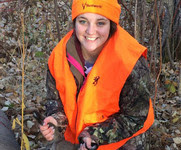
young hunter dressed in blaze orange

Apply for special youth deer hunts

Minnesota has special hunting opportunities for youth deer hunters. There is a limited number of permits for each hunt, with the individual hunts taking place on various dates during the fall in state parks and a national wildlife refuge. Adults must accompany youth during these hunts. Hunters may apply for special youth hunt permits through Friday, Aug. 20. Special youth deer hunts are different from the statewide youth deer season that does not require an application and takes place Oct. 21-24.


statewide map of goal-setting blocks

Deer population goals released

Results of the second year of deer population goal-setting are now available online. This year focused on portions of southwest and northeast Minnesota. Thank you to those of you who participated in the virtual engagement options this year!

Next year will focus on deer permit areas in the northeast, north-central and southeast portions of the state (noted in green in the map) and will start later this winter. Stay tuned for details of when and how you can provide your input for those areas and check out the deer populations and goals webpage for more information.


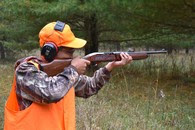
hunter dressed in blaze orange with ear protection

Webinar: How to get certified in firearms safety

Do you know someone who wants to go hunting this fall? Join a chat with DNR conservation officers officers at noon Wednesday, Aug. 4, to discuss Minnesota hunter safety requirements, including how to get certified in firearms safety.

The webinar is part of the Minnesota Outdoor Skills and Stewardship Series that aims to give participants quick, relevant information on upcoming seasons and events, and skills to help enjoy these opportunities. Registration is free.


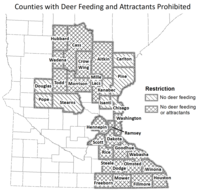
areas where deer feeding and attractant bans are in place

Feeding ban reminder

Feeding and attractant bans are critical in limiting the spread of chronic wasting disease in wild deer. Due to the detection of CWD in Beltrami county, the deer feeding ban is expected to expand to include Beltrami County and neighboring counties this fall.

Currently there are deer feeding or attractant bans in the following counties: Aitkin, Carlton, Cass, Chisago, Crow Wing, Dakota, Dodge, Douglas, Fillmore, Freeborn, Goodhue, Hennepin, Houston, Hubbard, Isanti, Kanabec, Mille Lacs, Morrison, Mower, Olmsted, Pine, Pope, Ramsey, Rice, Scott, Stearns, Steele, Todd, Wabasha, Wadena, Washington and Winona.

Learn more about what you need to do to help our wild deer, and the difference is between feeding and attracting deer, on the deer feeding ban webpage.

Friday, June 18, 2021

Wisconsin DNR Confirms CWD In Green Lake County Wild Deer; New Baiting And Feeding Ban In Effect


BROOKLYN, Wis. – The Wisconsin Department of Natural Resources (DNR) has confirmed a wild deer tested positive for chronic wasting disease (CWD) in Green Lake County. The CWD-positive deer was an adult deer found dead in the Town of Brooklyn in early May 2021. This is the first wild deer that has tested positive for CWD in Green Lake County, and its location is also within ten miles of adjacent Fond du Lac, Winnebago and Waushara counties.

With this new CWD-detection, Winnebago County is now considered a CWD-affected county. As required by state law, the DNR will enact a new two-year ban on baiting and feeding of deer in Winnebago County effective July 1, 2021. State law requires the DNR to enact a ban on feeding and baiting deer in counties or portions of counties within a ten-mile radius of a wild or farm-raised deer that tests positive for CWD or tuberculosis.

Green Lake, Fond du Lac and Waushara counties are already identified as CWD-affected counties and already have baiting and feeding bans in place. This new CWD-positive detection will renew a three-year baiting and feeding ban in Green Lake County and two-year bans in Fond du Lac and Waushara counties.

"We are committed to working closely with local communities, including the citizen-based County Deer Advisory Councils as we explore future management options for this disease in Green Lake and the surrounding counties,” said Daniel Lekie, DNR Wildlife Supervisor.

In response to the detection of this CWD-positive wild deer, the DNR will:

  • Coordinate swiftly with County Deer Advisory Council members from the counties impacted by this detection to discuss response actions, including issuance of CWD surveillance permits this winter.
  • Determine surveillance activities to assess disease distribution and prevalence to also include:
    • Encouraging reporting of sick deer
    • Sampling vehicle-killed adult deer when feasible
    • Sampling adult deer harvested under agricultural damage permits
  • Encourage hunters to follow recommendations to help prevent the spread of CWD.

More information regarding baiting and feeding regulations and CWD in Wisconsin is available on the DNR’s baiting and feeding regulations webpage.

More information on how to have deer tested during the upcoming 2021-22 Wisconsin hunting seasons is available on the DNR’s sampling for chronic wasting disease webpage.

Tuesday, July 28, 2020

Minnesota Hunters will have more opportunities to harvest deer this season

Hunters can start planning ahead for the deer season with the release of the 2020 Minnesota Hunting and Trapping regulations handbook, now available on the Minnesota Department of Natural Resources deer hunting page at mndnr.gov/hunting/deer.

“This season, hunters in general will see more chances to harvest deer,” said Barbara Keller, DNR big game program leader. “These opportunities are due to increases in deer populations in much of the state and as part of our response to chronic wasting disease in southern Minnesota.”

Hunting licenses go on sale Saturday, Aug. 1, and are available at any DNR license agent, by telephone at 888-665-4236, or online at mndnr.gov/buyalicense.

The popular youth deer hunting season continues and will happen statewide Oct. 15-18. During last year’s inaugural statewide youth season, nearly 5,700 young deer hunters harvested a deer, which represented a 77 percent increase from the previous season when it was limited to fewer areas.

“Positive early hunting experiences go a long way toward starting or continuing a rewarding fall tradition,” Keller said. “We’re excited to be able to continue providing this great opportunity that helps adults introduce youth to all that deer hunting has to offer.”

Other deer season changes include:

  • The DNR has expanded the early antlerless deer season, Oct. 15-18, to include more deer permit areas in central and southeastern Minnesota. The season increases opportunities for hunters in areas where deer populations are above population goals, or where there is an increased risk of chronic wasting disease spreading. Permit areas open during the hunt are 213, 214, 215, 341, 342, 343, 344, 604, 605, 643, 645, 646, 647, 648, 649 and 655.
  • Several deer permit area boundaries in north-central and northwestern Minnesota have changed due to input from the public and DNR staff during the deer population goal-setting process, or in response to CWD spread. Hunters should double check the boundaries of any permit areas where they plan to hunt.

CWD testing requirements

There are significant changes to the regulations related to chronic wasting disease, as the DNR continues its aggressive management of CWD and also ensuring hunter and staff safety by implementing sampling changes that allow for social distancing and community mitigation measures.

The DNR has created additional CWD testing areas due to the detection of CWD in both wild and captive deer in new areas last year. While sampling is voluntary this season, a move the DNR made to mitigate the risk of spreading coronavirus during the COVID-19 pandemic, the DNR highly encourages hunters in these sampling areas to participate in testing their harvested wild deer. The DNR remains confident that hunter cooperation will allow the agency to detect the disease.

Since fall 2017, the DNR has required hunters to have their deer tested for CWD in certain areas of the state to monitor the disease and discover new areas where it may have spread. Rather than having staffed sampling stations as in the past, the DNR will set up a network of self-service stations where hunters can drop off samples. Full details will be available on the CWD webpage closer to the start of the season.

On July 1, deer feeding and attractant bans were expanded to include the metro area. In addition, due to the spread of CWD, the antler point restrictions in southeastern Minnesota have been temporarily lifted and cross-tagging, also known as party hunting, will be allowed in southeastern Minnesota for antlered bucks.

As in previous years, the DNR is enforcing carcass movement restrictions in disease management and control zones to limit the spread of disease.

Additional regulation changes are detailed on the DNR’s deer hunting webpage at mndnr.gov/hunting/deer.

Monday, July 27, 2020

South Dakota Third Deer Drawing Now Open

The third draw for South Dakota rifle deer seasons is now open with licenses available for West River Deer and East River Deer units.
Paper applications must be submitted by Aug 7, and online submissions must be made by 8 a.m. CDT, Aug 12.
Residents will be able to apply for any season that they do not already have a license in. Nonresidents can apply for West River Deer if they do not already have a license for that season and do not already posses licenses for two deer seasons.
If you are applying via paper application, and you have not already purchased a Habitat Stamp, you must purchase one ($10 resident, $25 nonresident) in addition to your application.
Remember, Special Buck licenses count towards a license being held in that season.

Wednesday, July 22, 2020

Announcements for Minnesota Deer Hunters

Hunting regulations available

Hunters, you're all set to plan ahead for the fall!

The DNR has released the 2020 Minnesota Hunting and Trapping regulations handbook, now available on the DNR website.

Deer hunters this season will generally see more harvest opportunities. Deer hunting regulations and permit area maps are on the DNR deer hunting page.

Hunting licenses go on sale Saturday, Aug. 1. You can buy your license at any DNR license agent, by telephone at 888-665-4236, or online at mndnr.gov/buyalicense.


Statewide youth deer season continues

The popular youth deer hunting season continues and will happen statewide Oct. 15-18. During last year’s inaugural statewide youth season, nearly 5,700 young deer hunters harvested a deer, which represented a 77% increase from the previous season when it was limited to fewer areas.


Check your deer permit area boundary

Several deer permit area boundaries in north-central and northwestern Minnesota have changed due to input from the public and DNR staff during the deer population goal-setting process, or in response to CWD spread. Hunters should double check the boundaries of any permit areas where they plan to hunt.


a buck in tall grass

Read up on CWD testing changes

There are significant changes to the regulations related to chronic wasting disease, as the DNR continues its aggressive management of CWD and also is ensuring hunter and staff safety by implementing sampling changes that allow for social distancing and community mitigation measures.


Sign up for deer virtual open house

Anyone interested in discussing deer and deer management can tune in to a virtual open house 6-7 p.m. Tuesday, Aug. 18, hosted by the DNR. Registration for the event is required and available on the deer open house webpage. Attendees are encouraged to submit questions in advance on their registration form.


a young hunter holding a deer she harvested

Apply for special youth deer hunts

Check out these special deer hunting opportunities for youth—there are a limited number of permits for each hunt, in state parks and a wildlife area. Adults must accompany youth. Remember to apply for these special hunts (PDF) by the Aug. 14 deadline.

Tuesday, July 14, 2020

Full Ahead: Modeling CWD in Wisconsin

The Southwest Wisconsin CWD, Deer and Predator Study is entering its second phase. Most of the fieldwork is finished, so now researchers are diving into the analysis portion of the project as data keeps rolling in.
This CWD study is the largest, most comprehensive deer research project ever performed in Wisconsin, and it is also one of the biggest CWD studies in the world. Dan Storm, Deer Research Scientist at the Wisconsin Department of Natural Resources (WDNR) and lead of the deer side of the project, said, “Its scale shows how seriously CWD is being taken.”
Storm continued, “CWD is here in a big way, and the problem is getting worse. Prevalence is increasing over time in the [counties] where it already exists and is spreading geographically. CWD is impacting a greater and greater portion of the deer population and portion of the people who interact with deer.”
Since its launch in 2016, the CWD Study has been focused on setting up the infrastructure needed for this project. The purpose of the capture component (Phase 1) of this project was to get the data generation machine flowing. GPS collars will continue to transmit their location until the animal dies or the collar’s battery runs out in 2-3 years, so the collaring phase was just the start of data generation, not the end. The animals need to keep living out their lives, and the GPS collars will continue to send us data about how they live and how they die.
Fortunately, the researchers have already received enough data from animals collared in past years to move into Phase 2 of the project. Phase 2 is where researchers begin to make sense of the stream of data they’ve been collecting. Storm said, “We’ve got a lot of good, quality data for this project. The more animals you catch, the more you can learn.” And if the 1,200+ animals that were captured and collared for this study are any indication, there is a lot researchers will learn about CWD in Phase 2.
Measuring bobcat

What’s in store during Phase 2?

While data continues to flow in, Storm and his counterpart on the predator side of the study, Nathan Roberts, Furbearer Research Scientist at the WDNR, are ramping up the project’s data analysis phase. This phase aims to create a model for how CWD impacts our deer in Wisconsin. Roberts said, “We’ve realized that these [CWD] questions are really complicated. We can’t just look at a few variables at a time.”
Storm added, “These models are [therefore] very data hungry, because we have to account for so many different factors. Take survival, for instance. Right off the bat, you have differences in survival for each sex, age and CWD status. Just by having three different attributes to look at, you’ve already increased the sample size you need a bunch. Every little bit of complexity that’s added, increases the sample size needed.”
Roberts explained, “It is similar to how we think about human disease. You can look at the impacts of a disease on people, but that doesn’t tell you the whole story. To have a better understanding of what is going on, you need to look at some of the other factors like the impact of age or preexisting conditions. It’s the same with deer. You might think of predation even as a preexisting condition. We want to look at these important questions, not in isolation, but [together] with all these other factors that have the potential to impact the population.” Fortunately, Phase 1 was so successful at collaring a large sample size that the researchers will be able to look at CWD’s impact in a way that wouldn’t have been possible otherwise.

Why is modeling CWD so complicated?

CWD has the potential to change the likelihood that an infected deer dies from other causes, such as hunting, predation, and weather.
Let’s think of the deer population as a bag with ten marbles in it. Each year, three marbles are removed to represent annual deaths: one marble for hunting, one for predation and one for weather. At the same time, three marbles are added to represent that year’s new births, and the balance is maintained.
However, if CWD+ deer die more often during harsh winters, then two marbles need to be removed for weather (instead of one). Now, a total of four marbles are removed each year, yet only three are added. After a few years, there won’t be many marbles left in the bag.
Without incorporating these other variables and the potential of CWD to interact with them, researchers can’t fully understand the impact of CWD on deer.
Roberts said, “If we looked at these variables in isolation, it’s not very complicated. There [already] are models for individual factors like hunting or weather. What is unique here is that this study is comprehensive. We are integrating several sources of data into a single model.” With a large sample size and good analytical approach, such a comprehensive model is possible.
The researchers are currently at the beginning steps of building their model using the data that has already been collected, and more data will continue to flow in from the collars while the model is being built. Once the model is built and tested, the researchers will use the full dataset to analyze the effect CWD is having on the Wisconsin deer population.
David MacFarland, Wildlife Research Team Leader at the WDNR, said, “We are only at the halfway point. We still have a long road ahead of us.”

Upcoming Milestones in Phase 2

While we wait for the project to finish, we can look forward to a couple intermediate milestones. One upcoming milestone is the analysis of fawn survival. Since no new fawns are being collared, the monitoring period for these deer will finish soon, and the data can be analyzed.
Another milestone that our volunteers and nature lovers will enjoy is the analysis of juvenile dispersal. The year following their births, juveniles will begin dispersing around a larger area. In a few months, researchers will see the most recent batch of juveniles begin to disperse. Roberts said, “Each life stage presents different sets of challenges [for deer] and looking at each life stage gives us a fuller picture of the factors that influence deer populations throughout their lives.”
In addition to learning more about specific life stages of our deer, the researchers have also been expanding the team through collaborations. MacFarland mentioned bringing on research collaborators from the University of Wisconsin system and US Geological Survey during Phase 2. Two important collaborators, Alison Ketz, Assistant Scientist in the Department of Forestry and Wildlife Ecology at the University of Wisconsin-Madison, and Dan Walsh, Quantitative Ecologist at the U.S. Geological Survey’s National Wildlife Health Center, will play key roles in the model-building team.
Holding Fawn

Using our momentum

Phase 2 of the Southwest Wisconsin CWD, Deer and Predator Study is now underway and gaining initial momentum. The project’s success during Phase 1 set up the second phase to also be successful, and the researchers are confident that the project is in a great place. What we learn from this CWD study will better inform deer management decisions across the state, so stay tuned!
Roberts said, “In Wisconsin, wildlife are very important to our public. Wildlife and our communities are intertwined, so the public is very interested, not only in wildlife but having the information we need to make informed decisions regarding the management of wildlife.”
deer in the distance
As a final thought, MacFarland said,
“If you care about deer, you should care about this project. CWD is a critical issue for deer management in the state. Like it or not, it is here and influencing our deer population.
If you are someone who values the ecosystems of the state, you should value this project. Deer are a primary influencer on our ecosystems. Not only on wildlife but on vegetation and other elements of the ecosystems. By understanding deer and their impacts, we learn about these critical ecosystems in the state.
If you care about conservation in Wisconsin, you should care about this project. The funding model we have for wildlife conservation across all of North America is based on funding through the sale of hunting licenses. Deer are the primary source of funding in Wisconsin. If there is something that is negatively impacting deer and therefore hurting deer hunting, then it’s negatively impacting the funding available for everything else we do in the state. The money that is generated not only funds deer management, but it funds prairie management, bird management, and the management of other important species.”
Stay tuned in this upcoming year for more from this study on the impact of CWD in Wisconsin.

What aspects of this project get the researchers excited?

MacFarland: “This project has been cool, because it is an example of what we can do as an agency and what we can do as a research group. The scale of this project is bordering on unprecedented, in terms of the number of animals collared and the scope of the project. This project is a testament to what is possible as an agency, especially when we have the cooperation of citizens.”
Storm: “For me, the biggest thing to learn [in Phase 2] is the main question: What really is the impact of CWD on the deer population? There are also so many other things [to learn] like how species interact with the landscape and how being infected influences how deer move across the landscape.”
Roberts: “I’m really excited to have a better understanding of the indirect impacts of carnivores on deer. We know that carnivores eat deer, nothing too surprising there. But with the work we are doing, we are able to look beyond that first level question of do they eat deer and ask what the potential indirect effects are. Does the type of habitat that they are using influence how deer move on the landscape? Being able to look at the indirect impacts of these species that all share the same landscape, that’s really fascinating, and I’m excited to see what we learn there.”
“That and… bobcats and coyotes are both secretive animals, because they are very cautious and elusive. They are common, but people don’t get to see them often. In this study, we have been able to look closely at those species in a way we haven’t been able to before. The number of animals and the technology we are using has really allowed us to look into the lives of these animals and the population as a whole. That’s been really fascinating to me.”