Friday, October 10, 2014

EARLY MUZZLELOADER DEER SEASON BEGINS OCTOBER 11

Iowa’s popular early muzzleloader deer season begins Saturday. The season is an
opportunity for hunters to pursue deer using muzzle loading rifles or pistols. The early muzzleloader deer season runs from Oct. 11 – 19.
Hunters can expect deer behavior to begin changing as the breeding season, or rut, gets closer. Bucks are starting to show signs of preparing for the rut by making scrapes and rubs. Some cool weather may cause an increase in this behavior. 
Deer will have plenty of places to hide as the harvest has been delayed due to cold and wet conditions.  They will likely be seeking out any remaining green browse and acorns, if available.  Stand sites that take advantage of these food resources or trails connecting them to bedding areas are good bets during this season. 
Epizootic Hemorrhagic Disease (EHD) that impacted the deer herd in certain local areas was not reported in 2014. Deer will begin moving in to those areas where a void was created by the disease in 2012 and 2013.
Muzzleloader hunters should remember that well camouflaged bowhunters and others who enjoy the fall countryside will be sharing the woods with them. Hunting hours are from one-half hour before sunrise to one-half hour after sunset and muzzleloader hunters are required to wear blaze orange
All deer taken must be reported using the harvest reporting system by midnight the day after the deer is recovered.  Accurately reporting your kill is an important part of the deer management program in Iowa, playing a vital role in managing deer populations and future hunting opportunities.  Hunters can report their deer online at www.iowadnr.gov, by calling 1-800-771-4692 or at any license vendor.  For hunters with Internet access, the online reporting of your harvest is the easiest way to register your deer.
Last year, early muzzleloader hunters reported harvesting about 2,950 deer.

Indiana Top 5 deer hunting misconceptions

1. I cannot harvest an antlerless deer in firearms season.

• FALSE—An antlerless deer can be harvested in firearms season with the proper license (such as a bonus antlerless license). A deer firearms license is valid for one antlered deer.
2. When hunting in an urban deer zone, I have to follow all urban deer zone regulations.
• TRUE and FALSE—If you're hunting in an urban deer zone, using an urban deer zone license and working towards those bag limits, you must follow those regulations (earn-a-buck). If you're hunting in an urban deer zone and working towards statewide bag limits (archery, firearms, muzzleloader, etc.), you would follow the statewide bag limits and regulations.

3. I need both a hunting and a deer license to hunt for deer.
• FALSE—A hunting license is not required to hunt deer. Only a deer license for the appropriate season is required.
4. There is an acreage requirement to qualify for the farmland license exemption.
• FALSE—There is no acreage requirement. To see if you qualify, check out the Hunting & Trapping Guide.
5. The license vendor is responsible for knowing what license I need.
• FALSE—It's always the hunter’s responsibility to have the right license for the right season.

View the deer hunting FAQs.
Deer Hotline
If you have questions about deer hunting regulations, call
(812) 334-3795, 8:30 a.m. to 4 p.m., Monday through Friday.

Thursday, October 9, 2014

Clarification on firearm use during archery season

The Michigan Natural Resources Commission recently adopted several changes to the Deer Management Assistance Permit (DMAP) program, in order to provide additional assistance
to landowners on an individual basis.
A DMAP is a permit that allows for the take of an antlerless deer and may only be utilized during an open season for deer. In order for a landowner to receive DMAPs, one of the following four criteria needs to be met:
  • Significant agricultural or horticultural damage.
  • Documented serious disease outbreak that threatens humans, livestock or deer health.
  • Significant safety hazard caused by deer.
  • Current antlerless deer regulations insufficient to achieve landowner deer-management objectives.
In the past, individuals possessing a DMAP were able to utilize only the legal equipment for that particular hunting season (e.g., only archery equipment could be utilized during archery season). However, in some cases archery equipment has proven to be ineffective, and damage incurred by deer has continued through the season as a result.
The new change to the DMAP program will allow a DMAP holder, on a case-by-case basis, to seek additional signed permission to harvest deer using a firearm during select time periods of the archery season. DMAP holders will be required to have hunted their property during the archery season for the last two years and be in good standing with the DMAP program, meaning they have reported all DMAPs requested, issued and utilized on an annual basis.
The changes recommended to the Natural Resources Commission were developed collaboratively between Michigan Farm Bureau and special-interest groups, including Michigan United Conservation Club and the Michigan Bow Hunters Association.
“We understand when several special-interest groups come together to come up with a solution, compromise on all sides is important but can be difficult,” said DNR deer biologist Ashley Autenrieth. “These changes to the DMAP program will have a sunset in three years, at which time we will evaluate the changes and determine whether they are having the desired impact.”
Statewide, DMAP holders can seek additional signed permission to harvest deer from Oct. 1-14with a firearm. Within a pilot area of the northern Lower Peninsula (Antrim, Benzie, Charlevoix, Grand Traverse and Leelanau counties), DMAP holders can seek additional signed permission to harvest deer with a firearm during the majority of the archery season. Firearm use will be prohibited Oct. 1-4 and Nov. 10-14 in the new pilot program area. In all cases, the use of a firearm during archery season will be evaluated on a case-by-case basis, and DMAP holders must have signed permission in order to utilize firearms during any portion of the archery season.

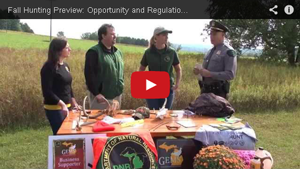
Fall Hunting Preview: Opportunity and Regulations Roundtable


Video player thumbnail imageAre you up to speed on the deer hunting regulations for this season? Curious about the additional hunting opportunities available to you this fall? Ever wonder about the most common hunting violations that conservation officers see? These issues and more are covered in our latest video, Fall Hunting Preview: Opportunity and Regulations Roundtable. So sit back with a warm beverage on a cool fall afternoon to watch the video from beginning to end, or click the times listed in the video description to view individual topics that catch your interest. 
English: crop of File:Bgforhunting.jpg Taken b...


Also, don't forget to tweet your harvest photos this deer season using the hashtag #MiDeerPic, or share your favorite hunting memories and mentoring experiences using the hashtag#MoreToTheHunt, because there is always more to the hunt than the harvest!

Finally, we encourage Michigan hunters to support Sportsmen Against Hunger when you purchase your license this hunting season. Just tell your license vendor you would like to donate to MSAH. Your donation will be used to help process venison donated to the program. Hunters can also support the program by donating a legally taken deer to one of the supporting processors across the state. Each year venison processed through this program helps provide a healthy source of protein in over 100,000 meals. For more information go to www.sportsmenagainsthunger.org. Let’s keep this important tradition of helping others that need a hand going and growing stronger.

Wednesday, October 8, 2014

PLOTS Regulations

Fruits of the hunt!
 (Photo credit: Wikipedia)
Out-of-state hunters are reminded that state law does not allow nonresidents to hunt on North Dakota Game and Fish Department owned or managed lands during the first week of the pheasant season.
Private Land Open to Sportsmen acreage and state wildlife management areas are open to hunting by resident hunters only from Oct. 11-17. Nonresidents, however, can still hunt those days on other state-owned and federal lands, or private land.
The law applies to all small game, waterfowl, furbearer and big game hunting on PLOTS and state wildlife management areas during the first seven days of the pheasant season. Starting Oct. 18 this year, nonresidents may hunt on PLOTS and WMAs as long as the appropriate season is open.
In addition, all hunters are reminded that activities such as riding horses for hunting purposes or for pleasure on PLOTS require written permission from the landowner. Permission from the landowner is always required for motorized vehicle access, such as for setting decoys in a field, unless specially designated on the PLOTS sign.
Also, leaving equipment or other provisions in a PLOTS area overnight, for example tree stands or blinds, decoys, firearms and archery equipment, trail cameras, or any type of bait used to attract big game animals, is not allowed without written permission from the landowner.

Tuesday, October 7, 2014

Pure Michigan Hunt winners hit the woods for fall hunting season

Every year Pure Michigan Hunt winners get to spend their fall hunting season living out a big dream - pursuing elk, bear, antlerless deer, turkey and ducks in Michigan's outdoors. For the most recent group of winners, the hunting adventure has begun.
On Sept. 14, Frank Zrepskey of Algonac successfully harvested a large 6 x 7 bull elk with the help of his guide, Gene Skiba, and sons. Zrepskey used his 30.06, given to him by Michigan Gun Owners as part of his Pure Michigan Hunt prize package, to harvest the elk.
“This elk hunt was great. The weather was perfect, we saw lots of game, and when the right bull came along, we were successful,” said Zrepskey. “The whole Pure Michigan Hunt contest win has been a great experience for me!”
PMH Shaneour elk
Bruce Shaneour of Osseo also was successful in his elk hunt. He harvested a nice 6 x 6 bull elk on Sept. 27 in the Vanderbilt area with help from his guide, Kevin Johnson of Big Boys Adventures. [Pictured: Bruce Shaneour, left, and guide Kevin Johnson with Shaneour's Pure Michigan Hunt elk.]
“What a hunt! The elk were in full rut and bugling all around us. I’ve hunted elk out west a few times, but I’ve never had an experience like this,” said Shaneour. “Kevin Johnson and his team at Big Boys Adventures were excellent. It was the most phenomenal Michigan elk footage they’ve ever captured.”
Bill Kring of Cadillac is still awaiting his chance to harvest a trophy Michigan bull elk.
Bear season is also under way for the Pure Michigan Hunt winners.
PMH veteran bear
This year, there was a Pure Michigan Hunt license transfer of a bear tag. Kring generously transferred his bear tag to a Michigan veteran from Manton. This veteran had the opportunity to hunt with Rob Nixon, on land southwest of Cadillac, and was able to harvest a 217-pound black bear. The veteran reports having a great time on his hunt and being "extremely happy" with his harvest. [Pictured, a Michigan veteran from Manton (left) with the black bear he harvested and guide Rob Nixon.]
New this year, Pure Michigan Hunt winners can now transfer one or all of their licenses to another eligible hunter of their choice or keep the licenses for themselves. This will allow anyone to buy as many applications as they want for themselves and others instead of needing to know someone else’s driver’s license number, address and birthdate to apply for the other hunter.
All three Pure Michigan Hunt winners have the flexibility to hunt many different times and places, with the ability to pick and choose hunt areas and seasons that fit into their schedules.
For hunters who dream of experiences like this, there's still plenty of time to make 2015 the hunt of a lifetime by applying for the Pure Michigan Hunt. Along with all of the hunting licenses, each winner will receive a hunting prize package valued at more than $4,000. Visit www.michigan.gov/puremichiganhunt for more information and to purchase applications.
Waterfowl season is coming up next for the Pure Michigan Hunt winners; look for more about their adventures coming soon.

Monday, October 6, 2014

MDC reminds deer hunters to properly dispose of carcasses

Proper deer-carcass disposal helps prevent the spread of deer-borne diseases.

JEFFERSON CITY, Mo. – The Missouri Department of Conservation (MDC) reminds deer hunters throughout the state to properly dispose of carcasses from harvested deer to help prevent the spread of infectious diseases in deer, such as the always-fatal chronic wasting disease (CWD).
“Conservation makes Missouri a great place to hunt deer, and deer hunters are key to keeping it that way,” says MDC Deer Biologist Jason Sumners. “Because many hunters process their own deer, they are key players in slowing the spread of diseases such as CWD. One way that disease can spread is by the transportation and improper disposal of carcass parts.”
Deer can become infected with chronic wasting disease if they come into contact with other infected deer or with surface soil containing carcass parts from diseased deer. Deer carcass parts known to concentrate CWD include brain, spinal cord, eyes, spleen, and lymph nodes.
Chronic wasting disease was first found in Missouri in Macon and Linn counties several years ago. In response, MDC established a CWD Containment Zone covering Adair, Chariton, Linn, Macon, Randolph, and Sullivan counties. The disease remains limited to the local area.
“Hunters who harvest deer in these counties should not take whole deer carcasses out of the containment zone, or carcass parts that contain brain, spinal cord, eyes, spleen, or lymph nodes,” Sumners adds, along with the following information.

Proper Carcass Disposal

  • Avoid cutting through bones, spine, or brain when processing deer carcasses. 
  • Remove meat in the field and leave the carcass behind. Bury it if possible.
  • If processing harvested deer in camp or at home, place carcass parts in trash bags and properly dispose of them through a trash service or landfill.
  • Take harvested deer to a licensed commercial processor to assure proper carcass disposal.
  • For taxidermy work, use a licensed taxidermist to assure proper carcass disposal.

Safe Parts to Transport

  • Meat that is cut and wrapped, or has been boned out,
  • Quarters or other portions of meat with no part of the spine or head attached,
  • Hides or capes from which all excess tissue has been removed,
  • Antlers, including antlers attached to skull plates or skulls cleaned of all muscle and brain tissue, and
  • Finished taxidermy products.
The Wildlife Code of Missouri requires hunters who harvest deer, elk, or moose out of state and bring the animal with the spinal column or head attached into Missouri to call toll free, 877-853-5665, and report the animal’s entry within 24 hours. They also must take the carcass to a licensed meat processor or taxidermist within 72 hours of entry. This is designed to prevent introducing CWD into new areas of Missouri from other states. Hunters transporting deer through Missouri en route to other states do not need to call the number.

Donate Tissue Samples

Sumners also encourages hunters who harvest deer within the CWD Containment Zone of Adair, Chariton, Linn, Macon, Randolph, and Sullivan counties to donate tissue samples from their deer to the Conservation Department for its CWD monitoring program. Numerous deer-processing facilities and taxidermists in the area are participating in the effort.
Details about these measures are listed in the 2014 Fall Deer & Turkey Hunting Regulations and Informationbooklet, which is available at MDC offices and nature centers, where hunting permits are sold, and online atmdc.mo.gov/sites/default/files/resources/2010/03/ftd2014.pdf.