Friday, February 11, 2022

Get your 2 Cents Worth in On Minnesota Deer Hunting


Too often, we as outdoorsmen and women wait until after decisions are made - even when our opinion has been solicited - to get in our 2 cents worth.  Minnesota DNR is asking stakeholders to offer their ideas. Find information on the outdoors at Family-Outdoors.

Share your opinions on deer population trends by Feb. 13

Do you have an interest in deer management? Help us shape deer population goals for 28 of Minnesota's 130 deer permit areas by giving your feedback online through Sunday, Feb. 13. We’re looking for your input on deer population trends in the areas where you live, work and recreate. Regardless of your affiliation or interactions with deer, we want your opinions.

More details: Share your thoughts about deer populations

Tuesday, February 8, 2022

Making Your Property a Deer Destination - Wisconsin


Landowners can join DMAP year-round,
but the deadline is March 1 to be eligible for a site visit in 2022.
Photo Credit: iStock/Charlie Dobbs

Deer hunters know that the seasons they hunt are just a part of the picture.  Whether you own property and want to manage it to improve deer and other wildlife habitat, or are spending time year 'round in the woods on public land, learning trails and scouting, deer hunting offers a great way to learn about and conserve our resources.  Wisconsin is offering this program for landowners in this effort. At FAMILY-OUTDOORS, we want to support these efforts as part of the broader goal of getting families and individuals in the outdoors!

MADISON, Wis. – The Wisconsin Department of Natural Resources (DNR) is hosting a virtual open house for the public to learn about our Deer Management Assistance Program. 

Join DNR staff and current Deer Management Assistance Program (DMAP) members via Zoom at 6 p.m. on Wednesday, Feb. 16. Be sure to pre-register to reserve your spot.

DMAP is a cooperative effort between the DNR, landowners and hunters to provide habitat and deer herd management assistance to those interested in managing their property for wildlife. Simply put, DMAP is a partnership for healthy deer, healthy wildlife and healthy habitat.

The DNR’s wildlife and forestry staff assist landowners with management practices that consider the ecological and social impacts that white-tailed deer have on the landscape. In return, DMAP cooperators can choose to share habitat information, collect biological data and participate in DMAP workshops.

This one-on-one relationship encourages communication and cooperation and makes DMAP a flexible and effective deer management program for private and public lands alike.

Since 2014, DMAP has helped Wisconsin landowners manage habitat for deer and other wildlife.

If you enroll 160 acres or more in DMAP by March 1, 2022, you will be eligible for a site visit by a DNR wildlife biologist and forester, as well as a customized management plan tailored to your property goals.

Landowners with properties of any size may enroll in DMAP at any time. And those with less than 160 acres may combine acreage with neighboring landowners to reach the 160-acre requirement and enroll as a DMAP cooperative.

More information regarding DMAP and how to apply is available here.

To receive DMAP email updates and other information, sign up here. Follow the prompts and select the "Deer Management Assistance Program" option, found under Wildlife Management.


EVENT DETAILS

WHAT: Deer Management Assistance Program Virtual Open House

WHEN:  6-8 p.m. Feb. 16, 2022

WHERE: Join live via Zoom. Pre-register here

Friday, January 21, 2022

Minnesota DNR seeks input on deer population goals


Get insight into deer population goal setting next week during webinars scheduled for the 28 deer permit areas that will have their goals adjusted in 2022.

Affected areas are in portions of the southeast, Arrowhead and north central areas of Minnesota. Webinars are scheduled:

  • Monday, Jan. 24, for north central DPAs
  • Wednesday, Jan. 26, for northeast DPAs
  • Thursday, Jan. 27, for southeast DPAs

People are strongly encouraged to attend the webinar for their DPA before formulating their responses to the online questionnaire on goal setting. At each webinar, the DNR will present additional information about each goal-setting block, seek participant input and answer questions. 

The DNR establishes deer population goals — how much of an increase or decrease is desired in a deer population in a particular DPA — as part of managing the state’s wild deer.

More details: Learn about deer population goal setting

Sunday, August 1, 2021

South Dakota: Third Deer Draw - Municipal Archery Drawings Now Open


The third draw for South Dakota rifle deer seasons is now open with licenses available for West River Deer and East River Deer units.

Paper applications must be submitted by August 6, and online submissions must be made by 8 a.m. CDT, August 11.

Residents will be able to apply for any season that they do not already have a license in. Nonresidents can apply for West River Deer if they do not already have a license for that season and do not already posses licenses for two deer seasons.

If you are applying via paper application, and you have not already purchased a Habitat Stamp, you must purchase one ($10 resident, $25 nonresident) in addition to your application.

Remember, Special Buck licenses count towards a license being held in that season.

MUNICIPAL DEER

Online applications are also still being taken for limited resident public archery deer hunts in certain areas for the cities of Custer, Rapid City and Sioux Falls.

 Applicants must provide a valid email address as email is the only way you will be notified whether you are successful on unsuccessful in drawing a license.

 Successful applicants must attend a mandatory hunter briefing meeting prior to hunting. The dates and times of the briefing will be supplied in the email to successful applicants.

Visit gfp.sd.gov/pages/municipal-deer/to learn more about requirements, restrictions and hunting zones.

Thursday, July 29, 2021

Operation Deer Watch Launches Aug. 1 Wisconsinites Collect Scientific Data To Inform Deer Management


MADISON, Wis. – The Wisconsin Department of Natural Resources (DNR) will launch Operation Deer Watch on Aug. 1, allowing citizen scientists around Wisconsin to report deer sightings in their area, which provides crucial data for deer management.

Participation in Operation Deer Watch is simple, requires no registration and can be done using a computer or mobile device. DNR researchers ask participants to report deer sightings, including bucks, does and fawns, between Aug. 1 and Sept. 30 via an easy-to-use online form.

Data collected provides insights into the reproductive status of Wisconsin's deer herd and helps shape deer management for the state.

Many participants carry a printable tally sheet with them in the car to record sightings and then enter their results online later. For safety, participants should only record sightings when their vehicle is stopped, not while driving.

"This is a fun and useful opportunity for everyone to enjoy Wisconsin's plentiful wildlife," said Brian Dhuey, DNR Wildlife Population And Harvest Assessment Specialist. "The DNR encourages everyone interested in deer, from hunters and trappers to outdoor enthusiasts, to take part."

County Deer Advisory Councils also use data from the survey to develop deer season framework, harvest quotas and permit level recommendations.

Learn more about Operation Deer Watch by visiting the DNR webpage here.

Minnesota Deer Notes

Deer hunting season details available

Ready to plan ahead for the fall? Check out the details for the 2021 season in the Minnesota Hunting and Trapping regulations handbook, now available on the DNR website. Printed copies of the handbook will be delivered to hunting license vendors the first week of August.

Hunting licenses go on sale Sunday, Aug. 1. You can buy your license at any DNR license agent, by telephone at 888-665-4236, or online at mndnr.gov/buyalicense.

Archery deer season opens S

Saturday, Sept. 18, and firearms deer season opens Saturday, Nov. 6. Find out more on the deer hunting page.


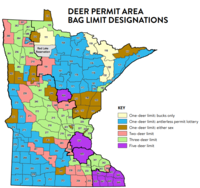
map of Minnesota deer permit areas with bag limit designations

Deer bag limit name changes

Bag-limit labels have been changed to make the limits clearer:

  • "Lottery" is now "antlerless permit lottery" (one-deer limit)
  • "Hunter choice" is now "either-sex" (one-deer limit)
  • "Managed" is now "two-deer limit"
  • "Intensive" is now "three-deer limit"
  • "Unlimited antlerless" is now "five-deer limit"

"Bucks only" remains the same, with the one-deer limit. Areas that were previously under an unlimited antlerless bag limit are now a five-deer limit.


Early antlerless season expands

The DNR has expanded the early antlerless deer season, Oct. 21-24, to include more deer permit areas in central and southeastern Minnesota. The season increases opportunities for hunters in areas where deer populations are above population goals or where there is an increased risk of chronic wasting disease spreading. Permit areas open during the hunt are 213, 214, 215, 221, 227, 236, 277, 341, 342, 343, 604, 605, 643, 645, 646, 647, 648, 649, 655 and 701. Early antlerless permits go on sale Aug. 1.


snapshot of some DPAs with new boundaries for 2021

Check your deer permit area boundary

Several deer permit area boundaries in southwest and northeast Minnesota have changed based input from the public, tribal communities and DNR staff. The permit areas affected are: 169, 171, 173, 179, 184, 197, 237, 259, 275, 276, 277, 281, 282, 283 and 295.

Changes are depicted on the 2021 Deer Season Area Map and hunters should double-check the boundaries of any permit areas where they plan to hunt, as well as bag limits in those areas.

Key CWD changes for the 2021 season

  • Mandatory sampling of deer harvested in chronic wasting disease zones will resume this year during the opening weekends of both firearms A and B seasons.
  • The names of the zones are simplified to three tiers: management zone, control zone and surveillance zone. 
  • The surveillance zone has expanded following detections of the disease in wild and captive deer, adding deer permit areas 110, 184, 197, 233 and 342, and a portion of deer permit area 169.
  • Late chronic wasting disease hunts are scheduled for Dec. 17-19 and Dec. 31-Jan. 2; additional details will be posted on the DNR website closer to hunt dates.

Check out the regulations book (PDF) and the webpage for more information.


young hunter dressed in blaze orange

Apply for special youth deer hunts

Minnesota has special hunting opportunities for youth deer hunters. There is a limited number of permits for each hunt, with the individual hunts taking place on various dates during the fall in state parks and a national wildlife refuge. Adults must accompany youth during these hunts. Hunters may apply for special youth hunt permits through Friday, Aug. 20. Special youth deer hunts are different from the statewide youth deer season that does not require an application and takes place Oct. 21-24.


statewide map of goal-setting blocks

Deer population goals released

Results of the second year of deer population goal-setting are now available online. This year focused on portions of southwest and northeast Minnesota. Thank you to those of you who participated in the virtual engagement options this year!

Next year will focus on deer permit areas in the northeast, north-central and southeast portions of the state (noted in green in the map) and will start later this winter. Stay tuned for details of when and how you can provide your input for those areas and check out the deer populations and goals webpage for more information.


hunter dressed in blaze orange with ear protection

Webinar: How to get certified in firearms safety

Do you know someone who wants to go hunting this fall? Join a chat with DNR conservation officers officers at noon Wednesday, Aug. 4, to discuss Minnesota hunter safety requirements, including how to get certified in firearms safety.

The webinar is part of the Minnesota Outdoor Skills and Stewardship Series that aims to give participants quick, relevant information on upcoming seasons and events, and skills to help enjoy these opportunities. Registration is free.


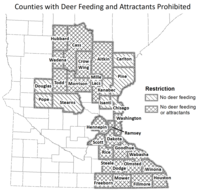
areas where deer feeding and attractant bans are in place

Feeding ban reminder

Feeding and attractant bans are critical in limiting the spread of chronic wasting disease in wild deer. Due to the detection of CWD in Beltrami county, the deer feeding ban is expected to expand to include Beltrami County and neighboring counties this fall.

Currently there are deer feeding or attractant bans in the following counties: Aitkin, Carlton, Cass, Chisago, Crow Wing, Dakota, Dodge, Douglas, Fillmore, Freeborn, Goodhue, Hennepin, Houston, Hubbard, Isanti, Kanabec, Mille Lacs, Morrison, Mower, Olmsted, Pine, Pope, Ramsey, Rice, Scott, Stearns, Steele, Todd, Wabasha, Wadena, Washington and Winona.

Learn more about what you need to do to help our wild deer, and the difference is between feeding and attracting deer, on the deer feeding ban webpage.

Friday, June 18, 2021

Wisconsin DNR Confirms CWD In Green Lake County Wild Deer; New Baiting And Feeding Ban In Effect


BROOKLYN, Wis. – The Wisconsin Department of Natural Resources (DNR) has confirmed a wild deer tested positive for chronic wasting disease (CWD) in Green Lake County. The CWD-positive deer was an adult deer found dead in the Town of Brooklyn in early May 2021. This is the first wild deer that has tested positive for CWD in Green Lake County, and its location is also within ten miles of adjacent Fond du Lac, Winnebago and Waushara counties.

With this new CWD-detection, Winnebago County is now considered a CWD-affected county. As required by state law, the DNR will enact a new two-year ban on baiting and feeding of deer in Winnebago County effective July 1, 2021. State law requires the DNR to enact a ban on feeding and baiting deer in counties or portions of counties within a ten-mile radius of a wild or farm-raised deer that tests positive for CWD or tuberculosis.

Green Lake, Fond du Lac and Waushara counties are already identified as CWD-affected counties and already have baiting and feeding bans in place. This new CWD-positive detection will renew a three-year baiting and feeding ban in Green Lake County and two-year bans in Fond du Lac and Waushara counties.

"We are committed to working closely with local communities, including the citizen-based County Deer Advisory Councils as we explore future management options for this disease in Green Lake and the surrounding counties,” said Daniel Lekie, DNR Wildlife Supervisor.

In response to the detection of this CWD-positive wild deer, the DNR will:

  • Coordinate swiftly with County Deer Advisory Council members from the counties impacted by this detection to discuss response actions, including issuance of CWD surveillance permits this winter.
  • Determine surveillance activities to assess disease distribution and prevalence to also include:
    • Encouraging reporting of sick deer
    • Sampling vehicle-killed adult deer when feasible
    • Sampling adult deer harvested under agricultural damage permits
  • Encourage hunters to follow recommendations to help prevent the spread of CWD.

More information regarding baiting and feeding regulations and CWD in Wisconsin is available on the DNR’s baiting and feeding regulations webpage.

More information on how to have deer tested during the upcoming 2021-22 Wisconsin hunting seasons is available on the DNR’s sampling for chronic wasting disease webpage.