Saturday, July 16, 2016

Deer Camp Available for First Time South Dakota Youth Deer Hunters

PRESHO, S.D. – Seven first-time deer hunters will have the opportunity of a lifetime to participate in a managed youth deer hunt and camp on Sept. 24-25 at the Snake Den Lodge near Presho.
This free event is open to first time youth deer hunters between the ages of 12 and 15. Participants must be HuntSAFE certified and accompanied by a parent or mentor. Participants will learn how to select the best ammunition and firearm for deer hunting, improve shooting and safety, sight in a firearm, field dress and how to properly care for meat. The South Dakota Game, Fish and Parks (GFP) will provide three meals, snacks, lodging, tags, guns, ammunition, safety equipment, transportation to and from hunting, binoculars and assistance with field processing.
Each hunter will be paired with a knowledgeable and experienced guide. Participation is limited to seven hunters. Applicants will be selected based upon their responses to the application questions. Successful applicants are required to attend a hunt orientation meeting on the morning of Sept. 24. Hunting will take place on Presho area farms on Sept. 24-25.
For more information and to apply for this opportunity, contact GFP conservation officer, Brian Ridgeway at 605.730.1573 or Brian.Ridgeway@state.sd.us.

Here are some upcoming South Dakota Deer Hunting Season Applications

Applications deadlines for the 2016 South Dakota West River, East River, Black Hills, Refuge, Youth, Archery, Muzzleloader and Custer State Park Deer Hunting Seasons are quickly approaching.
Deadlines for the first drawings are as follows:
West River, Black Hills, and Custer State Park Deer:
  • Paper applications July 15                                                                                           
  • Online applications 8 a.m. CDT July 20
East River, Refuge and (Any Deer) Muzzleloader:                                                    
  • Paper Applications Sept. 2                                                                                          
  • Online applications 8 a.m. CDT Sept. 7.

There are no deadlines for Archery, Youth and Muzzleloader (antlerless) licenses.

Friday, July 15, 2016

Wisconsin Outdoor Report 7/15/2016

Torrential rains hit northwestern Wisconsin cause some closures but most properties remain open
Some areas of far northwester Wisconsin received torrential rains early this week, with 8 to 10 inches reported in some areas causing major washouts of roads and even major highways. Copper Falls State Park was closed temporarily but has reopened. A campground at Governor Knowles State Forest is closed, and as the water moves down through the St. Croix and Mississippi rivers, some facilities are closed or may be closed at Merrick and Interstate state parks. Sections of the Wild Rivers, Saunders and Gandy Dancer state trails are also closed. Other state properties in the area including Amnicon Falls and Pattison state parks and the Brule River State Forest are open, but travel to destinations may take longer due to numerous road closures. People traveling to the area should check the Wisconsin Department of Transportation www.511wi.gov website for details. The waterfalls are roaring at both Amnicon Falls and Pattison with many visitors showing up with cameras to capture the images. Paddlers are being asked to stay off the Brule River for a few days until the extremely high flows recede.
The heavy rains were quite localized to northwestern Wisconsin and other northern properties such as the Flambeau River, Northern Highland-American Legion and Peshtigo River state forests were not affected by the storm and facilities remain open as is access to all these properties.
Angling pressure remains strong, despite pressure from changing winds and heavy rain. Anglers in the Northwoods are seeing consistent success for largemouth and smallmouth bass. Warmer waters also seem to have improved the number of follows for musky, with some fish up to 45 inches. Panfish action has also been fair.
On Green Bay, the walleye bite has been good at the Menominee River in Marinette and from Pensaukee to Oconto. Anglers out of Suamico were finding good numbers of walleye along with freshwater drum and catfish. Shore anglers on the Fox River were having good success catching white bass, freshwater drum, channel catfish and some walleye. Fishing pressure was far below average this past week along Door County with pleasure boat traffic far outweighing fishing pressure on the bay side. Decent numbers of yellow perch are being caught off of Little Sturgeon Bay and Sawyer Harbor but most were on the smaller side.
Along Lake Michigan pier fishing picked up at Kewaunee, Manitowoc, Sheboygan, Port Washington, Milwaukee, Racine and Kenosha, with chinook, coho and brown trout all being caught. Perch action was also on the rise at Milwaukee. Out on the lake, trolling success was down some this week but some boats were still hitting their limits in just a few hours, with mostly chinooks were being caught but also many coho and a few rainbows and lake trout.
Healthy looking fawns are plentiful now and moving about; bucks are still growing their velvet antlers with some becoming quite well developed. Plenty of grouse coveys and numerous turkey broods are being seen. Eagles and many other wildlife are fledging at this time, so don't be too surprised to see them on the ground or hear them complaining from the nest as they prepare for their first flights.
Raspberries, blackberries, juneberries and blueberries are ripening across the state. Virginia mountain mint, marsh hedge-nettle and purple prairie clover are a few of the species that are flowering for the first time this year.
Cedar waxwings and whip-poor been feeding frequently on the insects. Up to 40 butterfly species have been counted at Crex Meadows State Wildlife Area since July 1.

Thursday, July 14, 2016

Wisconsin Deer Management Assistance Program continues to grow

MADISON -- In its third year of serving the people and wildlife of Wisconsin, the Deer Management Assistance Program continues to build relationships with landowners, hunters and property managers to manage deer and improve wildlife habitat.
Following the March 1, 2016 enrollment deadline, the Wisconsin Department of Natural Resources received 228 new DMAP applications covering over 124,000 acres in 62 counties. This brings the three-year total number of landowners involved in DMAP to nearly 1,000, with 220,980 acres enrolled in the program statewide.
"The DMAP cooperator base continues to expand, allowing for increased opportunities for private landowners, public land managers and DNR staff to properly manage forests while improving habitat for deer and other wildlife species," said Bob Nack, DNR DMAP coordinator. "The partnerships being developed to do good things for the wildlife we all enjoy are really impressive."
DMAP applicants can sign up at one of three levels of enrollment based on property size; each offers a different enrollment fee and set of benefits. Properties of any size can enroll at Level 1 at no cost to receive benefits such as consultation with a local DNR wildlife biologist, access to online deer and habitat management publications and participation in local DMAP workshops and citizen science opportunities. Properties greater than 160 acres can enroll at Level 2 or 3 for a minimal three-year fee. Along with all Level 1 benefits, Level 2 and 3 properties receive a site visit from a local DNR wildlife biologist and forester, a property-specific management plan and the potential for reduced-price antlerless harvest tags. Properties within a half mile of each other can combine acreage to sign up as a group cooperative and qualify for benefits at a higher enrollment level.
DMAP cooperators at any level may also attend one of several workshops offered around the state in the spring and summer of each year.
"DMAP workshops provide information on the habitat needs of deer and other wildlife, proper forest management techniques to benefit wildlife, cost-share programs for habitat improvement projects and much more," said Nack. "Our focus for these workshops is to get cooperators thinking about which strategies they could implement on their property to provide the best habitat for the wildlife they want to watch or hunt."
Summer workshops are open to DMAP cooperators, and combine professional presentations, discussion, hands-on activities and tours of DMAP properties to share information on the principles of wildlife habitat and deer management. Workshops also provide an opportunity to network with wildlife and forestry professionals and other DMAP cooperators.
Four summer workshops are scheduled for 2016:
  • July 22: Jefferson County
  • July 30: Sawyer County
  • August 13: Buffalo County
  • August 27: Juneau County
Overall, reception of DMAP continues to be positive. On average, 82 percent of DMAP cooperators rated the quality of service through DMAP as "good" or "very good." DMAP site visits also received high marks, with 91 percent of cooperators responding that they were "satisfied" or "very satisfied" with the site visit.
Landowners not currently enrolled in DMAP can attend the remaining summer workshops by signing up for DMAP at any time. Level 2 or 3 applications received now will immediately receive DMAP benefits and will be eligible for a site visit in 2017. To find more information and to enroll in DMAP, visit dnr.wi.gov, keyword "DMAP."

Tuesday, July 12, 2016

How does CWD get Transmitted?

From Michigan DNR

Although CWD is a contagious fatal disease among deer and elk, research suggests that humans, cattle and other domestic livestock are resistant to natural transmission. While the possibility of human infection remains a concern, it is important to note there have been no verified cases of humans contracting CWD.
Transmission: Animal to Animal
Transmission of CWD is possible in species with closely related proteins, thereby being able to exchange prions and cause disease. It is not likely to jump the species barrier. There is no evidence at this time that CWD can be naturally transmitted to livestock or animals other than deer and elk. In deer and elk, the causal agent of CWD is transmissible from infected to uninfected individuals. Both circumstantial and experimental evidence implicates an animal to animal form of transmission. This occurs via horizontal or lateral (contact between adult animal and adult animal, contamination of feed or water sources with saliva, urine, and/or feces, or contact with an infected facility or area), and more rarely as vertical or maternal (adult animal (dam) to offspring via contact). Concentrating cervids in captivity and baiting or feeding animals can greatly increase the chances of disease spread.
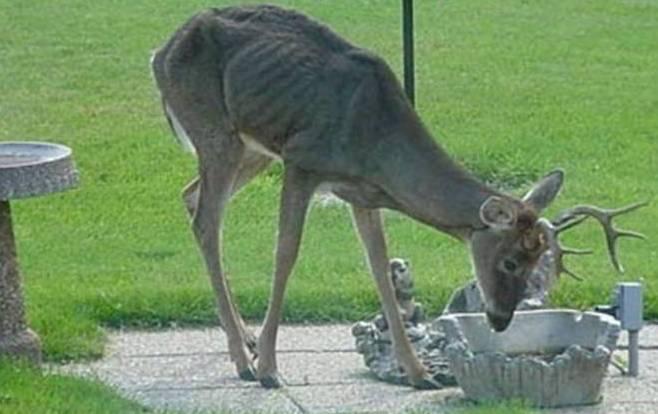
Once natural transmission occurs, a minimum incubation period (the time from infection to observance of clinical signs) of 18 months is required between exposure to the causal agent and development of the disease. In captive cervid herds a minimal incubation period of 18 to 20 months for mule deer and 18 to 36 months for elk was observed. Some signs associated with  CWD include: a decline in body conditioning, changes in behavior, tremors, reduced feed intake, and difficulty standing.
Transmission: Animal to Human
To date, there is no evidence that CWD can be naturally transmitted to humans or to animals other than deer and elk. There is no evidence that the agent that causes CWD occurs in the meat. CWD is not a food borne disease. Unlike BSE, CWD is not associated with being spread though the use of rendered meat or bone meal products. Proteins differ from one species to another therefore prions are unlikely to prosper in a new species. There is a "substantial barrier" to CWD transmission between animals and people.
Development
The clinical course of CWD varies from a few days to approximately a year, with most animals surviving from a few weeks to several months. While a protracted clinical course is typical, occasionally acute death may occur; this may be more common in the wild than in the relative security of captivity. Aspiration pneumonia is a common finding at postmortem examination of terminal CWD cases and may confuse the diagnosis if the brain is not examined. Aspiration pneumonia presumably is due to difficulty swallowing, hypersalivation, and inhalation of foreign material into the lungs. Thus the brain should be examined for evidence of CWD on every prime age cervid that dies with pneumonia. Currently there is no clinical treatment available for CWD. Once the disease develops is perceived as fatal. Therefore, within captive facilities CWD management options are limited to quarantine or depopulation. 

Sunday, July 10, 2016

Michigan DNR announces expansion of Chronic Wasting Disease Core Area and Management Zone

Additional townships and counties are affected

The Michigan Natural Resources Commission expanded the Core Chronic Wasting Disease (CWD) Area to include 17 townships. This area, which will continue to be referred to as Deer Management Unit (DMU) 333, now will consist of Lansing, Meridian, Williamstown, Delhi, Alaiedon and Wheatfield townships in Ingham County; DeWitt, Bath, Watertown, Eagle, Westphalia, Riley, Olive and Victor townships in Clinton County; Woodhull Township in Shiawassee County, and Oneida and Delta townships in Eaton County.
The CWD Management Zone also has expanded; it now will include the remainder of Clinton, Eaton, Ingham and Shiawassee counties, as well as all of Ionia County. The expanded Management Zone will be referred to as DMU 419.
“With the detection of CWD-positive deer in the southern part of Clinton County, we need to better understand the magnitude of the disease in those areas,” said Chad Stewart, Department of Natural Resources deer specialist. “Expanding our surveillance to include those areas is key at this point, and we need help from landowners and hunters within the expanded zone to help us with this effort.”
Other regulation changes include:
  • Banning deer feeding and baiting on all properties within the Core CWD Area and Management Zone.
  • Opening Eaton and Ionia counties to the early antlerless deer season.
  • Allowing roadkill deer in the Core CWD Area to be possessed and kept with a DNR-issued salvage tag from a law enforcement officer or DNR employee, as long as the head is submitted to a DNR biologist, biologist appointee or check station.
Continuing from last year, other regulation reminders include:
  • Those hunting within the Core CWD Area are required to present the head of all hunter-harvested deerwithin 72 hours of harvest to a DNR deer check station.
  • Hunters leaving the Core CWD Area are required to present the entire carcass of all hunter-harvested deer originating from the Core CWD Area within 72 hours of harvest to a DNR deer check station. (A list of deer check stations is available at michigan.gov/deercheck.)
  • All live free-ranging deer from within the CWD Management Zone or Core CWD Area are prohibited from being rehabilitated. Permittees located within the CWD Management Zone or Core CWD Area may no longer rehabilitate deer.
CWD affects members of the deer family, including elk and moose. It is caused by the transmission of infectious, self-multiplying proteins (prions) contained in saliva and other body fluids of infected animals. Since the May 2015 discovery of chronic wasting disease in a free-ranging, Michigan white-tailed deer, more than 5,000 deer have been tested for CWD in order to gauge the extent of the disease across the landscape. Of those tested, seven deer were confirmed positive for the disease in Clinton and Ingham counties.
To date, there is no evidence that the disease presents any risk to non-cervids, including humans, either through contact with an infected animal or from handling venison. As a precaution, the U.S. Centers for Disease Control and the World Health Organization recommend infected animals not be consumed as food by either humans or domestic animals.
To learn more about CWD, visit mi.gov/cwd.
In an effort to end common CWD misconceptions, the DNR in mid-July will launch a 10-week CWD myth-busting campaign. Visit mi.gov/cwd for more information at that time.

Friday, July 8, 2016

Wisconsin weekly Outdoor Report

Green Bay
Great weather brought out crowds for holiday weekend followed by storms that brought down trees, power lines across the south
Sporadic and punctuated rain and storm events across the state have tempered off into cloud cover and light rain, after what was an excellent Fourth of July weekend. Severe winds in southern Wisconsin took down trees and power to some areas earlier this week, but most trails have been cleared or will be going into this weekend.
Water levels are continuing to drop closer to average across the state. Many sandbars were submerged on the Lower Wisconsin State Riverway, but there are still sandbars showing. It looks like it will be an excellent weekend to take a canoe or kayak down any of Wisconsin's major rivers.
The holiday weekend's pleasant weather saw large increases in angling pressure across the Northwoods. Panfish and bass produced erratic action, with rock bass and pumpkinseed showing the most consistent success, along with some musky bite. Large and smallmouth bass have both settled into their summer residencies, deeper along weedy and woody edges. Walleye success seems to be a hit or miss proposition, with just a few reports of decent action being found.
On Green Bay, fishing pressure was relatively high this week with Fourth of July traffic. The walleye bite was inconsistent, and walleye anglers were having a tough time finding active fish. But anglers were catching decent numbers of yellow perch although the average size was about 6 inches. Smallmouth bass were a little tougher to come by but anglers were still finding a few fish.
Along Lake Michigan, fishing pressure and reported successes out of both Kewaunee and Algoma made for the busiest weekend of the year to date. Both landings were full and good numbers of chinook salmon were coming into both ports, including some weighing well into the mid to upper 20-pound range and even a 30 pounder was recorded in Kewaunee. Success was also good in southeastern harbors, with good numbers of chinook and coho salmon along with some rainbow and brown trout coming in to Sheboygan, Port Washington, Milwaukee, Racine and Kenosha, including many limits.
White-tailed bucks are starting to get some very noticeable antler growth. Rabbits and squirrels are beginning to give birth to their second litters. Songbirds such as wrens, chickadees, sparrows, and bluebirds have fledglings.
Along the prairie and oak savannas compass plants are flowering, as is pale Indian plantain and purple prairie clover should bloom within the next week or two. Be mindful of invasive and/or poisonous weeds along roadsides and trails. Wild parsnip is in bloom at this time and its oil will cause burning when exposed to sunlight, even on cloudy days.
Along other edge habitat, including bike paths and hiking trails, blackberries are beginning to set their fruits. Look for their ripening in a month or so and be prepared for competition; more than 100 bird species eat blackberries, including robin, cardinal and ruffed grouse.
Scarlet tanagers, cerulean warblers and yellow-throated vireos will continue their song for a short while longer as their young leave the nest and begin to feed themselves. Brightly colored butterflies, amazingly camouflaged moths, and boldly patterned dragonflies are being seen in many areas. Unfortunately they have been joined by many mosquitoes, deerflies and "ankle-biters" out in force with the recent rains and humidity to be a nuisance to outdoor recreationalists.