Showing posts with label Percentage. Show all posts

Saturday, March 8, 2014

Deer harvest down in 2013 but still a top 10 season

Hunters harvested fewer deer in the 2013 season than in each of the previous five seasons. The reported harvest of 125,635 deer was about 10,600 fewer deer than the record harvest of 136,248 in 2012, a decline
of 7.8 percent. It still ranks eighth best since regulated deer hunting began in 1951.

The firearms season accounted for 57 percent of the total, followed by archery at 27 percent. The muzzleloader (8 percent), late antlerless (5 percent), and youth season (2 percent) made up the rest.

At least two and possibly three factors contributed to the lower harvest – carryover from a widespread outbreak of epizootic hemorrhagic disease (EHD) in 2012 and more in 2013, a record antlerless harvest in 2012, and the second season of new hunting regulations aimed at lowering deer densities in some areas of the state.

The full harvest report is at wildlife.IN.gov, under Featured Topics.

Friday, November 15, 2013

Minnesota Firearms deer harvest down 8 percent from 2012

Department of Natural Resources Logo

Minnesota hunters harvested 77,008 deer during the first three days of the firearms season, down 8 percent from 2012, according to the Department of Natural Resources (DNR). 
Leslie McInenly, DNR big game program leader, said a slightly smaller harvest over the first three days is not surprising.
“Last year, opening weekend weather was almost ideal and the state’s corn harvest was virtually complete, she said. “So given Saturday’s roaring winds of up to 30 miles per hour, which tends to restrict deer movement, and more available deer refuge areas due to pockets of standing corn, the harvest is about what you’d expect.” In some areas, she said, about a quarter of the corn crop was not yet harvested.
The DNR had sold 445,385 firearms deer licenses as of Monday, about 1,000 fewer than last year but roughly 10,000 more than 2011.
Around the state, opening day hunting conditions included snow in the north and gusty winds and overcast skies most everywhere, turning nicer on Sunday. The harvest was down 19 percent in the northeast, 4 percent in the southeast and 6 percent for the remainder of the state. Because hunters have 48 hours to register a harvested deer, final opening weekend numbers for 2013 will be greater than those reported today. 
With improving weather conditions this week, the DNR still expects the final 2013 harvest to be similar to last year when about 185,000 deer were taken.
The firearms season continues through Sunday for all but northeast Minnesota, which extends until Nov. 24. There is also a late southeast firearms season that runs Nov. 23-Dec. 1.
The DNR reminds hunters who harvest a deer to tag it at the kill site. Also, new this year, hunters are required to register their deer within 48 hours after harvest and before processing.
Hunters can report violations 24/7 by calling the Turn In Poachers hotline at800-652-9093.

Monday, March 25, 2013

2012 North Dakota Deer Gun Season Summarized

White-tailed deer in Toronto, Canada
(Photo credit: Wikipedia)
North Dakota deer hunters took approximately 34,500 deer during the 2012 deer gun hunting season.

The State Game and Fish Department made available 65,150 deer gun licenses in 2012, and more than 95 percent were issued. Overall hunter success was 63 percent, and each hunter spent an average of 4.4 days in the field.

Randy Kreil, wildlife chief, said this past season’s hunter success rate bounced back from an all-time low of 51 percent in 2011. “The 63 percent clip is fairly good, but still below the long-term average of around 70 percent,” he added. “In addition, the number of days spent hunting is still higher than usual, which is expected with lower deer populations.”

Hunter success for antlered white-tailed deer was 76 percent, and antlerless whitetail was 62 percent.

Mule deer buck success was 81 percent. No mule deer doe licenses were issued in 2012.

Hunters with any-antlered or any-antlerless licenses almost exclusively harvest white-tailed deer. These buck and doe hunters each had a success rate of 64 percent.

The department is in the process of determining recommendations for licenses in the 2013 deer proclamation. These recommendations will be discussed at the upcoming Game and Fish public advisory board meetings, scheduled for the week of April 15-18. The proclamation will be sent to the governor’s office for approval in late April.

In addition to harvest rates and winter aerial surveys, the department monitors a number of other population indices to determine license numbers, including deer-vehicle collision reports, depredation reports, hunter observations, input at advisory board meetings, and comments from the public, landowners and department field staff.

Monday, March 11, 2013

INDIANA Hunters set record deer harvest in 2012 seasons

Hunters took advantage of new equipment regulations and extra hunting dates to harvest a record 136,248 deer during the 2012 season, according to data the DNR gathered from designated check stations and from a recently implemented online and phone reporting system. 

The total harvest represented a 6 percent increase over the 2011 season’s harvest and topped the previous record of 134,004 deer set in 2010. 

“We started down the path to strategically reduce the deer herd in order to balance the ecological, recreational, and economic needs of all Indiana citizens,” said Mitch Marcus, wildlife chief for the DNR Division of Fish & Wildlife. “To meet that strategy, we initiated several regulation changes to make it easier to take antlerless deer. It appears the regulations may be working.” 

Key regulation changes implemented in 2012 included making crossbows legal equipment for all licensed hunters during archery season; adding a special late antlerless season in designated counties from Dec. 26 to Jan. 6; extending the urban zone season to run continuously from Sept. 15 to the end of January; and allowing youth hunters in the two-day youth season to take whatever the bonus antlerless quota was in the county where they hunted. Archery season also increased by seven days with elimination of the traditional one-week break between early and late segments. 

Crossbow hunters took 8,452 deer, or 6 percent of the overall total. That was an increase from 1,091 deer, or 1 percent, reported in 2011 when crossbows could be used in early archery season only by persons with a disabilities permit or by any licensed hunter in late archery season. 

Hunters using archery equipment tagged more deer in 2012 (27,580) than they did in 2011 (26,715) or 2010 (27,186). 

Youth hunters bagged 3,587 deer, up 55 percent from 2011, and the new special late antlerless season accounted for 10,091 deer. 

It also was the first year of a license bundle, which allowed the buyer to hunt in all segments of deer season—except in urban zones—for a total of one antlered and two antlerless deer. More than 56,600 license bundles were purchased in 2012, second only to the resident firearm license. 

“In previous years, five or six at the most, resident license holders accounted for 42 percent of the harvest,” said Chad Stewart, DNR deer management biologist. “This year, resident license holders accounted for 47 percent of the total harvest. That’s only a couple percentage points, but to move it even that much is pretty significant. That’s probably attributed to the bundle license. We don’t know that for sure, but that’s where we’re leaning because it’s the one thing in the rules that only affected resident hunters.” 

The total harvest was made up of 45,936 antlered deer and 90,312 antlerless deer. The proportion of reported antlered deer in the harvest (34 percent) is the lowest in Indiana’s history while the antlerless total was the highest. 

“Despite the record harvest, trends within the harvest data showed that deer numbers were down this year,” Marcus said. “The number of antlered deer in the harvest was at its lowest point since 2000, an indicator of a reduced deer herd.” 

Stewart said the antlered deer harvest tracks the total population about as well as anything because there are fewer variables to consider. 

“Year-to-year hunter efforts don’t change much, so people aren’t all of a sudden taking three bucks or eight bucks; they’re locked into one buck,” he said, noting the one-buck limit in Indiana. “If there are fewer bucks to kill with the same amount of hunter effort, not as many bucks get killed, which tells us the overall population is down.” 

Additionally, an outbreak of epizootic hemorrhagic disease affected deer in nearly 60 counties. EHD is a viral disease transmitted by biting flies that is often fatal to deer, though some deer will survive the illness. 

“Whether this (population) decline is due to this year’s outbreak of EHD, recent efforts to strategically reduce the deer herd, or a combination of both factors remains to be seen, but probably varies from county to county,” Marcus said. “As we continue on the path to strategically reduce the deer herd, we will monitor the herd and harvest each year and make adjustments to ensure that hunters will have the opportunity to be successful.” 

Switzerland County had the highest reported harvest at 3,506 deer, leading the state for the first time since 2004 and ending a seven-year run by Steuben as the top county. Steuben dropped to fifth with a reported harvest of 3,076 deer, the fewest for that county since 2003. 

Of the total harvest, 82,151 deer were recorded at check stations, 53,389 online, and 708 by phone. 

To read the complete report, go to wildlife.IN.gov and click on the Deer Harvest Summary link at the bottom of the page. 

Wednesday, July 11, 2012

Wisconsin Hunters called to protect state’s hunting heritage

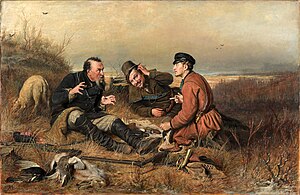
The Hunters at Rest 1871
The Hunters at Rest 1871 (Photo credit: Wikipedia)
Survey: hunter numbers dropping
We had 11 hunters, including five kids, at our deer camp last year. Sleeping arrangements were a bit complex, but we made it work. In the moments before dawn, all 11 were up and dressed ready to venture out to their posts to play an assigned role in the group hunt.
That’s hunting in Wisconsin -- steeped in tradition and family values. There are hunting families and camps that have persisted for generations. Others, like ours, can only claim a decade or two of fun stories. If you only talk with hunting friends – in person or electronically – it’s easy to get the feeling there will always be as many hunters as there are today.
A look at statistics gives a different picture, however. The total number of hunters the Wisconsin Department of Natural Resources reported to the federal government has declined from 770,000 in 2000 to about 704,000 in 2010. A recent demographic analysis published in Population and Environment predicts the number of resident male deer hunters will decline by more than 25 percent in the next 18 years. The figures predict an average decline of 1.6 percent per year with the drop off accelerating in the later years.
Moreover, DNR surveys reveal the number of small game hunters has declined by an average 2 percent per year for the past eleven years and attendance at Hunter Education courses has dropped by an average of 2 percent per year since 2000.
The evidence indicates we are at the beginning of a long, steady decline in number of hunters in Wisconsin. With more than 700,000 still hunting in the Badger State, should we respond now? Yes.
Yes, because we still have a lot of hunters. And, hunters are the only ones who will be able to ensure our future by mentoring new hunters. Further, there’s no successful model to follow for recruiting new hunters and hunter numbers are declining around the nation. We need time to learn what works for hunter recruitment in the 21st century.
Efforts to slow the decline have been growing in popularity recently. Groups and partners around the state have offered the Learn to Hunt program where anyone 10 years old or older (including adults) can try hunting with a mentor, without passing hunter education. In addition, people participating in an organized Learn to Hunt event are not required to have a hunting license. Licenses are required for youth hunts and for mentored hunting outside of Learn to Hunt events. More than 10,000 people have participated in a Learn to Hunt program around the state since the first one occurred in 1997. Last year participation increased by more than 10 percent -- a great sign.
Change is in the air as we continue to grow the hunter recruitment and retention program. We are actively recruiting more and more adults and families to learn to hunt events using the DNR website to open up registration to anyone looking for an event. (Search keyword "LTH" at dnr.wi.gov to find an event near you.) Streamlined access to hunter education courses will be made available for adults who are interested in starting up. We can track the successful recruitment of a new hunter over time and hopefully identify the factors that lead to lifelong interest. And, finally, we are piloting a course designed to teach interested adults to hunt and provide the first-time hunting experience at Madison College this fall.
Now comes the hard part: Sacrifice is required to make a new hunter. Maintaining our hunting heritage will only be successful if we all take it on. We can all increase the focus on mentoring adults and families into hunting. It takes time and commitment and I believe we have enough of both. Stay tuned for more information on what you can do and how you can be involved in protecting your hunting heritage.
FOR MORE INFORMATION CONTACT: Keith Warnke – 608-576-5243